
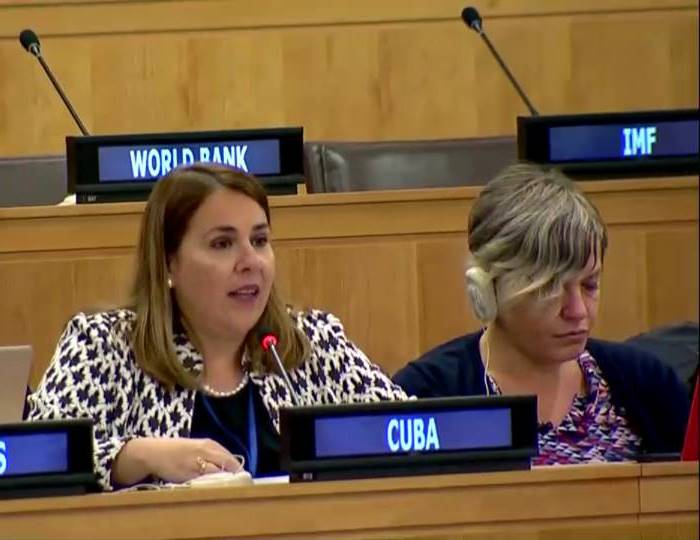
Mr. Chairman,
Cuba endorses the statements by Ecuador on behalf of the Group of 77 and China; by El Salvador on behalf of the Community of Latin American and Caribbean States (CELAC); and by the Maldives on behalf of the Alliance of Small Island Developing States.
We thank the Secretary-General for his report on the item under discussion.
Following the World Summit on the Information Society, progress has been made regarding connectivity, innovation and access to ICTs, in particular the rapid growth of fixed and wireless broadband, although not everybody benefits equally from these achievements: a wide digital divide remains among and within countries, and between urban and rural areas. Developing countries, and in especially the least developed countries, are at a particular disadvantage.
In 2016, estimates by the International Telecommunication Union show that in developed countries there were 90 subscriptions to mobile broadband services per 100 people, compared to 41, in developing countries and less than 20, in least developed countries. The proportion of households with Internet access amounted to 84% in Europe, but only to 15% in Sub-Saharan Africa. The broadband speed in developed countries is much higher than that of developing countries and the cost of access is usually lower in relation to the average income of households.
These deep inequalities, as a result of the unjust global development model, prevent developing countries from having full access to and enjoyment of these technologies, which are so necessary today for the development and achievement of the SDGs adopted by the General Assembly.
At a global level there are the necessary resources to bridge the digital divide and promote broad, just and equal access to and development of these technologies for all. Changing the status quo requires political will and commitment by developed countries with regards to financing, investment, training, infrastructure creation, knowledge dissemination, as well as transfer of intellectual property and technology.
Mr. Chairman,
ICTs should be used to enhance people's capacities for economic and social development, to promote peace, knowledge, to eradicate poverty, illiteracy and social exclusion, on the basis of strict respect for the Charter of the United Nations and International Law. They should never be instruments to promote war, interventionism, destabilization, subversion, unilateralism or terrorist actions.
The establishment of a New World Information and Communication Order is a pressing need for developing countries to successfully assume the commitments agreed upon at the World Summit on the Information Society and to contribute to the implementation of the 2030 Agenda.
Cuba expresses its deep concern at the covertly and illegal use by individuals, organizations and States of the computer systems of other nations to attack third countries for their potential to generate international conflicts. The only way to prevent and face these threats is joint cooperation among all States.
Cyberspace and Internet access should be considered strategic resources and common good of all humanity. The Internet must have international, democratic and participatory governance, based on international law and multilateralism, in order to achieve a peaceful, secure, open and cooperative cyberspace that contributes to the sustainable development of our peoples.
Mr. Chairman,
Cuba works to develop the computerization of society and extend the use of the Internet to all, facilitating an effective, universal and accessible insertion of Cubans in that space, giving priority to its use for education, health care, science and culture sectors and as a means to increase productivity and economic growth.
These efforts have been carried out under the economic, commercial and financial blockade imposed by the United States against Cuba for more than half a century. In the field of communications and information technology, including telecommunications, from April 2016 to April 2017, loss amounted to 68,922,110 dollars. The implementation of unilateral coercive measures by some Member States against developing countries prevents them from achieving universal access to the benefits of ICTs.
In conclusion, we reiterate Cuba's commitment to the fight against inequality, underdevelopment, discrimination and manipulation; and to the establishment of a more just and equitable international order, which really focuses on human beings, their dignity and well-being.
Thank you very much