
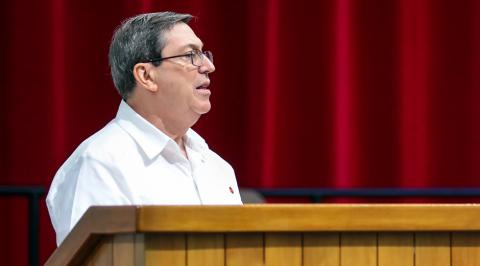
Comrade Army General Raúl Castro Ruz, leader of the Cuban Revolution,
Comrade First Secretary and President of the Republic, Miguel Díaz-Canel,
Comrade Esteban Lazo, President of the National Assembly of People’s Power,
Comrade Prime Minister Manuel Marrero,
Comrade Roberto Morales, Secretary of Organization of the Communist Party of Cuba,
The recent speech of the First Secretary and President, Miguel Díaz-Canel, on July 26, and his brilliant and forceful demonstration of the genocide perpetrated by the government of the United States against the Cuban people, the deliberations of the United Nations General Assembly on July 7, and the introduction just delivered by the President of the National Assembly relieve me of addressing certain aspects.
I am accompanied in this session by the Executive Council of the Ministry of Foreign Affairs.
The National Assembly of People’s Power, as a whole, its Council of State, the Commission on International Relations, and many of its deputies have played and continue to play a significant role in the exercise of Cuba’s foreign action and in the development of foreign policy.
Comrades,
The international political context in which our Revolution defends and represents the interests of the people has significantly worsened.
The government of the United States has decided to undermine and destroy International Law, the Charter of the United Nations, and the pillars that emerged from World War II, which for more than 80 years have guided relations among States on the basis of respect for sovereignty and the principle of sovereign equality.
It has demonstrated its relative and temporary capacity to impose its will on various governments, above their sovereign and constitutional prerogatives, through intimidation, coercion, and specifically the use of unilateral coercive measures and punitive trade tariffs.
It has resorted to military aggression, unjustified wars, the bombing of civilian populations, the kidnapping of a sitting Head of State, political assassination, State terrorism, “regime change,” and cognitive or unconventional warfare.
They justify such conduct with a new and unusual doctrine they call “peace through force,” reminiscent of the historical past of plunder, dispossession, conquest, extermination, occupation, slavery, ethnic cleansing, the peace of old colonial empires, the World Wars, the bombings of Hiroshima and Nagasaki, fascism and Nazism, the Monroe Doctrine and its corollaries, Hitler’s attempt to redraw the map of Europe in the first half of the 20th century, or more recently the failed redesign of the Indo-Pacific, the “New Middle East,” or NATO.
In recent weeks, as if history’s lessons had not been learned, the ghost of McCarthyism and witch hunts has reemerged in the United States as official policy. A strange summit, hastily convened in Washington with dozens of foreign ministers, was devoted to launching a persecution of a phenomenon previously unheard of. They call it the “resurgence of extreme left terrorism.” Before that, they tried to coin the odd concept of “narco-terrorism.” One must recall the bloody Latin American dictatorships and Operation Condor.
Shortly thereafter, the State Department published an extensive report on Cuba, widely criticized for its superficiality, mendacity, and inconsistency, as if drafted by a poorly used artificial intelligence application, according to some, but which attempts to single out Cuba as a danger to the United States.
Besides the absurdity of suggesting that our country could threaten the world’s largest nuclear military power, the report seeks to criminalize and repress genuine expressions of solidarity with Cuba, manifested across multiple sectors of U.S. society.
It condemns and criminalizes Cuba’s sympathy with causes of justice, civil rights, anti-racism, anti-Zionism, anti-war, and anti-oppression. It questions our right to defend ourselves against imperialist aggression. It attacks the solidarity and humanitarian work we have undertaken in many parts of the world. It condemns Cuba’s internationalist effort in support of Africa’s liberation and against apartheid, and identifies our country as a danger because of its example, resistance, dignity, and social justice.
(…)
The speech continues reaffirming Cuba’s right to defend itself, denouncing the economic blockade as collective punishment, highlighting international solidarity, and closing with the historic slogans:
“Socialism or Death! Homeland or Death, We Shall Overcome!”