
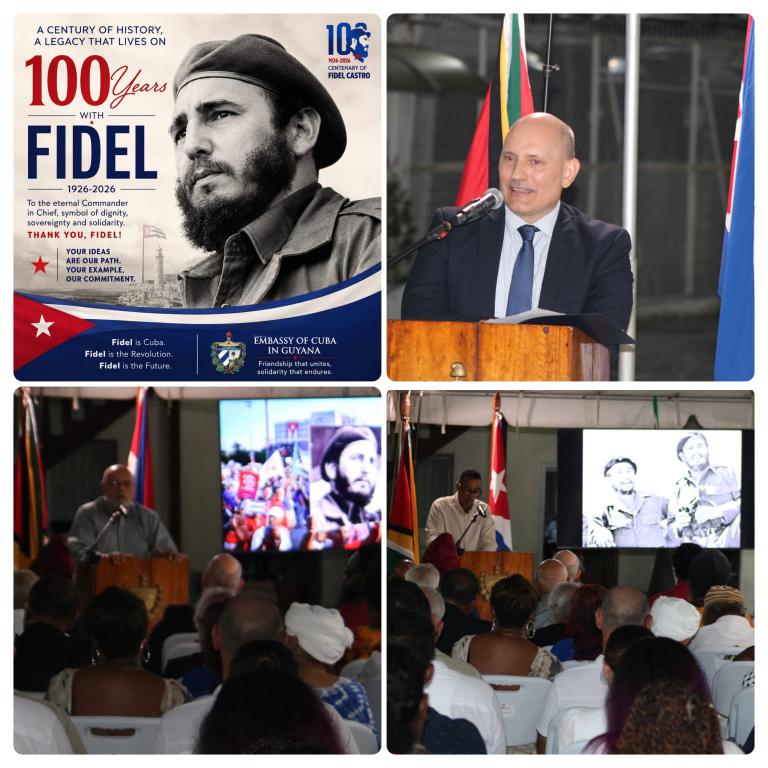
August 16, 2026. Guyana, Georgetwon. August 13, 2026, marked the 100th birthday of Cuban revolutionary leader Fidel Castro. Throughout the Caribbean, the Americas, Africa, Asia and Europe, people gathered in large numbers to pay tribute to Castro’s legacy. Guyana was no exception. On the evening of Saturday August 15th, the Embassy of the Republic of Cuba, in partnership with the Guyana Coalition in Solidarity with Cuba, hosted a well-attended event on the Embassy grounds.
Guests were treated to a film presentation highlighting Fidel Castro and the Cuban Revolution’s historic contribution to the liberation not only of Cuba, but nations throughout the world, and especially in Africa. The crowd watched a heartfelt exchange between Fidel Castro and Nelson Mandela during Castro’s visit to South Africa, where he was hailed as having driven the final nail in the coffin of Apartheid. Cuba's military response to the forces of the South African Apartheid regime at the historic and decisive battle of Cuito Cuanavale is credited with bringing the Apartheid Regime to the negotiating table. Nelson Madela and others spoke of the incredible contribution of Cuban internationalists to African independence, freedom, and justice, calling it “unparalleled for its principled and selfless character." It was recalled with pride that President Forbes Burnham had allowed the Cuban planes to refuel in Guyana on their way to Angola.
The first speaker, Dr. Gerald Perreira, Chairperson of Organization for the Victory of the People (OVP) told the gathering: “It is said, over and over, that Fidel Castro will never die. It's a cliché — but in the case of Fidel, it happens to be true”. He said that he is “convinced that a hundred years from now, long after his enemies and adversaries are completely forgotten, people will still gather in every corner of the earth to remember, and to speak of the man Fidel Castro, and how he changed the world”.
To a rousing applause he stated that “Fidel Castro had a vision for a new society, built on the affirmation of human dignity and the sanctity of the human person. That vision endures today”. He explained that “every revolution must go through a process of rectification and renewal to respond to shifting internal and external dynamics. All political and social systems must evolve and change or otherwise become stagnant and perish”. However, Dr. Perreira was adamant that “the kind of reforms and changes that will happen in Cuba is the business of the Cuban people and only the Cuban people – a people who understand what it means to be independent, sovereign and self determining and for them, there is no turning back. The changes that Cuba is currently pursuing are not about taking Cuba in the direction of capitalist restoration, but rather about finding ways to make the socialist project more viable and sustainable, so that it can exist in a hostile sea of neo-liberal capitalism”.
He pointed out that “the Cuban revolution taught us how to remain steadfast, courageous and relevant in an ever-changing world, ravaged by neo-liberal capitalism and the flawed liberal-democratic notion of what constitutes democracy, where 1% own and control everything, and where the resources and wealth of a nation does not benefit the majority of the people.” Highlighting some shocking statistics documented in a recent Oxfam report, which notes that the world’s 12 richest individuals own more wealth than the bottom half of humanity, which is approximately 4.1 billion people, and the top 1% control more wealth than 95% of humanity, he added that it is no wonder that the “marketplace governed by capitalism is referred to as a slaughterhouse”.
Dr. Perreira told the gathering that “although the US did everything in its power to cultivate an opposition in Cuba that could topple the revolution, all its efforts have failed”. This he said “stands as a testimony to Fidel and the Cuban revolutionary leadership...after almost 7 months of this intensified embargo that would bring any nation to its knees, Cuba is still standing strong and more than 6 million Cubans have signed up to defend their homeland. No revolution can withstand all that Cuba has withstood without the support of the majority of Cubans”. He noted that “the determination of the majority of the Cuban people to honour the life of their heroic leader by continuing the struggle for Cuba’s right to self-determination and true independence is perhaps Fidel’s greatest legacy” adding that “this is surely the litmus test of any revolution”. He pointed out that the people of Cuba are “highly educated and politically conscientized and cannot be easily confused or misled”.
Claiming that every revolutionary initiative worldwide, since 1959, owe a debt of gratitude to the Cuban revolution, Dr. Perreira asked the crowd “How can we repay that debt?”
His answer was that “if those gathered truly want to honour Fidel, that Fidel himself would expect nothing less than for us to use this commemoration of his birthday to recommit ourselves to the struggle for a just and humane world. He said “this means standing with Cuba – our solidarity at this time is imperative. Cuba must not fall – and it is up to us in the Caribbean to grow the solidarity movement and our resistance to this illegal and inhumane blockade. We must continue to demand a return of the Cuban Medical Brigade to Guyana and join with anti imperialist movements throughout the Caribbean to make it clear that any military intervention in Cuba is an attack on the entire region. I urge you to never believe that you cannot make a difference – all of you here tonight are making a difference when you stand for the truth and on the right side of history”.
Former President Donald Ramotar took to the podium next, having returned from Cuba earlier that day after attending the commemoration of Fidel’s 100th birthday in Havana, along with 1500 delegates from 63 countries. He told the audience that “it was a great honour and privilege to join the leaders and members of the Communist Party of Cuba and the Cuban people to celebrate the centenary of the birth of the Caribbean’s greatest son, and one of the foremost freedom fighters in our world, Comrade Fidel Castro” adding that “few leaders have had the impact on history that Fidel had.”
Mr. Ramotar said that “people from all over the world were in Havana for the commemoration because Fidel was not just the principal leader of Cuba, but one of the greatest champions of working and oppressed people the world over. His example and solidarity to peoples struggling to cast off the chains of colonialism and imperialism contributed to socio-economic progress throughout the Global South”.
Confirming Dr. Perreira’s assertions, Mr. Ramotar told the audience that he was expecting to see a Cuba that was devastated and was pleasantly surprised to once again witness the extraordinary resilience, steadfastness and creative genius of a people determined to resist and to fight for their right to self-determination. He said that the mood in Cuba was calm and defiant and that the Cubans were united in their determination to defend their revolution.
Mr Ramotar recalled Cuba and Fidel’s strong relationship with Caribbean nations, lamenting the major changes that have taken place, which have severed these ties. He urged the guests to “continue the struggle against US imperialism which has been sabotaging and doing its darndest to reverse the positive charges in the world at large, and in our region in particular”.
Mr. Ramotar took the audience back to a time when the English-speaking Caribbean was still under colonial domination. He explained that “when the Cuban Revolution triumphed the “The anti-communist propaganda against Cuba was spread throughout the region. This was when the criminal blockade was first imposed on Cuba, a blockade that persists to this day”.
He recalled that back then, “the governments of South America and the Caribbean came under tremendous pressure from the US to break relations with Cuba, to try to isolate the isle of freedom”.
Mr. Ramotar pointed out that “one colony stood out heroically in solidarity with Cuba, and that was British Guiana under the premiership of Dr. Cheddi Jagan. In those difficult days Guyana was the only colony in the region that sent congratulations to Fidel on the victory of the revolution and Dr. Cheddi Jagan was the first leader in the region to visit Cuba in 1960, to express solidarity and to welcome the revolutionary changes taking place”.
Under Jagan’s leadership Guyana traded with Cuba. The then colony defied the US blockade and sold rice, timber, and other products to Cuba and imported cement among other products from Cuba.
Mr. Ramotar recalled that “as we were preparing for Independence, Cuba offered the first scholarships to Guyanese students as early as 1961/62 period”, noting that “at the time of the Bay of Pigs invasion, many Guyanese students volunteered to stand beside the Cuban people in defence of the Revolution”.
Mr. Ramotar drew the audiences attention to the courageous step taken by then President Forbes Burnham, Michael Manley of Jamaica, Eric Williams of Trinidad and Tobago, and Errol Barrow of Barbados, when in 1972, as newly independent nations they announced their decision in unison to establish diplomatic relations with Cuba, breaking Cuba's diplomatic isolation in the Western Hemisphere and challenging the trade embargo imposed by the United States. According to Mr. Ramotar, “This was by any yardstick, one of the most important steps in the Region’s relations with Cuba, and demonstrated that when we are united, we can have a profound impact on international relations, despite size and geography”.
Mr. Ramotar pointed out that “thanks to the revolution, Cuba is one of the richest countries in the world in terms of human capital, which is the most important condition for socio-economic progress”. He added that “one of the reasons that the US spends billions in its desperate attempts to destroy the revolution is their fear of the example that Cuba can become if given the chance to compete on an equal footing”.
He also spoke of the huge amount of assistance that Guyana and the entire Caribbean received from Cuba contending “that if we put a price on Cuba’s generosity, we would find that it is far greater than the “assistance” the region got from Western sources”.
Cuban Ambassador to the Cooperative Republic of Guyana H.E. Jorge Francisco Soberón Luis spoke last. He thanked all those present, commenting that he was particularly pleased to see so many young people in attendance, and also so many Cuban residents in Guyana. He congratulated the people of Guyana for their historic and heartfelt solidarity, and in the name of the people of Cuba thanked the Coalition in Solidarity with Cuba for their hard work. He reported that the Cuban Relief Project, initiated by the Coalition, which includes concerned citizens, organizations and representatives of the Christian, Muslim and Hindu communities, had already sent 120 tons of rice to Cuba which was distributed to the most vulnerable citzens. He described the relief project, known as A container of Love from the People of Guyana to the People of Cuba, as an historic and extraordinary people-to-people initiative, and announced that a third shipment would soon leave for Cuba containing food items, medical supplies, personal hygiene and cleaning supplies, clothing, footwear and over 100 solar powered fans. lights and other equipment, all donated by the people of Guyana. Ambassador Luis also took the opportunity to recognize the outstanding performance of Dr. Asaph Ahmad from Guyana, who was the top graduating student at the University of Medical Sciences in Havana in 2026.
At the end of the program, Guyanese guests joined their Cuban brothers and sisters to share an array of Cuban delicacies and drinks. As chants of Venceremos (we shall overcome) could be heard breaking through the upbeat Cuban music that filled the air, the mood was one of resistance, steadfastness and hope – certainly not despair or defeat. It seems that Cuba has once again taught the world what true empowerment looks like - a small Caribbean nation that refuses to surrender its sovereignty, no matter what the cost.