
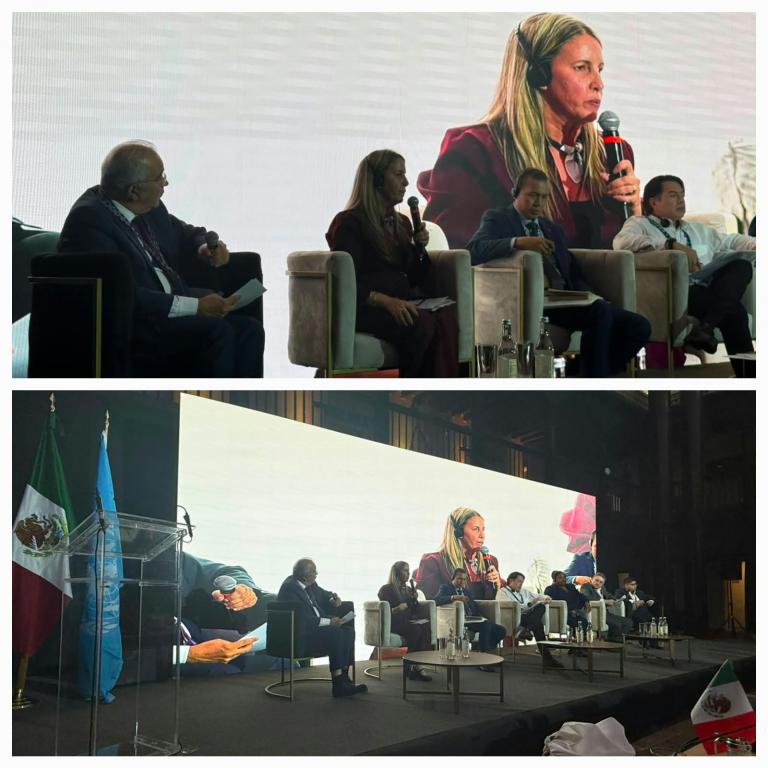
Chiapas, Mexico, September 8, 2026.— Cuba’s Minister of Education, Naima Ariatne Trujillo Barreto, spoke on Tuesday at the main panel, “Literacy in the service of people, the planet and prosperity,” as part of the global celebration of International Literacy Day convened by UNESCO.
The World Conference on Literacy for People, the Planet and Prosperity is taking place on September 8 and 9, on the occasion of the 60th anniversary of International Literacy Day, under a theme that places at the center the contribution of literacy to sustainable development in its social, environmental and economic dimensions, as well as to peace.
UNESCO recalls that, despite the progress achieved over the past six decades, significant challenges remain. At least 739 million adults worldwide still lack basic literacy skills, of whom approximately two-thirds are women. Likewise, many children still fail to acquire basic literacy skills. Globally, only 58% of primary school students reached the minimum proficiency level in reading and 44% in mathematics in 2019.
Cuba’s presence in this international forum is not fortuitous. It reflects the recognition of the country’s accumulated experience in literacy, whose starting point lies in the historic 1961 National Literacy Campaign. That educational epic made it possible for Cuba to declare itself, on December 22 of that year, the first territory free of illiteracy in Latin America. UNESCO itself has recognized the National Literacy Campaign as a landmark event in Cuban education and culture in the 20th century and as a reference for popular education movements in Latin America.
That experience was followed by a policy of educational continuity and international cooperation that transcended the borders of the Island. In 2003, at the initiative of the historic leader of the Revolution, Fidel Castro Ruz, Cuba made the “Yo, sí puedo” program available to other peoples. The program was designed to facilitate the literacy of young people and adults through audiovisual and, subsequently, digital tools adapted to different cultural and linguistic contexts.
According to information provided by Cuba’s Ministry of Education, the program and its successive updates have been implemented in more than 35 countries and have contributed to the literacy of more than 11 million people since 2003. The program has been contextualized in different languages and Indigenous languages, reaffirming the importance of respecting the cultural identity and linguistic traditions of communities.
Cuba’s achievements in education are today confronted with the harsh electro-energy reality facing the country, as a consequence of the unprecedented tightening of the economic, commercial and financial blockade imposed by the Government of the United States against Cuba for more than six decades, and of its effects on access to resources, equipment, technologies and other means essential to the teaching and educational process.
The criminal U.S. energy siege is today one of the main obstacles to guaranteeing the continuity and quality of education in Cuba. External restrictions that hinder fuel imports have direct impacts on the functioning of essential services, affecting transportation for students and teachers, school meals, and the availability of electricity necessary for educational activities. UNESCO itself has recognized this situation, calling in February 2026 for international cooperation to support the continuity of education in Cuba.
Despite the complex circumstances, Cuba began the 2026–2027 school year in September at all levels of education, with adjustments designed to address the exceptional conditions facing the country. President of the Republic Miguel Díaz-Canel Bermúdez has highlighted the commitment of administrators, teachers, families and communities to ensuring the continuity of the educational process, even amid material and energy limitations.
In this regard, UNESCO Assistant Director-General for Africa Priority and External Relations, Lidia Arthur Brito, who heads UNESCO’s in-person representation at the global event and who has just paid an official visit to Cuba, stated on her LinkedIn profile:
“I particularly welcomed the efforts being made to ensure the continuity of education in a challenging context. The commitment of teachers and the wider education community is a remarkable example of Resilience!”
Cuba’s participation in the global celebration of International Literacy Day thus reaffirms the country’s commitment to contributing to the international debate on the present and future of literacy and to sharing an experience that, from the 1961 National Literacy Campaign to current cooperation programs, has placed education and literacy as fundamental rights and pillars of social transformation.
Within the framework of the Conference, Cuba will continue to advocate for the need for a global literacy agenda that places people at its center, respects linguistic and cultural diversity, promotes lifelong learning, and makes it possible to address, from a perspective of equity and inclusion, the new challenges associated with technological and digital transformation.