
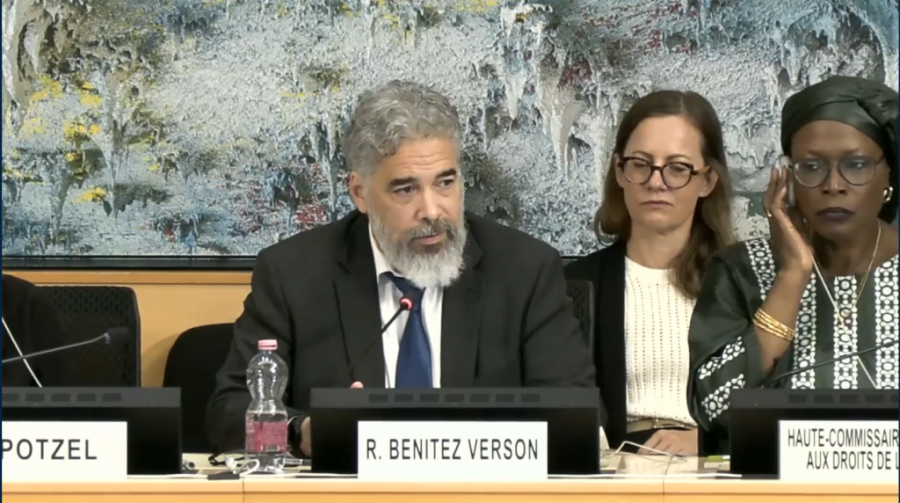
Geneva, 11 September 2026. The Human Rights Council convened a special Panel to commemorate the 40th anniversary of the United Nations Declaration on the Right to Development. The event aimed to take stock of the achievements and obstacles encountered over the past four decades in implementing the Declaration and to identify a roadmap for operationalizing the right to development.
Cuban Ambassador Rodolfo Benítez Verson was one of the invited panellists to make a presentation at the event, which was moderated by the President of the Human Rights Council, Sidharto Reza Suryodipuro.
The representative of Cuba described the UN Declaration as “a revolutionary text and a historic milestone”, as it formalized the recognition by the UN General Assembly of the right to development as an inalienable human right of individuals and peoples.
However, he warned that the operationalization of the human right to development remains a pending task and an elusive goal for the vast majority of countries of the Global South. He stressed that, as the Declaration adopted in 1986 is not legally binding, it is not, by itself, sufficient to ensure the effective realization of this right.
He identified the absence of a legally binding international instrument on the right to development as one of the main limitations of international human rights law today.
In this context, he emphasized the need for the UN General Assembly to adopt, as soon as possible, an International Covenant on the Right to Development, based on the text recommended by the Human Rights Council in 2023.
He stated that such a Covenant would help place development where it belongs: at the centre of the international agenda, on an equal footing and at the same level as all other human rights, with concrete and internationally enforceable obligations. He added that such an instrument would create an appropriate framework to address the main systemic and structural challenges to development.
He described the right to development as a “synthesis right”, as its realization is essential for the enjoyment of all other human rights.
The Cuban representative also stressed the importance of ensuring that the future Covenant explicitly recognizes the incompatibility of unilateral coercive measures with the right to development and establishes an obligation for States neither to adopt nor to apply such measures.