
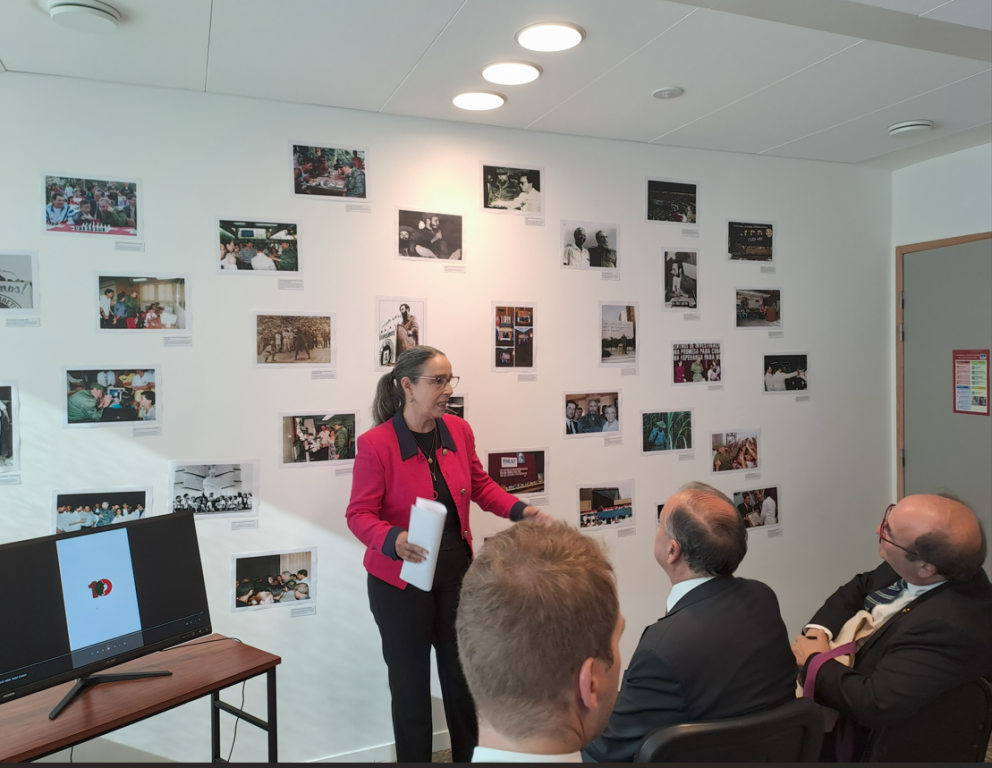
Paris, September 29, 2026. – The Permanent Delegation of Cuba to UNESCO today paid tribute to Commander-in-Chief Fidel Castro Ruz as part of the celebrations marking the centenary of his birth. A group of ambassadors and delegates to the Organization attended the event, where they learned about Fidel’s relationship with UNESCO and his commitment to education, culture, science, technology, and the promotion of peace and international cooperation—areas closely linked to the Organization’s mandate.
As part of the event, a photographic exhibition was presented featuring different moments from the life and work of Fidel Castro Ruz and his ties to sectors of particular relevance to UNESCO. The images recall, among other milestones, the 1961 National Literacy Campaign; his relationship with Cuban children, young people, students, and workers; the promotion of sports and culture; the creation and development of the Young Computer and Electronics Clubs; the promotion of Cuban scientific research and biotechnology; the training of health professionals through the Latin American School of Medicine; the preservation of cultural heritage; and his ties with prominent figures from the worlds of culture, science, and international affairs.
The exhibition also includes images of Fidel alongside figures such as Nelson Mandela, Gabriel García Márquez, Federico Mayor, Eusebio Leal, and Hugo Chávez, as well as moments associated with institutions and projects that reflect the importance attached by the Cuban Revolution to education, culture, science, and the training of new generations in Cuba, Latin America and the Caribbean, and around the world.
In her remarks, the Cuban ambassador, Maria del Carmen Herrera Caseiro, stressed that these advances have been achieved in a context marked by the economic, commercial, and financial blockade imposed by the United States against Cuba for more than six decades, and by its progressive tightening. Today, this policy of collective punishment is accompanied by an energy siege that exacerbates the difficulties faced by the country and directly affects sectors essential to the well-being of the population, while the threat of secondary sanctions against companies, banks, and institutions in third countries that maintain ties with Cuba remains in place. These measures, with humanitarian consequences, have created additional obstacles to the country’s development and place important achievements in areas related to UNESCO’s mandate at serious risk.
During the tribute, excerpts were shown from the address delivered by Fidel Castro before the UNESCO Executive Board in Paris on March 13, 1995, on which occasion he addressed issues relating to peace, cooperation, education, culture, and development. UNESCO itself preserves an audiovisual recording of that address in its archives.
In her remarks, the Cuban ambassador emphasized the continued relevance of Fidel’s thought and work and their connection with UNESCO’s ideals and areas of work, and invited those present to view the photographic exhibition and listen to excerpts from his address to the Organization.
The ambassador’s remarks at the tribute are reproduced below:
This year, 2026, we celebrate the Centenary of the birth of the Leader of the Cuban Revolution, Commander-in-Chief Fidel Castro Ruz. It is in this context that we are presenting this small photographic exhibition, which illustrates Fidel’s activism and leading role, as well as his commitment to the ideals of UNESCO and to the promotion and development of the sectors within the Organization’s mandate.
This commitment took shape from the very triumph of the Cuban Revolution, with the launch of the Cuban social project aimed at prioritizing inclusive and quality education, free and universal access to cultural creation and practices, scientific and technological development, and the enjoyment of new information and communications technologies by our entire population. It was a program of profound transformations, aligned with the values and principles promoted by UNESCO and which, at the same time, as an unequivocal reflection of Fidel’s spirit of solidarity, was shared with other peoples around the world.
The advances and achievements attained by Cuba in UNESCO’s areas of competence are widely recognized. They are the result of the enormous efforts made by the country, inspired by Fidel’s leadership, under extremely adverse circumstances due to the strict blockade imposed by the United States against Cuba for more than six decades, now tightened to unprecedented levels with the imposition of an energy blockade and the threat of secondary sanctions against companies, banks, institutions, etc. in third countries for maintaining ties with Cuba, which affects and places the achievements attained at risk.
Fidel was a deeply humanistic man, a staunch defender of peace and just causes, and an unwavering ally of the poor and disadvantaged. He was a man of great ideas and a universal vision of the future. His thought and work remain fully relevant today.
In 1995, invited by the Organization’s then Director-General, Federico Mayor, in his address before the UNESCO Executive Board, Fidel reaffirmed the need for peace and cooperation for development, based on respect for the sovereignty and self-determination of nations. He also recalled that there can be no development without education, nor education without culture, nor culture without independence and dignity. Thirty years later, those words are particularly relevant in a world burdened by conflicts and inequalities.
I invite you to listen to excerpts from Fidel’s address at UNESCO and to visit the exhibition.
Thank you very much.