
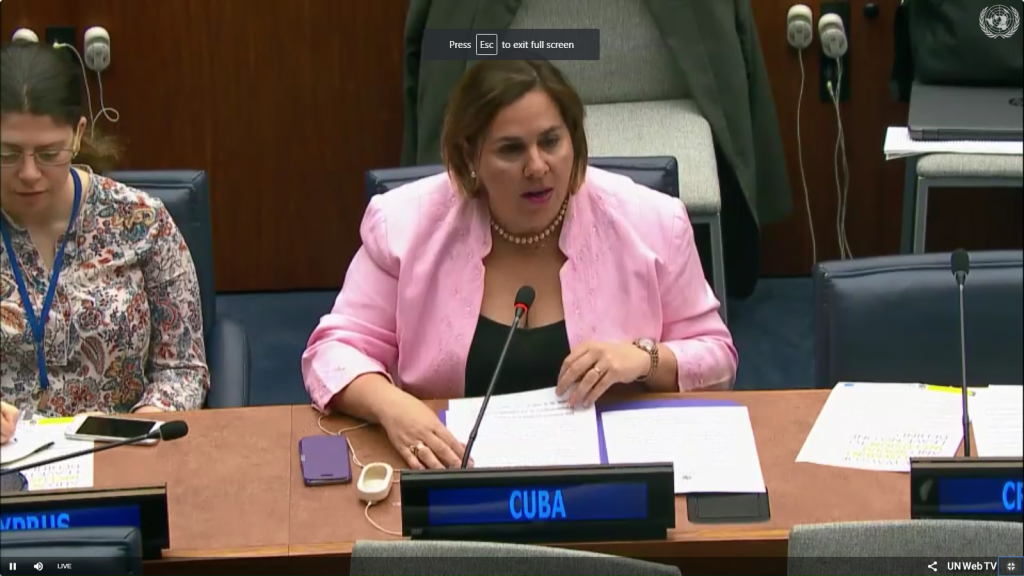
Mr. President,
We congratulate the newly elected members of the Committee on the Rights of Persons with Disabilities.
As part of the high priority Cuba attaches to this issue, we reiterate our strong commitment to the spirit of the Convention.
Mr. President,
Most developing countries do not have the financial resources to build national capacities for care of persons with disabilities. Consequently, regardless of the State’s willingness, the vulnerability of these people in terms of social exclusion, poverty and discrimination is deepening in many of these countries.
International cooperation has played an increasingly important role in funding programmes for persons with disabilities. The working documents recognize that while there has been an increased global commitment to ensuring the recognition of the rights of persons with disabilities in development programmes, funding for these purposes continues to be insufficient.
Worse still, it is outrageous that this situation remains while the amount of financial, material and technological resources allocated to ethically reprehensible military purposes is increasing exponentially.
We attach great importance to the reference made in the working documents to the fact that the obligations set out in the Convention have financial implications, affecting not only the national level, and therefore require greater political will to foster international cooperation.
In this regard, Cuba advocates compliance with the provisions of the Addis Ababa Agenda for Action, particularly with regard to the need to reverse the current decline in Official Development Assistance, which will have a direct impact on improving the quality of life and social integration of persons with disabilities.
Mr. President,
It is worrying to note, as recognized in the working documents, that women and girls with disabilities worldwide continue to suffer multiple forms of discrimination and social exclusion and are the most vulnerable group within this population sector.
Furthermore, we are glad that this Conference has included a space for discussion on the need to significantly reduce the inequalities facing women and girls with disabilities. However, no progress will be possible if governments, along with the support of all actors, do not turn words into concrete actions. We are convinced that this path should start by addressing the structural causes lying at the root of this situation, such as underdevelopment, poverty, social marginalization and the lack of opportunities for the full integration of these people into society.
Mr. President,
It is equally worrying to note that in the midst of the 21st century, people with disabilities are still unable to enjoy their right to actively engage in decision-making processes in many countries under the same conditions as all other citizens.
It is imperative that governments contribute effectively to eliminating these barriers and formulate and implement policies, as part of the integration of persons with disabilities into society, to guarantee this human right and to promote in different ways that organizations that bring together persons with disabilities have their own space and voice in political and legislative bodies, as well as in other decision-making bodies from the national to the community levels.
Mr. President,
Cuba attaches paramount importance to compliance with the provisions of the Convention and the World Programme of Action concerning Disabled Persons. In this vein, protecting and addressing the specific needs of these people are an essential component of social development in my country.
In Cuba, persons with disabilities are both beneficiaries and key actors in the economic and social development of the nation. These people, like the rest of Cubans, are inviolable subjects of law.
This statement is reflected in practice through the implementation of a development strategy based on the principles of freedom, equity, social justice and inclusion, which places human beings at the focus of attention and promotes their comprehensive development, self-realization and full social integration.
The various National Action Plans for the Care of the Disabled implemented in my country have resulted in significant progress in terms of social integration and improvement of the quality of life of persons with disabilities, through a multisectoral and coordinated approach.
In order to develop and implement these policies, our State annually allocates the necessary resources to ensure that actions are undertaken in the areas of social security and assistance, health, education, culture, sports, communications, transportation, employment, adequate housing and other services offered in the community, which include but are not limited to, social assistance financial benefits, transportation to receive medical care outside the area of residence and subsidies for housing construction actions.
In recent years, particular emphasis has been placed on the access of persons with disabilities to new information and communications technologies, which are goods at the service of the entire population, particularly for the care of boys and girls with different types of disabilities, by using educational software adapted to different ages.
As part of the process of updating the economic and social model of socialist development in my country, other supplementary measures have been adopted and are being implemented to continue to take the provision of support and protection to persons with disabilities to higher levels.
These actions also include all the media by systematically broadcasting educational messages and promotions relating to the rights, guarantees and protection of persons with disabilities.
The development of national laws, policies and programmes has enabled the inclusive participation of boys and girls with disabilities in all activities for children, under the same conditions and with equal opportunities, taking into account the gender perspective. In my country, education is a basic human right, which is the basis for building a more just and equitable society. In this connection, our educational system protects and promotes the social inclusion of boys, girls, adolescents and young people with disabilities.
Our State has also worked on the labor inclusion of these people. The Social Security and Assistance System guarantees adequate protection for workers with inability to work by reason of age, disability or illness, as well as protection for the elderly lacking resources or protection and for any person who is unfit for work because of disability.
Mr. President,
Persons with disabilities in Cuba are not only beneficiaries of social programs and public policies of universal coverage, but also actors empowered by their own realities, with full government support.
In this regard, in our country there are several non-governmental associations that bring together this segment of the population. These organizations are key actors in defending, guiding, promoting, respecting and exercising the rights of persons with disabilities, with a focus on their members and society in general.
Another area through which the Cuban State promotes the social integration and equality of persons with disabilities is sport. Practicing sports with specialized assistance is part of the programs of our Special Education System. In like manner, the presence of persons with disabilities in the high-performance sports programme is promoted and supported, with important victories in the international arena. At the two most recent Olympics, Cuban athletes with disabilities have achieved the best performances in their history, ranking 18 with more than 200 nations participating. Cuba now has several Pan-American, Paralympic and world champions.
Mr. President,
The above expressions of political will are challenged by the lack of necessary economic resources. As a small developing country, we suffer the adverse effects of an unjust and morally unsustainable international economic order, in which the most backward economies are condemned to underdevelopment.
This is coupled with the serious effects of the economic, commercial and financial blockade imposed by the United States that my people has suffered for more than half a century and continues in full force. This policy, which is the main obstacle to Cuba's development, has hindered the access of the country to international markets, thereby placing additional burdens on its financial transactions and severely restricting economic growth. This has prevented us from having sufficient economic resources to continue improving our public policies and social programmes aimed at raising the standards of living and well-being of the population, in particular persons with disabilities.
Despite these challenges, we reiterate the firm willingness of our State, our Government and our people to continue strengthening actions geared towards ensuring full respect for the dignity of persons with disabilities and the protection and promotion of all their rights.
Thank you very much.