
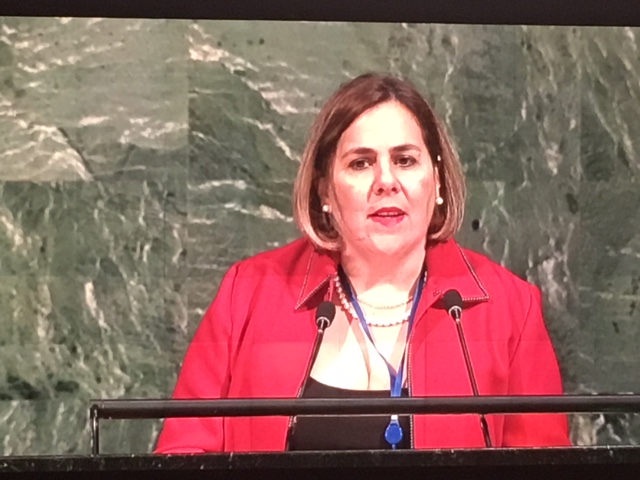
New York, June 28, 2018.In her statement at the United Nations High-Level Conference of the Heads of Counter-Terrorism Agencies of the Member States: "Strengthening international cooperation to combat the evolving threat of terrorism ", the Deputy Permanent Representative of Cuba, Ambassador Ana Silvia Rodríguez Abascal, reiterated the island's unwavering will to fight against terrorism and its deepest rejection and condemnation of all acts, methods and practices of terrorism, in all its forms and manifestations, committed by whomever, against whomsoever, and wherever they may be committed; regardless of their motivations, including those cases in which States are directly or indirectly involved.
She indicated that Cuba is a State Party to 18 international conventions on terrorism; in addition, it has increased judicial cooperation with other countries, for which it has signed 25 legal assistance agreements in criminal matters, 22 agreements to transfer sanctioned persons and 11 agreements for extradition; and it has an Interpol National Bureau.
She also highlighted that in October 2014, the Financial Action Task Force (FATF) recognized the Cuban institutional commitment and capacity to prevent money laundering and the financing of terrorism; and in June 2015, the Caribbean country formally became a member of Egmont Group, joining the global network of financial intelligence units.
She added that the country has a specific legislation on terrorism, and in December 2001, the Cuban Parliament approved Law 93 "Against acts of terrorism", which, in addition to categorizing acts of international terrorism, includes all individuals linked to terrorism who have been sanctioned. Besides, the Cuban criminal legislation has defined the crimes of Money Laundering and Financing of Terrorism since 1999 and 2001, respectively, and more recently, since December 7, 2013, the Cuban authorities adopted two legal provisions of high normative hierarchy in terms of prevention and confrontation of money laundering and financing of terrorism.
Rodríguez Abascal also explained that terrorism as a phenomenon cannot and should not be linked to any religion, nationality, civilization or ethnic group, and therefore, its confrontation must be holistic, through direct confrontation and prevention and with concrete actions to eradicate its root causes. She added that it cannot be eradicated if double standards and selectivity prevail in addressing it. In this regard, she called for rejecting the manipulation of such a sensitive issue to turn it into an instrument of politics against any country.
The Cuban representative referred to the harmful practice of certain states to finance, support or promote subversive acts aimed at "regime change", as well as messages of intolerance and hatred against other peoples, cultures or political systems, through the use of modern information and communications technologies, which constitutes a violation of the principles of the Charter of the United Nations and International Law.
Permanent Mission of Cuba to the United Nations