
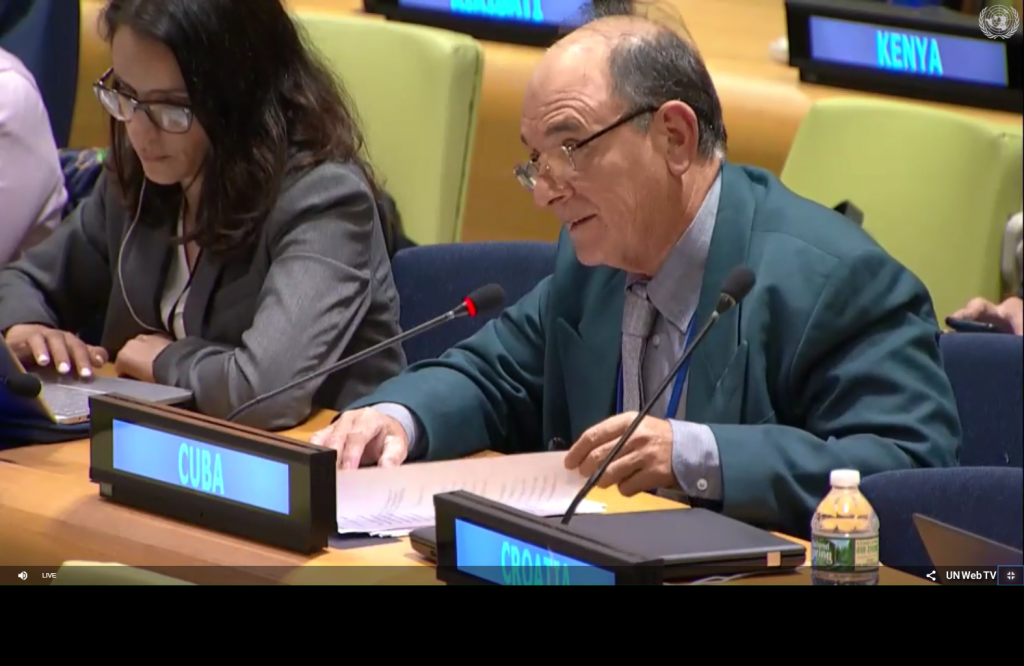
New York, April 18, 2019. Cuba attended today the 4th Forum of the United Nations Economic and Social Council (ECOSOC) on Financing for Development, held at the New York headquarters of the world organization.
The Minister Counselor Jorge Alberto Ferrer Rodríguez, who represented Cuba, explained that although discussions held at the Forum on Financing for Development have increasingly gained quality and relevance, they remain incomplete and biased, especially in the analysis of some fundamental issues and their root causes. He added that many speakers have offered the mobilization of internal resources to finance development, but have ignored the fact that the majority of transnational corporations from developed countries pay little or zero tax for their investment revenues in the developing countries, despite the call of the Addis Ababa Action Agenda in this regard.
Similarly, the diplomat referred to the problems faced by developing countries to facilitate private and foreign investment, because their private sector does not have cutting-age technologies or large financial resources. At the same time, he added, the developed countries do not ease investments and technology transfer, especially those necessary for sustainable development; nor do they want to give continuity to the Doha Development Round, launched by the WTO 18 years ago and whose standstill is their responsibility.
Ferrer Rodríguez argued that it is barely mentioned that the Official Development Assistance in 2018 decreased 2.7% in real terms, accounting for the 0.31% of the Gross Domestic Product and that only 5 donor countries attained or surpassed the commitment to allocate 0.7% of their GDP to meet this goal. This contrasts with the huge resources that are dilapidated for the world’s military spending, which grew in 2018 for the fifth consecutive year reaching the figure of 1.78 trillion dollars, surpassing the record set in 2010, he said.
The representative of the island emphasized that, in this complex and unequal international economic order, unilateral coercive measures against developing countries remain in place and are intensified, contrary to the Charter of the United Nations, international law and multilateral trade rules, which limit sustainable development and financing. An example of this is precisely the unjust and illegal economic, commercial and financial blockade imposed by the United States Government against Cuba for almost 60 years aimed at overthrowing the government of the country and which has been condemned by an overwhelming majority of the General Assembly for 27 consecutive years. This genocidal policy continues to be strengthened by the current US government, affecting the sustainable development of the Cuban people and the interests of third States and it must be lifted unconditionally, he said.
Permanent Mission of Cuba to the United Nations