
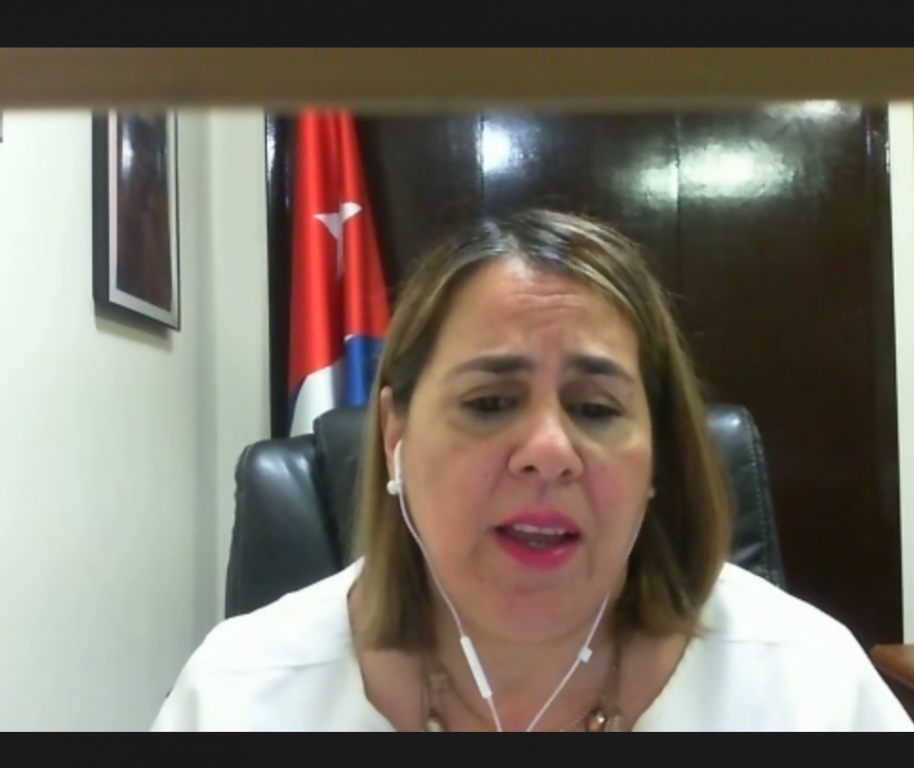
New York, 13 August 2020. An international webinar on the life and work of Commander-in-Chief Fidel Castro Ruz was held today, convened by representatives of the movement of solidarity with Cuba in the United States.
Ambassador Ana Silvia Rodríguez Abascal, Chargé d´Affaires a.i., Deputy Permanent Representative of Cuba to the United Nations; participated today in the event as a speaker, in which she explained the mark of the Historical Leader of the Revolution in the revolutionary diplomacy. She expressed that he provided the revolutionary diplomacy with principles such as the defense of sovereignty, independence and social justice, internationalism, the unity of the countries of the global south, international cooperation and solidarity and the struggle against imperialism, colonialism or neocolonialism, that have not only delineated Cuba´s foreign policy but have also conditioned Cuba's actions in all contexts, both bilateral and multilateral.
The island´s representative stated that the Commander-in-Chief taught Cuba to adopt, not in empty rhetoric but in staunch defense, the basic principles of international law: respect for the sovereignty, independence and territorial integrity of States; the self-determination of the peoples; the rejection of interference in the internal affairs of other States; the right to international cooperation for mutual and equitable benefit and interest; the peaceful relations among States, and other precepts that make up the purposes and principles of the United Nations Charter.
The Cuban diplomat recalled that at the multilateral level Fidel was in the vanguard in issues that today are part of the agenda of the United Nations: his historic speech at the Earth Summit in 1992, when many did not even know the words "global warming" or "climate change", and he called us to come together in the defense of our planet, through sustainable consumption and production and not through arms race. In addition, she affirmed that the Historical Leader of the Cuban revolution also actively defended the enormous importance of the unity and mobilization of the countries of the South in the joint solution of their common problems and unmistakably marked the activity of the developing countries’ platforms for political agreement, such as the Non-Aligned Movement and the Group of 77 and China.
Josefina Vidal, Ambassador of Cuba to Canada and José Ramón Cabañas, Ambassador of Cuba in Washington and representatives of the movement of solidarity with Cuba in the United States and Canada also participated in the comprehensive program dedicated to celebrate the life of the Commander-in-Chief.
Permanente Mission of Cuba to the United Nations