
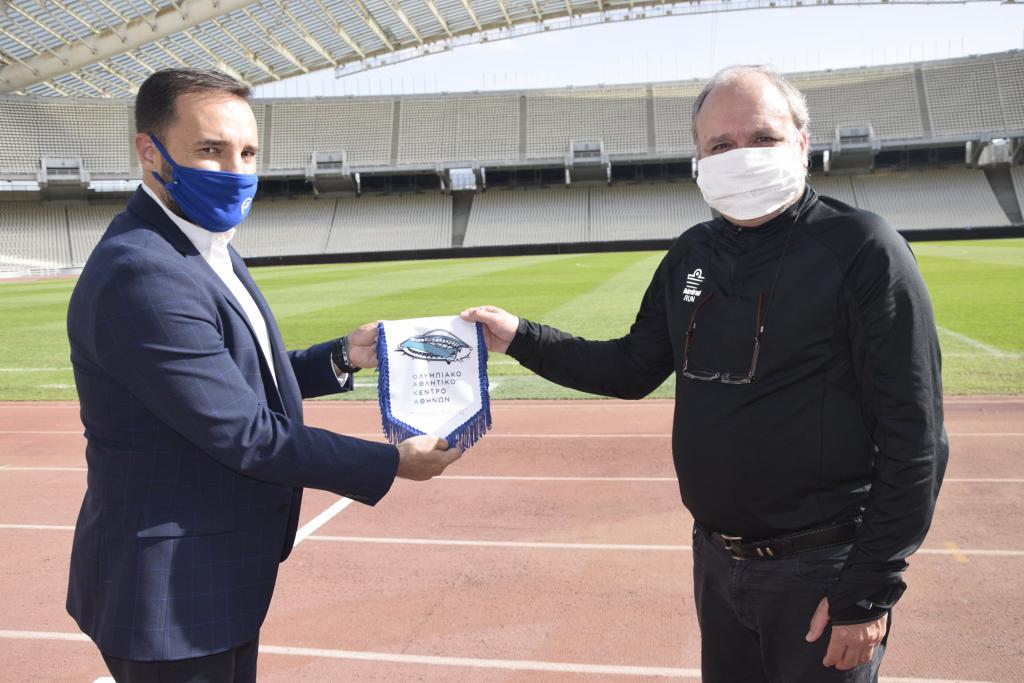
Meeting of the Councilor of the Embassy of Cuba in Greece with sports authorities in Athens
(taken from the Facebook of Oriol Marrero counselor Embacuba Greece)
Just over 15 years ago, at the 2004 Summer Olympics in Athens, the Cuban delegation was made up of 152 athletes, including 56 women. Cuba was placed in in place eleven (11), by country , winning 27 medals: 9 gold, 7 silver and 11 bronze. Except for superpowers or economic and/or population powers such as the United States, China, Russia, Australia, Japan, Germany, France, Italy, South Korea and the United Kingdom, the rest of the nations of the posed participants in those Olympics were located below Cuba in the medallion. Our country competed in 18 sports. His standard-bearer was the renowned athlete Ivan Pedroso. The island had not participated in the 1896 Olympics in Athens, the first of the Modern Era, organized thanks to the efforts of Pierre de Fredi, Baron of Cubertin (1863-1937). Nor at the 1906 Interspersed Olympics in Athens. So this, as it all indicates, would be the first Olympics with a Cuban presence in Greece, in history.
The Cuban route at Olympic Games in the Modern Era is marked by the victory of fencer Ramón Fonts Segundo, first Ibero-American Olympic champion and pioneer of Cuba's Olympic victories, in Paris 1900.
The first Cuban Olympic medalist after the triumph of the 1959 Revolution would be the portentous Enrique Figuerola, silver at the 1968 Olympics, Mexico, with 38.40 seconds in the relay 4 x 400, who in the "Message to young people", included in the work "Enrique Figuerola (El Figaro)", by Basilio Fuentes Ferrer, would say: "I was never intoxicated by triumph, for I always recognized simplicity and modesty before him. I felt committed to my collective, my team and Cuba; I also recognized that what I became was the work of a people, from whom I received their encouragement and incentive at every moment of my sporting life".
Returning to Athens 2004: in this city the Cuban baseball team was titled Olympic champion. So did 5 boxers (Bartelemí, Gamboa, Rigondeaux, Kindelán and Odlanier); a javelinist (Osleidys), a disco pitcher (Cumbá) and a Greco-Roman wrestler (Yandro). Yipsi got the silver in a hammer. Yudel in boxing; Aragon in judo; Daima and Yuliet in teakwondo; Monsoon in Greco wrestling, Rojas and Balceiro by canoe. The 11 bronzes went to Anier, in 110 meters with fences; Yunaika in hammer, Michel in boxing, and for the women's volleyball team. Five Judocas achieved bronze: Yordanis, Amarilys, Yurisleidy, Driulis and Yurisel. Juan Miguel also reached bronze in shooting, and Fundora in wrestling.
In order to recall the effort and feats of Cuban athletes in Athens, the presence of the Cuban sports delegation at the 2004 Athens Olympics, more than 15 years later, we respectfully asked those responsible for the Greek Olympic facilities to grant us permission to enter only "five minutes", and take some photos of places where Cubans then competed on The Land.
Not only do we receive friendly and quick permission to make them, but I must also thank Mr. Director General of the Olympic Centre of Athens "Spiros Louis", Mr Konstantinos Charlioris, for his kind welcome, his presence, the tour and interesting meeting, which he facilitated to fulfill and also on fulfilling the purpose, because after the interesting exchange and at his request that we thank, will soon be exhibited at the Olympic Stadium in Athens , site where the opening of the Olympics was made in 2004, the photographic exhibition "José Martí: with Greece at heart", which will be a greeting to the 200th anniversary of Greece's independence in March 2021 and an auspicious framework to show José Martí's love for Greece and "the Greek", especially the martyred admiration for Greek sport , which he spoke of in his works more than once. Thanks also to Ms. Adamantía Chatzimanoli, head of public and international relations at the Olympic Center of Athens "Spiros Louis", for his kind reception (Spiridon Louis, "Spiros", he was the Greek runner who won the gold medal at the first Olympics of the Modern Era, 1896, in the specialty of marathon. He was born on 12 January 1873 in Marusi, Athens, and died on 26 March 1940. His personal best was 2:58:50, 1896).
Pictured: Athens Olympic Stadium and several of the facilities where Cuban athletes competed in Athens 2004. Also appears the baseball stadium (not located in the area of the Olympic Center) where the Cuba team was crowned Olympic champion (now in repair, the view is taken from a nearby mountain –Himeto, several times cited by Martí in his Works, then famous for his honey of thyme flowers, made very present in the Martiana literature--). And the anthological Kalimarmaro Stadium appears, -- first and last image -- where the first Modern Age Olympics took place in 1896 in Greece. Cuba wasn't there in these. I would do it for the first time, in Greece, in 2004. And you can see some ships that are no longer used, in the old airport of Athens, but that as indicated by the design in its fuselage were also used to move Olympic athletes to the event where Cuba reached a prominent place in the World Sports Olympus.


