
By: Randy Alonso Falcón, Dinella García Acosta, Karina Rodríguez Martínez
June 21, 2021 CUBADEBATE
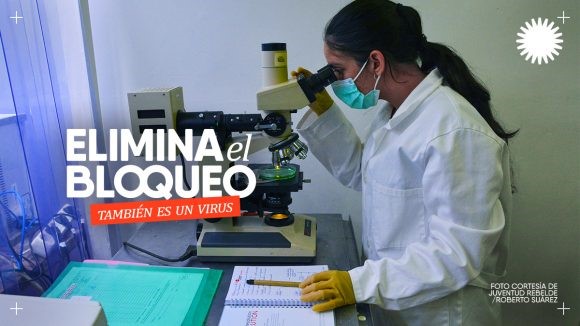
Cuba has faced the economic, commercial and financial blockade imposed by the United States government for almost six decades, and one of its greatest impacts is seen in the field of health. The largest of the Antilles is denied the right to acquire technologies, raw materials, reagents, diagnostic means, medicines, devices, equipment and spare parts, which have to be obtained in geographically distant markets or through a third country, with an increase in costs.
During the months of the pandemic, this policy, far from minimizing its impact, has intensified to unprecedented levels, hence 2020 was the year with the greatest impact both in number and in examples, due to the impact that the measures have had on combat. to COVID-19. To discuss this issue, directors of BioCubaFarma, FarmaCuba and MedSol appeared at the Round Table on Monday.
After hearing the news that Abdala's effectiveness is 92.28%, the Director of Science and Innovation at BioCubaFarma, Rolando Pérez Rodríguez, began the Round Table ensuring that this result, together with the previously known Soberana 02, " it has great scientific relevance and potential medical impact.
“Barely 10 months after starting the projects of the Finlay Vaccine Institute and CIGB laboratories, the efficacy data are achieved in a complex epidemiological scenario, characterized by the circulation of the variants of concern of the SARS-Cov-2 virus”.
"Of the 332 vaccine candidates under development in the world, - he stressed - only 10 have reported expository efficacy data in phase III, including Soberana 02 and Abdala".
At the end of June 19, 4,885,870 doses administered with both vaccine candidates had accumulated in the country, which has made it possible to generate data on their effectiveness in groups and territories at risk, so that 20% of the population has received at least one dose as of the close of June 20.
Pérez Rodríguez explained that these results have been obtained in the midst of a critical financial crisis and lack of resources necessary for the r & d activity and for the productive scaling up of vaccine candidates, "which further highlights the merit of scientists, technologists and specialists of the health system who have made this contribution to Cuban science ”.
Serious effects on the production and distribution of medicines
To talk about the effects of the blockade on Health, Tania Urquiza Rodríguez, Vice President of BioCubaFarma, began her speech by recalling how the business group has had to stress its entire production and research system to guarantee all protocol products to COVID-19 and the development of Cuban vaccines.
"All of this," she explained, "in the midst of an international economic crisis, where global industry and logistics have collapsed, making it difficult to bring all the supplies and raw materials necessary to research and produce medicines and vaccines to Cuba."
Urquiza Rodríguez stressed that BioCubaFarma workers have grown in the face of these adversities. “It is a feat what they have done in the midst of this health crisis, where the United States attacked Cuba, once again exacerbating the economic, commercial and financial blockade.
"Blockade that affects," he continued, "to a greater or lesser extent, all BioCubaFarma companies, and therefore, the entire national health system and our people."
When exemplifying the damages caused by the blockade, the vice president of the business group read a message from one of the most important suppliers of BioCubaFarma:
“I am writing to inform you that, as we had anticipated since we began operations, the pressures of the North American blockade against Cuba have caused, as of today, the bank where we have our accounts to suspend operations with Cuba, therefore, this payment method it is without effect in all our contracts. We must emphasize that said bank continued to operate with Cuba despite pressure from the North American government ”.
This means - Urquiza Rodríguez explained - that all the resources and raw materials that were required for production, included in those contracts, were paralyzed.
“The financial persecution that the US government has against Cuba also affects export activities and the ability to enter into new businesses, and makes it impossible to enter foreign currency abroad or bring to Cuba. Every time we set up a bank route, the blockade is mounted on it and it is impossible to bring those currencies”.
Another of the effects lies in the deliveries, until it is defined that they have less than 10% of components from the United States. One of the messages received this year from a supplier said: “I inform you that all operations are halted until it is defined which products have less than 10% content of USA origin. These would be the products that they will commercialize directly with Cuba, as long as the manufacturer does not complete this work, it is not possible to continue supplying”.
The vice president pointed out that this measure is causing effects on drugs that are presented in capsules, such as antibiotics or MedSol products such as omeprazole.
In addition, with the intensification of the blockade “our vaccines are also affected. The above message comes from a supplier that has had relationships with the Cuban biopharmaceutical sector for more than 30 years and has now stopped deliveries.
"The intensification of the blockade knows what it is going to do harm to and it knows that it will be the Cuban biopharmaceutical sector, those who gave and respond to this pandemic in our country."
The increase in the cost of purchases due to not being able to acquire them in nearby markets or having to use intermediaries who transfer or nationalize raw materials in a third country to be able to supply them, is another of the blockade measures that affects the sector.
According to Urquiza Rodríguez, “these blockade actions make the supplies and raw materials that we have to acquire in order to produce our medicines more than 30% and sometimes 50% more expensive. This also lengthens the resupply periods for the productions, because they are raw materials that we have to bring from China or India, take them to an intermediate port, download them and nationalize them, reassemble them and bring them to Cuba ”.
So how has BioCubaFarma been able in the midst of this crisis to continue its research and develop products? The vice president of the group recalled that it is a regulated industry, “it is enough that a component is missing from the formulations to not be able to produce that drug. They are not scenarios where alternatives can be sought. The raw materials have to be evaluated and approved by the producing laboratories.
“This has been possible,” she said, “thanks to an integrated industry, where the sense of unity, humanism and cooperation prevail in all its companies. We have an automated balance system in real time where producers see all raw materials and it is enough for there to be a priority for a raw material to be diverted to another laboratory.
“One of those examples is our vaccines, which were not in this year's production plan and there was no lack of a bulb, seal or cap to formulate them. Today we have the necessary doses of vaccines and we will continue to immunize our people,” she assured.
Urquiza Rodríguez recalled that the basic table of medicines, adjusted for the worsening of the blockade and the pandemic, has 619 medicines and, of them, 359 (58%) are produced in BioCubaFarma.
How has this table behaved during this year? The Vice President of BioCubaFarma explained that “there have been serious effects on the production and distribution of medicines.
“In 2018, for example, the average monthly absences were 44 out of 359 medicines from the basic table produced by BioCubaFarma. In 2019, for its part, this average was 55 and in 2020, under the effects of the blockade and the pandemic, it was 85 drugs.
“In 2021-she continued detailing -we have been running out of supplies and raw materials and the average monthly absence has been 120 medications.
“The priorities that have been established for the public health system have been hemodialysis, the products for the treatment protocols for COVID-19 (85% of BioCubaFarma), and the 116 medicines for serious patient care, where they have existed affectations, but they have been guaranteed. We have the marketing company Encomed that has an emergency system and watches over the necessary products”, she specified.
Other drugs that have had priority are those 12 with the highest consumption of the Control Card and then the rest of said card.
"They have been affected," he acknowledged, "cream products, jellies, ointments, liquids, syrups and topicals, products that are in high demand by the population, but unfortunately we have had to give priority to other”.
Limitations of the blockade for the import and export of pharmaceutical products
The general director of FarmaCuba, M.Sc. Adis Nuvia Neyra Muguercia said that this is one of the foreign trade companies of Biocubafarma that ensures most of the raw materials, containers and supplies for the maintenance of the industry.
"To carry out this function we have a portfolio of more than 500 suppliers, not because we want to have many, but because the blockade imposes on us a constant search for solutions so that the industry can function," she explained.
51% of these suppliers - she specified - are intermediaries, precisely because of the limitations of direct access to manufacturers and markets.
As reported by the CEO of FarmaCuba, not being able to access a natural market, even though we are only 90 miles from the United States, the largest economy and the richest country in the world, “we are forced to work under long replenishment cycles, acquire the necessary inputs at prices increased by 30-50%, and have intermediary contracts in most of the contracts. All this results in high costs and risks of international logistics operation.
“Today we received the sad news that another shipping company decided to stop operating with our country. This will have a direct impact on our imports and exports, reducing the levels of access to international transport logistics, influencing the supply cycles”, he informed.
To this is added - she expanded - the issue of containers that are cargo unitizers, which if they are leased with North American companies cannot touch Cuban ports. “To this must be added Cuban logistics operators, shipping companies and banking institutions that are included in the OFAC list. All of this has repercussions on the foreign trade necessary to guarantee Cuban biopharmaceutical production”.
When FarmaCuba assures the entire industry, "he added," it moves large volumes of merchandise "that not all of them can be transported by air. There are products, such as the so-called dangerous substances, that cannot be transported by this route, only by sea. Hence the importance of logistics ”.
Neyra Muguercia warned that all these elements have a very sad translation: “the low availability of medicines in these circumstances.
“Due to the impossibility of being able to declare the destination of Cuba, it is necessary to nationalize the merchandise in third countries. Due to this, the costs and risks of operation and production increase. In addition, logistics cycles are lengthened and these operations must necessarily be carried out with intermediaries that affect the final price of the merchandise. This results in prices being less competitive for export ”, she explained.
For their part, the banks require demonstrating which goods have not touched US ports or airports or have been operated by entities linked to North American companies.
"Likewise, they refuse to make payments to suppliers because in reviewing the collection documents they identify that the cargoes have been transported by our airline or by a shipping company included in the OFAC list."
The lengthening of logistics cycles, she reiterated, breaks with the industrial production structure. Within the dynamics of FarmaCuba is the systematic evaluation of new manufacturers, due to the context in which the industry has to move to guarantee the resources that require a high quality standard.
An example of how the blockade affects the management of foreign trade is in substances subject to international controls such as narcotics and psychotropics, even when they are destined for legal use, such as the production of medicines.
"These products are very important in health care, as they are used in the care of serious patients, cancer cases, however, acquiring these products every day is more complex. Few suppliers risk making offers for the acquisition of these products, because a clear and transparent declaration of origin and destination of these goods must be made and because of the blockade they are afraid of selling to FarmaCuba ”, she said.
Suppliers ask to demonstrate that equipment and merchandise have no more than 10% component of US origin. This imposition has caused the stoppage of equipment and even complete production lines. In addition, it limits access to high-standard technologies, increases costs and has a negative effect on exportable products.
In these times of pandemic -she stressed-, during which some countries have limited the exports of their products to attend to their internal health situation, there is instability in the production processes where the raw materials that Cuba acquires are manufactured, which means that they do not there is a quick response to the availability of inputs.
"In addition, there is an increase in speculation in the pharmaceutical sector, which has increased the cost of raw materials and there are limitations in the movement of technicians to guarantee the assistance to the technologies and the management of the maintenance of the industry."
At the end of her intervention in the Round Table, the general director of FarmaCuba said that foreign trade today is full of obstacles, but that stimulates the commitment of workers in the search for alternatives and solutions. "We do that every day to guarantee the health of our people."
MedSol: Productive readjustments and search for an alternative to face the blockade
MedSol is a company dedicated to the production of tablets, capsules, aerosols and plastic containers for the pharmaceutical industry, indicated engineer Luis Armando Alarcón Camejo, CEO of MedSol.
With a product portfolio of 196 drugs, it is the largest producer of drugs for the Basic table of national production with 35%. This company produces 77% of the control card drugs, known as the card.
“The blockade has hit us hard. As of the recrudescence of this policy under the administration of Donald Trump, we had to change our usual suppliers, which has had an impact on 95 raw materials that we use, some active ingredients and others that are incipient that participate in more than one medicine, ”she said .
When changing the supplier - explained the general manager - we have to take into account the quality of the raw materials, so that they comply with the physicochemical and microbiological characteristics. It also carries a process of productive adjustment, a stage of analysis of the products. "In these three years this fact has strongly impacted on the satisfaction of the demand for medicines."
Another effect of the blockade is its impact on the equipment for the production of tablets and capsules. Alarcón Camejo reported that they bought an encapsulator at a cost of $ 930,000, because at that time there were two die cutters out of service. This new machine made it possible to manufacture some of the drugs that are included in the COVID-19 protocol.
Other laboratory equipment, such as the gas chromatograph, is also idle due to a lack of spare parts.
A practical example is the issue of enalapril, which is the antihypertensive with the largest number of patients enrolled in the country.
“We must produce 41,000,000 tablets of this drug every month. During 2020 and early 2021 what we have been delivering is 60 to 70% of the demand. We had an impact on the enalapril packaging line, due to the breakage of one part and the contract for a spare part that could take three months became seven.
“The part,” she explained, “was replaced by another from a similar machine and alternating between both equipments so as not to stop any of the production lines.
“But when we thought we were going to stabilize enalapril production, the supplier of one of the inputs returned one of the payments for the transfer from the banks. We had to find other ways for the input to arrive, "he explained about one of the products most demanded by the Cuban population, which" every year the number of patients tends to rise, due to population aging. "
How is capital investment in science projects difficult?
The blockade produces great effects on research and development activity, said Rolando Pérez Rodríguez, director of Science and Innovation at BioCubaFarma. First, it hinders access to the venture capital market and public funding for research and development through international collaboration.
“Scientific results are capitalized through pre-commercial agreements in which the intellectual property associated with the projects is negotiated. The North American market represents 50% of the world pharmaceutical market and not having access is a disincentive for investors who can invest risk capital in our projects "
In the framework of the pandemic, hundreds of millions of dollars have been mobilized from the global cooperation fund to which Cuba has practically not had access. "Specifically, we have not had access to the financing that has been promoted for the development of vaccine candidates against anti-Sar-Cov-2," said Pérez Rodríguez.
The blockade also affects the availability of diagnostic and therapeutic means for the execution of clinical trials with standards of industrialized countries. For example, there are technologies such as those used for high-flow DNA sequencing that would allow a more complete and quantitative study of the strains that are circulating in the country.
Despite the limitations of the blockade, he said, our system of science has looked for alternatives. Integration with the National Health System, with universities, the multisectoral approach, the institutionalization of international scientific collaboration has helped to overcome many of these difficulties.
In video, Round Table
https://youtu.be/NHcKJD_vZXk