
Report by Cuba on resolution 74/7 of the United Nations General Assembly. " Necessity of ending the economic, commercial and financial blockade imposed by the United States of America against Cuba".

Introduction
This report covers the period from April 2019 to March 2020, marked by a serious setback in the bilateral relations between Cuba and the United States and a progressive tightening of the economic, commercial and financial blockade.
Statement by Bruno Rodríguez Parrilla, minister of Foreign Affairs of the Republic of Cuba, during the Ministerial Meeting of the Coordinating Bureau of the Movement of Non-Aligned Countries . October 9, 2020.

His Excellency Mr. Djeyhun Bayramov, Minister of Foreign Affairs of the Republic of Azerbaijan; Esteemed Ministers and Heads of Delegations; Delegates and guests; Sixty years after their adoption, the principles of Bandung, which were the most immediate precedent of the Movement of Non-Aligned Countries, remain fully valid and are ever more relevant. We recognize the work carried out by the Presidency of the Republic of Azerbaijan, the Movement and its efforts to preserve and strengthen the indispensable activism of the countries of the South.
The Cuban Embassy commemorates the 44th Anniversary of the crime in Barbados.
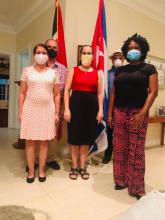
 Port of Spain, October 6th 2020.
Statement by Bruno Rodríguez Parrilla, minister of Foreign Affairs of the Republic of Cuba, at the United Nations General Assembly high-level meeting to commemorate and promote the International Day for the total elimination of nuclear weapons. October 2,

“The total elimination of nuclear weapons should be the top priority in the area of disarmament”. Mr. Secretary General; Mr. President; Distinguished delegates: It is appalling to realize that, seventy five years after the criminal bombings of Hiroshima and Nagasaki, there are approximately 13 400 nuclear weapons, of which nearly 1 800 are in operational alert and 3 720 have been already deployed. More than of these belong to the United States.
The United States strengthens its campaign against Cuba’s International Medical Cooperation.
- DECLARATION OF THE MINISTRY OF FOREIGN AFFAIRS OF CUBA
The Cuban people and the international community are aware of the dishonest campaign that the government of the United States has launched since 2019 to discredit Cuba’s international medical cooperation; exert pressure on the governments that have asked for it and deprive peoples of these health services.