
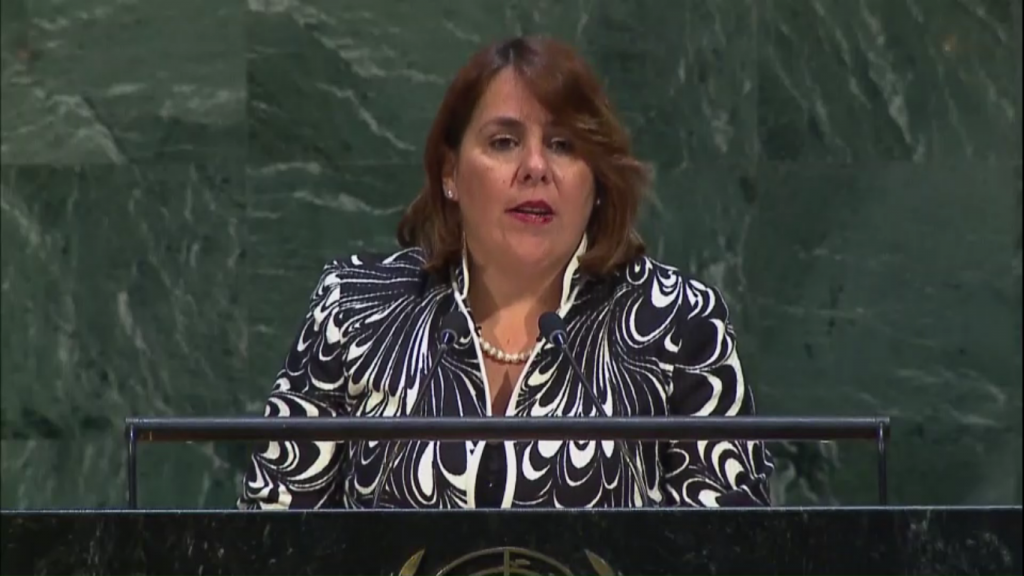
Mr. Chairman,
First of all, we would like to acknowledge your commitment, in your capacity as President of the General Assembly, to the Security Council reform process.
We take this opportunity to assure Ambassadors Kaha Imnadze and Lana Nussseibeh, Permanent Representatives of Georgia and the United Arab Emirates, respectively, of the full cooperation of Cuba to make progress in our work.
We recognize the efforts made by the Co-chairs during the previous session, the Permanent Representatives of Romania and Tunisia.
Mr. Chairman,
All delegations are aware that the issue of the increase in the membership of the Security Council and other matters such as its working methods, under different denominations of consultations, exchanges and now more recently as intergovernmental negotiations, now exceed 25 years.
Some results have been preliminarily achieved recently, but let's say it clearly, they have been extremely limited results, which do not address the fundamental issues, on which there are still wide differences.
If a profound negotiating effort is not made on key issues, we can return to this Assembly after another 25 years without satisfactory results.
Mr. Chairman,
The Security Council reform process must be carried out in a comprehensive manner, including all substantive matters, among them the question of membership, regional representation, its agenda, its working methods and the decision-making process, including the issue of veto, and must be carried out in such a way that it ensures the widest possible acceptance by Member States.
The reform must ensure that the Council's agenda reflects the needs and interests of both developing and developed countries, with a rational, non-selective objective and in non-arbitrary manner.
On the regional representation, the expanding size of the Security Council and the categories of membership.
As we have stated before, Cuba attaches great importance to the issue of regional representation, since the current composition of the Security Council does not reflect geopolitical realities and therefore, it needs to be rebalanced. There is no doubt that developing countries are underrepresented in the Council. This fact undermines the interests of the Council, its authority and credibility.
Pursuant to the above, the main objective of the expansion of the Council must be to rectify the insufficient representation of developing countries of Africa, Asia and Latin America.
Mr. Chairman,
The numeric expression of the expansion, following the criterion of the categories, in the opinion of the Cuban delegation, should represent an increase of new permanent members of two countries of Africa, two developing countries of Asia and two countries of Latin America and the Caribbean.
We consider that the expansion regarding non-permanent members should be extended to a total of at least 15 members.
The new permanent members must have exactly the same prerogatives and rights as the current ones, without establishing selective or discriminatory criteria. Cuba declares itself to be in favor of the elimination of the obsolete and undemocratic right to veto. If it is not removed immediately, the new permanent members must also have that prerogative.
If the category of the representation of developed and developing countries in the Council is not expanded; the Council would be even less representative, and therefore, less legitimate and effective.
Cuba does not favor the creation of new categories or sub-categories of members. The new categories would increase the existing differences and stimulate division among the members of the Security Council, instead of contributing to its better functioning.
Cuba considers an extended Council should amount to no less than 26 members. Only with that figure, the proportion between the number of members of the Security Council and of the Member States of the UN would at least get closer to the proportion existing when the Organization was founded.
Cuba will neither support a partial or selective expansion, nor an increase in the composition of the members of the Council to the detriment of developing countries.
Regarding the working methods of the Council:
Regarding the presentation of the annual report of the Council to the General Assembly, Cuba regrets that this report remains basically a descriptive document of the meetings, activities and decisions of the Council, when the great majority of the Member States of the United Nations have reiterated the need of the submission of a comprehensive and analytical annual report on the work of this body.
We reiterate that the Security Council, in carrying out its functions imposed by its primary responsibility for the maintenance of international peace and security under the Charter of the United Nations, acts on behalf of all Member States, and therefore, it must comply with the obligation established in Articles 15 and 24 of the UN Charter, to submit special reports on its actions for the consideration of the General Assembly.
Mr. Chairman,
Cuba reiterates its concern over the lack of transparency and democracy of the Security Council.
Although in the most recent period there was an increase in the number of public meetings and an unprecedented process of consultations and exchanges with the Member States during the selection and appointment process of the Secretary General, it continues the Council's trend to work mainly in closed formats and to make decisions without addressing the concerns of non-permanent members. At present, the Security Council is neither transparent, nor democratic, nor representative.
Urgent changes are required in its working methods that allow all its members to truly participate in its work and in the decision-making process. This includes the formalization of its rules, which continue to be provisional after more than 70 years.
In this regard, Cuba proposes once again that closed-door consultations in the Security Council should be the exception.
Mr. Chairman,
In addition to a change in the working methods and the composition of the members of the Security Council, this body must adjust its functions to the mandate established in the Charter and respect all the resolutions of the General Assembly, the main deliberative, policymaking and representative organ of the United Nations.
The trend of the Security Council to consider issues and assume functions that are not within its purview, thereby usurping the role conferred to other bodies, particularly the General Assembly, must end. We underline the need to achieve an adequate balance among the main bodies of the United Nations, in accordance with the Charter.
A reform of the United Nations Organization, such as the one currently being promoted by the Secretary General, will not be effective or real, without an in-depth reform process of the Security Council. A truly transparent, representative, democratic and efficient body is urgently needed.
Thank you very much