
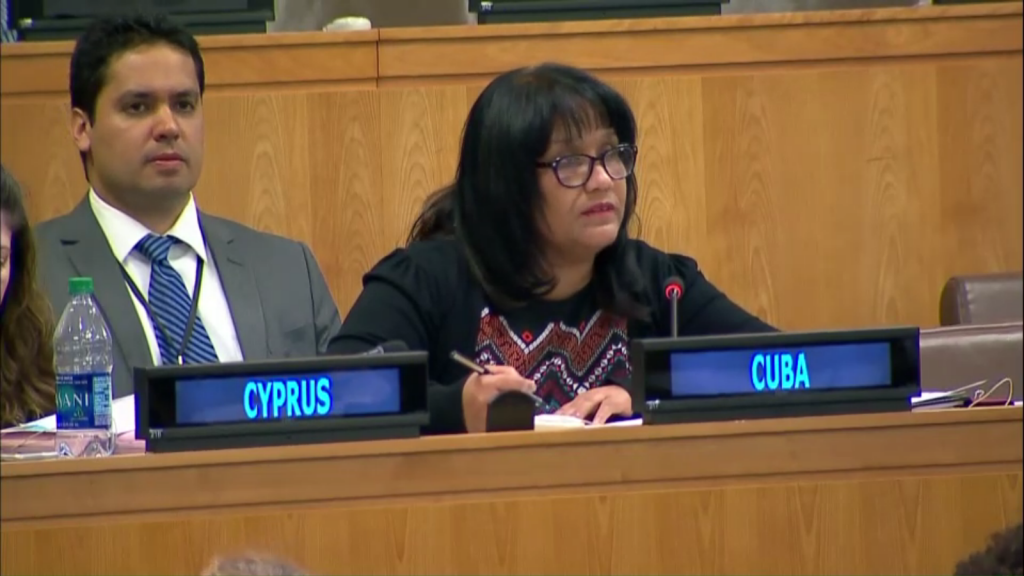
Mr. Chairman,
Cuba endorses the statement delivered by Ecuador, on behalf of the G-77 and China.
We stress the full validity of the Copenhagen Declaration and Program of Action on Social Development, in which we agreed that eradicating poverty was the main pathway for development. Twenty years after its adoption, some progress has been achieved in reducing poverty. However, many of these results have been uneven and have not brought us yet closer to succeeding in the fight against hunger, poverty and social exclusion, as indicated in the Secretary-General´s reports on this agenda item.
In Copenhagen we also undertook to put the man at the center of development. However, it is shameful that two decades later, 700 million people are living in extreme poverty, 758 million adults are illiterate, 815 million people are suffering from chronic hunger, and millions of children die from preventable and curable diseases
The eradication of poverty, the promotion of full employment and social integration are three pillars for achieving social development. We emphasize the need to implement public policies that foster these pillars, considering the fundamental role of States on this matter, in coordination with other actors.
It is therefore outrageous that 1.7 billion dollars are invested annually in military expenditures, while there is a lack of compliance with the Official Development Aid commitments, as well as new, predictable and sufficient financial resources to promote genuine international cooperation, without any political conditions and clearly oriented to addressing the serious problems facing humanity.
Mr. Chairman,
Cuba advances towards attaining the Sustainable Development Goals with the moral strength of having fulfilled the Millennium Development Goals and the satisfaction of having provided cooperation to other developing countries in a number of sectors, which we will continue to do to the extent of our modest possibilities. During these five decades, 325 000 Cuban health workers have provided assistance to 158 nations of the South, including 39 African countries, where 76 000 collaborators have worked. Additionally, some 38 000 doctors from 121 countries, 3 392 of them from 45 African nations, have received free education in Cuba; all of this without any exclusions or conditions.
Moreover, Cuba reached an infant mortality rate of 4.1 per thousand live births at the end of the first semester of 2017, indicator that demonstrates the comprehensive social development of the nation. Our life expectancy at birth is 78 years. In 2015, we were the first country to validate the Elimination of Mother-to-Child Transmission of HIV-AIDS and congenital syphilis, whose goals demanded highly-organized and quality sexual and reproductive health services.
In our country there are no illiterates, and we have a universal, accessible and free health care system for the entire population. Likewise, our vaccination program encompasses thirteen diseases with coverage of 100% of our children. More than two thirds of the state budget is allocated to raise levels of education, health, social security and assistance, culture, sports, scientific and technical research, among other sectors.
Estimates show that by 2030 in Cuba there will be 3.3 million people aged 60 and over. Therefore, care for the elderly has become a priority in our country, carrying out a multidisciplinary and cross-sector work to ensure the quality of life of this segment of the population.
Cuba has devised a Youth Policy highly focused on social benefit, which exalts the youth and places them at the center of its transformative dynamics. This policy enables the involvement of young people in the processes of discussion and decision-making on political, economic and social issues in Cuba, and ensures their representation in the major structures of the Government, Parliament and other decision-making settings in the country. It also fosters technical and vocational training of young people, facilitates their work insertion and ensures their social integration.
From 1995 to date, three National Action Plans have been implemented in Cuba for the Care of Persons with Disabilities. These plans are a group of strategies, actions, proposals and programs targeted at social integration and raising the quality of life of this population group, from a multi-sector and coordinated approach.
In terms of family-related matters, in Cuba at present there are 173 Women and Family Counseling Centers, with a focus on the family environment under a philosophy based on guidance and reflection, offering alternatives and strategies to cope with family conflicts and providing citizens with tools for human and social growth. These Centers are basically aimed at helping the family in the changes required within social processes, under the principle of respect for its reality.
Mr. Chairman,
All these results have been achieved despite the existence of the economic, commercial and financial blockade imposed by the United States against Cuba for more than half a century and which the current US administration has decided to strengthen. This criminal policy causes damage and deprivation to the Cuban people, is the major obstacle to the development of our country, affects other nations due to its extraterritorial scope and continues to harm the interests of US citizens and companies.
Mr. Chairman,
From our own experience, we believe that only giving due priority to social development, as the center of our public policies and strongly committing to the solidarity and genuine cooperation among all countries, we will ensure that the social development goals of the 2030 Agenda gain real content and have a positive and concrete impact on the lives of millions of human beings, for whom a dignified life and access to basic services and opportunities remain a chimera.
We reiterate that we will never renounce dignity, human solidarity and social justice, which are profound convictions of our socialist society. We will continue to share, to the extent of our ability, the human capital created by the Revolution and the best experiences we have.
Thank you very much.