
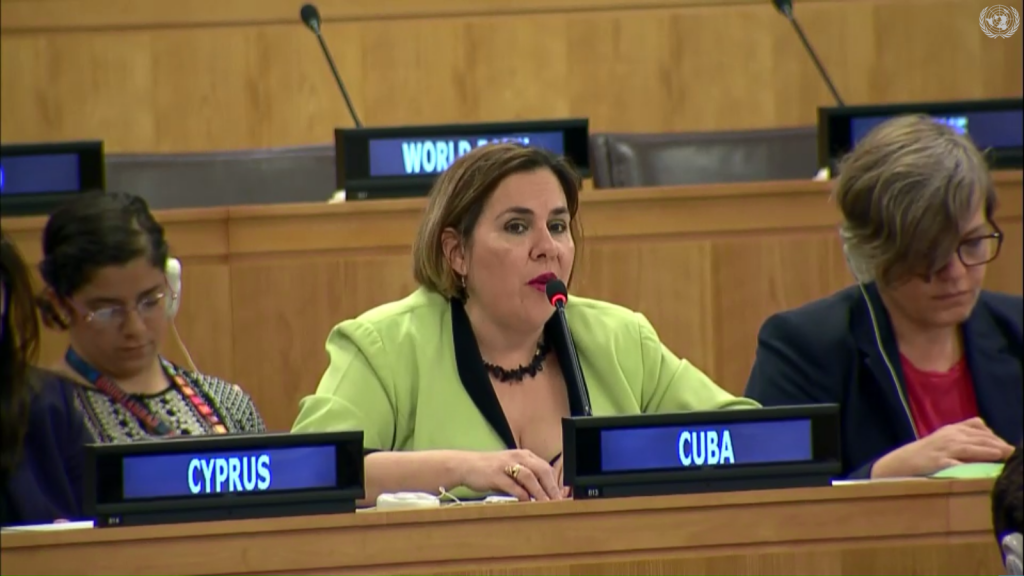
Mr. Chairman,
Allow me to convey our delegation's appreciation for your work in presiding over the work of this Committee throughout this session, as well as to the remaining members of the Bureau. I reiterate the cooperation of the Cuban delegation in order to bring our work to a successful conclusion.
I also thank Ms. Jan Beagle, Under-Secretary-General for Management, for her presentation on the financial situation of the Organization. We further extend our appreciation to Mr. Lionel Berridge and the Contributions Department for their continuing support to Member States on the issue before us today.
My delegation associates itself with the statement made by Egypt on behalf of the Group of 77 and China.
Mr. Chairman,
The financial resources earmarked for the implementation of the activities and proper management of the United Nations are increasingly reduced every year, not only in terms of regular budget but also in peacekeeping operations. We agree that efficiency and accountability are parameters needed for the proper functioning of the Organization. However, doing more with less may jeopardize the fulfillment of the mandates that we have collectively agreed in order to achieve the goals of the United Nations.
We want a United Nations ready to act in an ever-changing world increasingly threatened by the multi-systemic crises that have been consolidating for decades. In response, most Member States have committed to the Secretary-General's reform proposal in various areas. However, several have already suggested that we must undertake this task, which is still uncertain, with fewer resources than we had just a year ago.
With regard to what has been observed in our substantive session, we can only say that the situation regarding payment to the budgets of the International Tribunals remains positive. However, we regret that even with the adoption of a regular budget for the biennium 2018-2019, which was substantially reduced by more than $200 million on April 30, four months after the commencement of its implementation, $1,561 billion remains to be paid. Something similar occurs with peacekeeping operations, where $2.27 billion are pending payment in 2018, even when in a similar session in 2017, the budget for these vital operations had been reduced by some $600 million.
Mr. Chairman,
We welcome the fact that the number of Member States that have fully met their financial obligations has increased. This shows the commitment to the Organization, not just in words but in action. In this vein, we wish to highlight the efforts of many countries, in particular developing countries, which are most severely affected by the complex current economic and financial situation, to meet their payment obligations. The special situations experienced by certain developing countries, preventing them from meeting their financial commitments, beyond their political will, is also an element to consider when addressing this issue.
However, we cannot fail to reiterate our concern that to date 98 and 146 Member States still owe assessments to the regular budget and to peacekeeping operations, respectively. Among them, it is alarming that the largest debts of the UN budget as a whole continue to be concentrated in the same Member State, the State which benefits most from the main distortion in the calculation of the scale of assessments and makes outrageous profits by hosting this Organization in its territory, subjecting it to constant financial blackmail.
Mr. Chairman,
Cuba is grateful for the recognition that we have received from 42 other countries for having complied with all our financial obligations to the Organization. We are just fulfilling our duty. At the same time, we emphasize that it is a goal that is achieved with great effort. Fifty-six years after its imposition, the economic, commercial and financial blockade imposed by the United States against the Cuban people remains in force and continues to be hardened. This is a unilateral policy, in violation of the rules and principles of International Law and the Charter of the United Nations, which affects and hinders the payment of our assessed contributions to the Organization and other international bodies. Despite this siege that seeks to isolate us, Cuba remains firm in its commitment to multilateralism, which is manifested not only in its active participation in the work of the United Nations, but also in its political will to fulfill its financial obligations.
Thank you very much.