
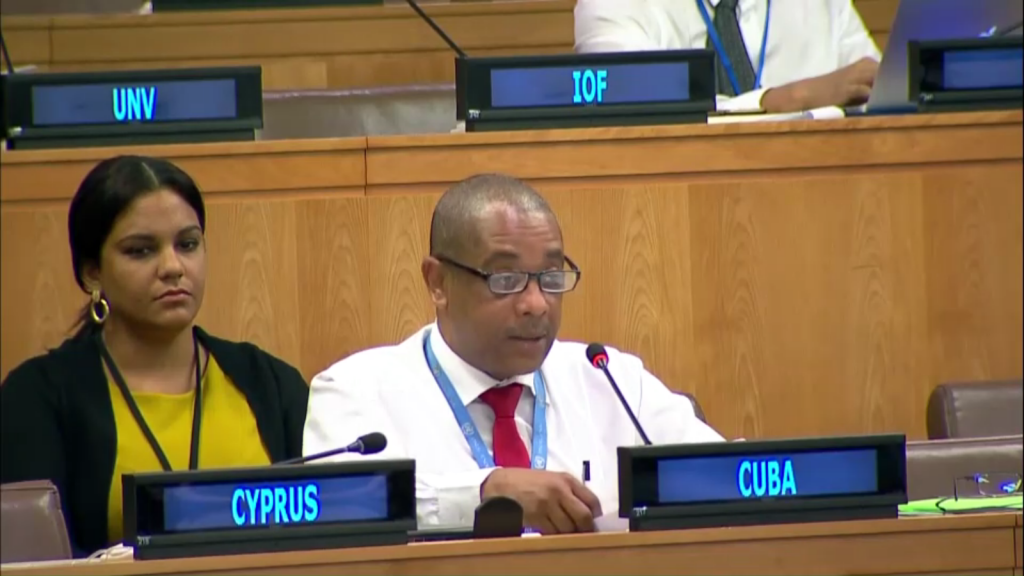
Madam Chair,
Cuba endorses the statement made by El Salvador on behalf of the Community of Latin American and Caribbean States (CELAC).
Indigenous peoples have historically been subjected to serious violations of their rights, to brutal discrimination practices, plundering of resources and genocide.
As recognized in the Report of the Special Rapporteur of the Human Rights Council on the Rights of Indigenous Peoples, these peoples have been deprived of their lands and resources, they have been subjected to any form of assimilation or forced integration; they have been stripped of cultural, intellectual or religious property; they have been deprived of their livelihood as well as of the development, use or exploitation of their mineral, water or other resources.
It should be recognized that progress has been made in the implementation of the United Nations Declaration on the Rights of Indigenous Peoples, particularly with regard to a broader understanding of this Instrument at the international level; progress has been made in enacting legislation aimed at providing greater social protection to native communities and some countries have implemented measures aimed at protecting the right of indigenous communities to maintain their own institutions, cultural identity and spiritual traditions.
However, ten years after the adoption of the Declaration, many native communities worldwide still face situations of violence, racism, marginalization, major economic and social disadvantages, extreme poverty and the dispossession of their lands.
The Special Rapporteur's report recognizes this when it notes that progress in the implementation of the Declaration has been limited.
Madam Chair,
All cultures have the right to preserve the traditional practices inherent to their identity. In this regard, we reaffirm the right of indigenous peoples to preserve their own institutions and spiritual traditions without discrimination.
We reiterate our support for the right of the Plurinational State of Bolivia to defend and protect coca leaf chewing as a tradition of their native communities. Bolivia is an example for the world in promoting and protecting the rights of its native communities. The Political Constitution of that State is one of the most complete documents on the recognition of the rights of indigenous peoples, including their right to self-determination and self-government, which has been recognized by the United Nations through the Permanent Forum on Indigenous Issues.
Cuba supports actions aimed at harmonizing conservation policies of protected areas with respect for the ancestral values of indigenous peoples.
Measures must be taken to protect the rights to the traditional and ancestral knowledge of native communities and to prevent such knowledge from being violated by third parties through records failing to recognize their ownership. We advocate for the promotion of fair and equitable participation of indigenous peoples in the benefits derived from the use of their knowledge.
Cuba reaffirms its strong support for the just claims of indigenous peoples and urges the international community to show greater political will to promote concrete actions to materialize such claims, as well as the enjoyment by these communities of all their economic, social, cultural, civil and political rights.
Thank you very much.