
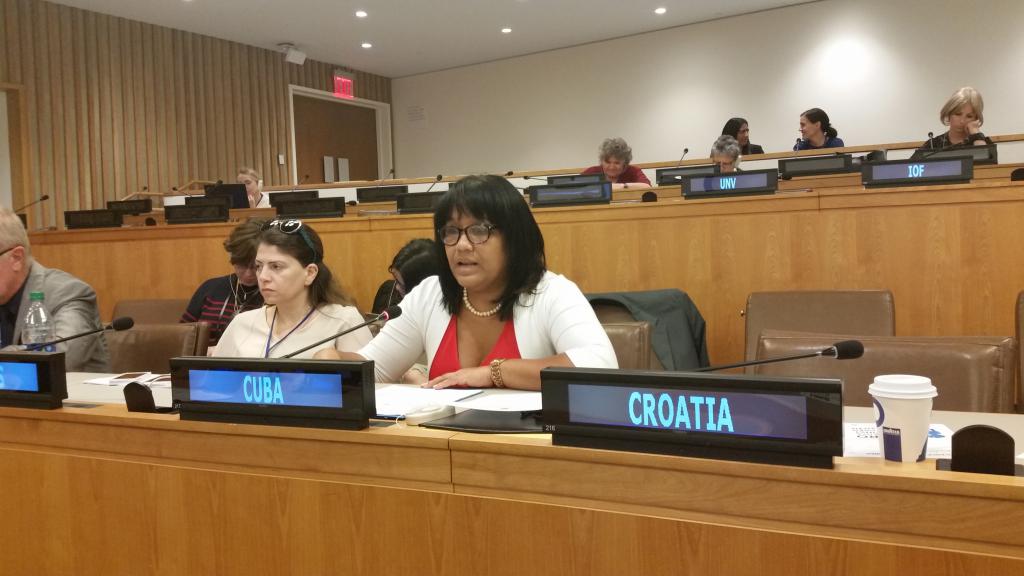
Mr. Chairman,
My delegation endorses the statement of El Salvador on behalf of the Latin American and Caribbean States.
Cuba ratifies its support for the agreements of the World Summit for Children, including the need to allocate more resources to solve the problems that most affect children and adolescents.
While progress has been achieved in upholding the rights of boys and girls, regrettably these have been unequally distributed due to wealth divide and polarization between the North and the South.
The ills afflicting children cannot be overcome without a just and equitable international order, that eradicates poverty and hunger, ends war conflicts, favors human beings over capital and preserves the environment.
The existing international economic order, if sustained, by the year 2030 will cause extreme poverty to 167 million children; 69 million children under the age of five years will have died from curable diseases; 60 million school-age children will remain deprived from education; some 3.6 million children under five years of age will die that year alone, and a total of 69 million will have died between 2016 and 2030.
With current trends, the prospects for universal achievement of the 2030 goals for neonatal health and survival of children under the age of 5 are gloomy.
Mr. Chairman,
Given the political will and efforts of the Cuban government, the promotion and protection of the rights of girls, boys and adolescents is a major priority issue. Cuba is a State Party to the Convention on the Rights of the Child since 1991 and is consistent with its letter and spirit.
The policies, actions and programs for children and adolescents began to be implemented since the triumph of the Cuban Revolution in 1959, more than 30 years ahead of the Convention itself. Therefore, today hunger, illiteracy, insalubrity and discrimination against boys and girls in Cuba are just bad memories.
These achievements are the result of the free and universal national health care and education systems at all levels, which are key mainstays in materializing this priority. More than 50% of the state budget is allocated for health, education and social assistance.
Cuba ended the year 2016 with an infant mortality rate of 4.3 per thousand live births and closed the first semester of 2017 with 4.1 per thousand live births. All Cuban children are vaccinated at birth against 13 communicable diseases and the early detection of congenital diseases is a priority. Likewise, Cuba was the first country to receive validation from the World Health Organization for eliminating mother-to-child transmission of HIV/AIDS and syphilis.
All these achievements have been attained by the Cuban people despite the severe impact of the genocidal economic, financial and commercial blockade imposed by the United States against Cuba for more than half a century.
Mr. Chairman,
The worst form of violence against boys and girls is denying their right to life, to a safe world, to health, food, education, culture and healthy forms of recreation. International cooperation and solidarity are therefore critical to eradicate this and all forms of violence and to achieve the full realization of the rights of girls and boys. The General Assembly must continue to play a fundamental role in the United Nations to promote these rights.
Thank you very much.
Permanent Mission of Cuba to the United Nations.