
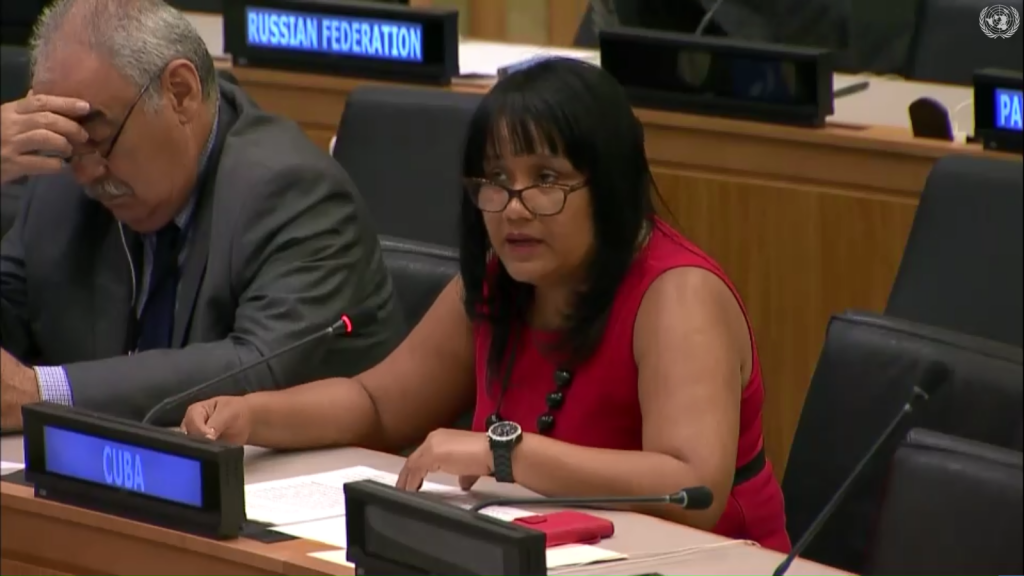
Mr. Chairman,
On behalf of the Cuban delegation, we welcome His Excellency Mr. Jorge Faurie, Minister of Foreign Affairs and Worship of the Argentine Republic to the Decolonization Committee, as well as the delegation of the Argentine Congress accompanying him.
The number of resolutions adopted on the subject in this Committee has now reached 33, in addition to the 10 resolutions adopted by the General Assembly since the adoption of resolution 2065 (XX) a little over 50 years ago. This shows that the question of the Malvinas Islands is an issue to which the international community has attached continuing importance within the framework of the UN.
Resolution 2065 is clear. It defines the question of the Malvinas Islands as a dispute concerning the sovereignty over the islands between the Argentine Republic and the United Kingdom of Great Britain and Northern Ireland, and provides that such a dispute must be resolved through negotiations between the two States, taking into account the fundamental provisions and objectives of the Charter of the United Nations and General Assembly Resolution 1514 (XV).
Mr. Chairman,
Cuba reiterates its unrestricted support for the legitimate right of the Argentine Republic in the sovereignty dispute over the Malvinas Islands, which constitute part of the national territory of that brotherly Latin American country. The Malvinas are and will remain Argentinean.
Support for the legitimate rights of the Republic of Argentina in the sovereignty dispute over the Malvinas Islands, South Georgias and the South Sandwich Islands and the surrounding maritime areas has also been reiterated in various forums at the highest level in our region, including the Community of Latin American and Caribbean States (CELAC), among other numerous regional groups that have called for the resumption of negotiations aimed at finding, as soon as possible, a peaceful solution to the existing dispute.
Mr. Chairman,
Latin America and the Caribbean is a Zone of Peace. This was endorsed in the "Proclamation of Latin America and the Caribbean as a Zone of Peace", adopted by the II CELAC Summit in Havana, Cuba, in January 2014.
Carrying out military exercises in the geographical areas of the Malvinas Islands runs counter to that Proclamation and to the pacifist vocation expressed thereof by the 33 Latin American and Caribbean nations. At the same time, it infringes on Argentina's sovereign rights and contravenes resolutions adopted by international forums, including the United Nations.
We reiterate once again the call for a negotiated, just and definitive solution to the question of the Malvinas Islands in the shortest possible time, taking into account both respect for the territorial integrity of Argentina.
This requires dialogue and cooperation between the parties. We note that some steps have been taken to creating and building confidence measures that can certainly contribute to a less tense bilateral environment between the two sides.
In that regard, we welcome the fact that both Governments, with the collaboration of the International Committee of the Red Cross, conducted the identification of the Argentine soldiers buried in Darwin Cemetery. Likewise, we recognize the steps taken by both parties to implement an additional flight to the existing weekly frequency and the start of scientific cooperation on fisheries.
While all this is important, we must recognize that negotiations on the fundamental issue of sovereignty have not yet begun.
We once again call upon the United Kingdom of Great Britain and Northern Ireland to respond positively to the willingness reiterated by the Argentine Republic to resume a bilateral negotiation process, with the aim of resolving the sovereignty dispute in a just, peaceful and definitive manner as soon as practicable.
Mr. Chairman,
It is incumbent upon our Special Committee, in carrying out its mandate, to make every effort to ensure that negotiations between the Governments of Argentina and the United Kingdom take place. We should also reiterate the request to the Secretary-General to exercise his good offices with the aim of assisting the parties in fulfilling the mandate of the General Assembly.
Cuba, as a member of CELAC and in accordance with the inalienable principles of its foreign policy, will continue to work within the framework of international law, in particular United Nations General Assembly resolution 1514 (XV), to ensure that the Latin American and Caribbean region is a territory free of colonialism and colonies.
Thank you very much.