
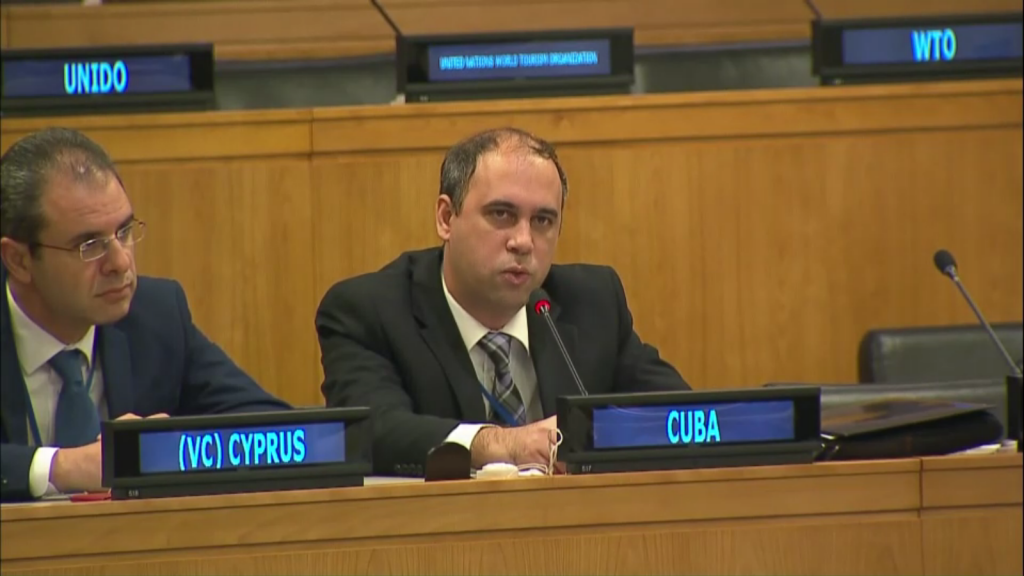
Mr. Chairman,
Macroeconomic policy questions are one of the core objectives of this Committee's work and one of the areas in which we must continue to strengthen the central role of the General Assembly in the intergovernmental deliberation on these issues.
For many decades, the aspiration of developing countries has been to achieve a fairer, non-discriminatory international order enabling growth and development for all and to narrow the gaps between developed and developing countries. Today, however, for the vast majority of countries in the South, the international environment remains an obstacle for further development possibilities
Structural changes in the economic, commercial and international financial level are urgent if we want to truly put an end to the underdevelopment of our peoples. We must move decisively towards greater representation, equity and transparency of developing countries in the mechanisms of global economic governance.
The fulfillment of the 2030 Agenda and the Addis Ababa Agenda will only be possible if there are firm commitments and a greater political will to mobilize additional, predictable and unconditional resources for developing countries to meet their development goals. International public financial flows are insufficient to cover funding gaps in developing countries. Many developed nations do not even fulfill their commitments to provide 0.7% of their GDP as Official Development Assistance.
Mr. Chairman,
We support external debt relief, including the cancelation and restructuring of the debt of the countries of the South, particularly the poorest and neediest countries. We must move decisively towards the implementation of a multilateral sovereign debt restructuring mechanism enabling a fair, balanced and development-oriented treatment.
There is a need to build a new international financial architecture that guarantees greater stability and less conditionality, volatility and speculation of financial flows to developing countries. Functioning and governance mechanisms in the main International Financial Institutions must be changed in order to achieve a fair representation, participation and decision-making capacity of developing countries in such institutions.
We must achieve a universal, rule-based, open, transparent, inclusive and non-discriminatory multilateral trading system that guarantees special and differential treatment for all developing countries.
We must reject discriminatory and protectionist trade practices that hinder our countries' development efforts.
We reject the promulgation and implementation of unilateral coercive economic measures as a means of exerting political and economic pressure on developing countries, contrary to international law and the Charter of the United Nations, and which impede the full realization of our rights, including right to development, as well as the fulfilling of the 2030 Agenda.
For almost sixty years, an economic, commercial and financial blockade has been imposed to Cuba, which causes deprivations to the Cuban people and constitutes the main obstacle to the country's development, to the achievement of its macroeconomic policy objectives and, consequently, to the implementation of the 2030 Agenda.
The right to development of Cubans is limited by the negative effects of the blockade, whose economic damages amount to
822,280,000,000 dollars. This prevents my country from accessing the best technologies on an equal basis, from normally establishing trade, financing or investment relations with the world, from maintaining normal relations with international financial institutions, companies from other countries and in particular with the world’s top economy, the US economy. We cannot speak in the abstract of globalization and interdependence without recognizing that reality.
Mr. Chairman,
Without urgent, deep and comprehensive actions on macroeconomic matters, we will not be able to overcome the most pressing problems of our time: poverty, hunger, inequality and marginalization of billions of people, especially in developing countries.
I conclude by reiterating Cuba's commitment to seek common solutions to global macroeconomic challenges, a task in which this Commission should continue to strengthen its core role.
Thank you very much