
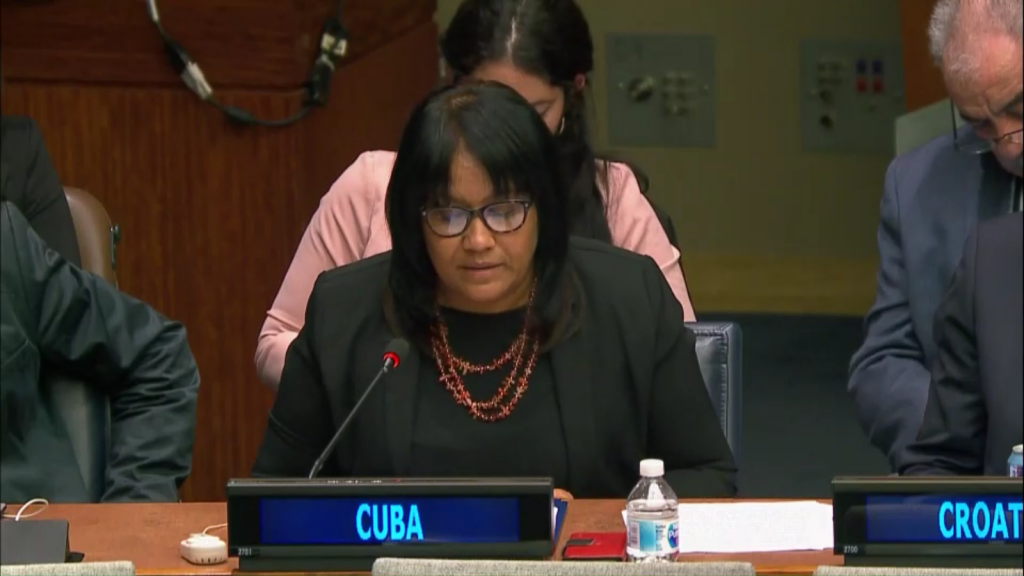
Mr. President,
My delegation endorses the statement delivered by the delegations of El Salvador and Ecuador on behalf of the Latin American and Caribbean States (CELAC) and the Group of 77 and China, respectively.
We seize the opportunity to welcome Ms.Alison Smale, Under-Secretary-General for Global Communication, wishing her success with her new role.
Mr. President,
The so called Information Society has demonstrated the importance of this resource as a strategic and key factor for development.
Many affirm that information is power. Today, we reaffirm that this power will only have a positive impact on society if there is equitable global access to information and knowledge for sustainable development.
Information and Communication Technologies have provided new spaces for managing and disseminating information. At the same time, these technologies have stressed the persisting digital divide between developed and developing countries.
According to the report submitted by the Secretary-General in February 2017 on Progress made in the implementation of and follow-up to the outcomes of the World Summit on the Information Society at the regional and international levels, ITU estimates for 2016 show that in developed countries there were 90 mobile broadband subscribers per 100 inhabitants, compared to 41 in developing countries and less than 20 in the least developed countries (LDCs).
In addition to this, the proportion of households with Internet access amounted to 84% in Europe, but only 15% in Sub-Saharan Africa. Moreover, broadband speed in developed countries is far above that in developing countries, whereas the cost of access is usually lower in relation to the average income of households.
In this regard, we reiterate that the infrastructure needed to access information is not sufficient. Society, likewise, must have the skills and competences required to access, manage and make decisions on information. This is what we call Information Literacy.
Mr. President,
Cuba, a developing country, has been able to develop information-related skills and knowledge, through the information and communication technologies. This has been the result of the curricula implemented in our country at all educational levels, as well as of the ongoing process of Computerization of the Society. All of that demonstrates the strong determination of the Cuban Government to develop a well-rounded society capable of facing up the current demands of the Information Society.
However, these efforts are undermined by the unjust economic, commercial and financial blockade imposed by the United States against Cuba for more than 5 decades. Last year only, damages to the communications and computing sector amounted to 68,922,110 dollars.
This deprives the Cuban people of access to the necessary technological infrastructure for health, education and biotechnology, just to set a few examples.
The Cuban people demand the immediate and unconditional lifting of the blockade, while urging the cessation of the radio electronic aggressions of the United States against our country. During 2016, on average, 1875 hours per week were illegally transmitted through 24 frequencies from the United States territory against Cuba. As of July 2017, illegal transmissions averaged 1890 hours on an equal number of frequencies.
We reiterate that the use of information and communication technologies must be fully consistent with the purposes and principles of the Charter of the United Nations and International Law, particularly the principles of sovereignty, non-interference in internal affairs and internationally recognized standards of civil coexistence amongst States.
Mr. President,
To ensure the fulfillment of the mandate of this multilateral Organization, outreach efforts are a key vehicle for society to understand and know our work.
We welcome the report submitted by the Secretary-General on this issue, which reflects the work carried out by the Department of Public Information between March and September 2017, through its three subprograms: strategic communications services, news services and knowledge dissemination and broadcasting.
We are pleased with the increasing number of users who consult content in Spanish, our official language. As the report indicates, Spanish is the second most visited site, with about 4.3 million single users, equivalent to more than a quarter of the total audience.
We recognize the important work carried out by the network of United Nations information centers, which, with limited resources, are making significant efforts to fulfill their mandate.
We also acknowledge the extensive work of the Department of Public Information during the period and urge them to continue their outreach activities to provide the audience with accurate, impartial, comprehensive, balanced, timely, relevant and multilingual information on United Nations tasks and obligations in order to strengthen international support for the activities of the Organization in complete transparency, as set out in its mandate.
We reaffirm the importance of considering the information realities and contexts of each audience in developing any communication and information strategies.
The message delivered by the United Nations must be accessible to all. The use of new information and communication technologies is important. However, the most conventional forms of dissemination of information should not be overlooked; hence the importance that the traditional media of the Organization is preserved.
The report submitted by the Secretary-General demonstrates the outreach work of the Department of Public Information on the question of Palestine. More than 50 years after the adoption by the General Assembly of resolution 1514 (XV), which resulted in the Declaration on the Granting of Independence to Colonial Countries and Peoples, and 50 years after the occupation of Palestinian lands, promoting the eradication of colonialism and other forms of foreign occupation, and supporting the Palestinian cause, should remain a priority task in the work of the Department of Public Information, as mandated by a significant number of resolutions.
Mr. President,
We reaffirm our commitment to promoting the establishment of a new, more just and equitable world information and communication order. You can therefore count on the support of our delegation to achieve this objective.
Thank you very much