
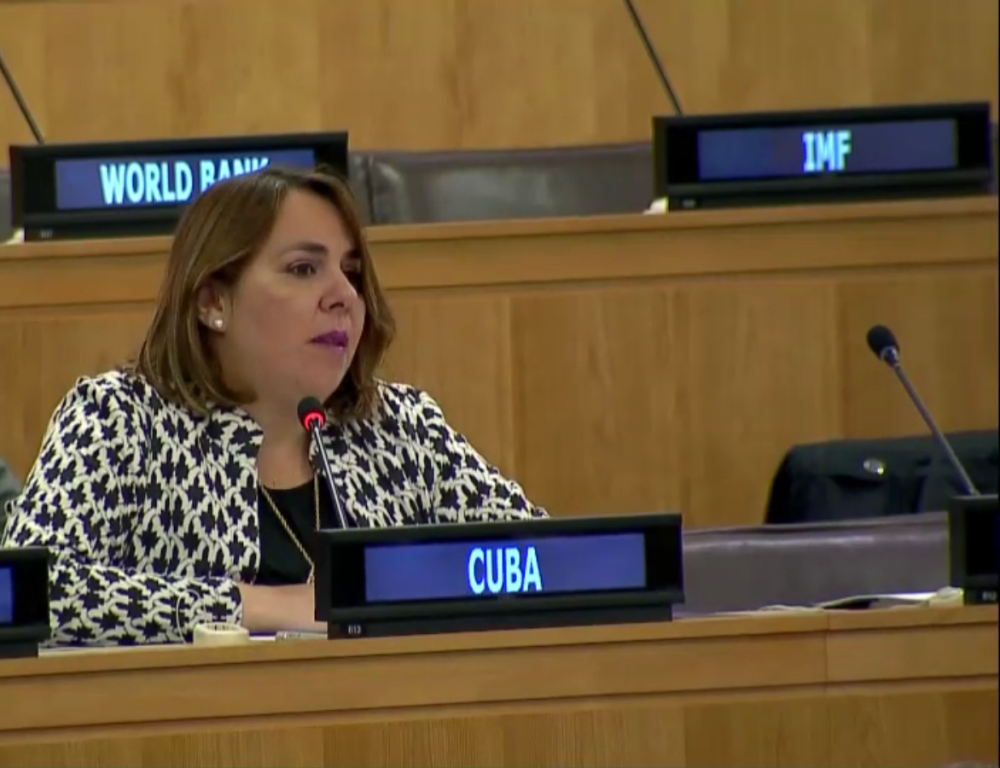
Mr. Chairman,
Cuba associates itself with the statement delivered by the Bolivarian Republic of Venezuela on behalf of the Non-Aligned Movement.
The culture of peace must be the essence of the United Nations, in order to save present and future generations from the scourge of war and to strengthen respect for the dignity and worth of the human person by all.
Achieving a culture of peace requires political will and greater commitment of all States to promote respect for life, the end to violence and the practice of non-violence through education, dialogue and cooperation. It also requires full respect for the sovereignty, self-determination of peoples, the territorial integrity and political independence of States, non-interference in their internal affairs, commitment to the peaceful settlement of conflicts, the efforts to meet development needs, the observance of the right to development and environmental protection.
A culture of peace also means condemning without hesitation all acts, methods and practices of terrorism, including State terrorism.
Mr. Chairman,
Despite the continuing international call for the achievement and strengthening of a culture of peace, there remain phenomena that hinder and undermine the real possibilities of achieving such a noble goal. These phenomena include intolerance and discrimination on ethnic, religious or racial grounds, as well as the promotion of hate speech and supremacist ideas on the pretext of the irresponsible use of freedom of expression; unilateral coercive measures; the threat and use of force contrary to the Charter of the United Nations; the promotion of regime change covert agendas in developing countries; the development of new, more lethal and sophisticated weapons; the persistence of large nuclear arsenals; or the violation by some States of the principles of international law.
Mr. Chairman,
The declaration of Latin America and the Caribbean as a Zone of Peace, adopted in 2014 in Havana within the framework of the II Summit of the Community of Latin American and Caribbean States (CELAC), is a demonstration of our region's commitment to strengthening peace and negotiated solutions to conflicts and differences, and a contribution to a global culture of peace. We therefore further reaffirm its full relevance and validity.
Thank you very much.