
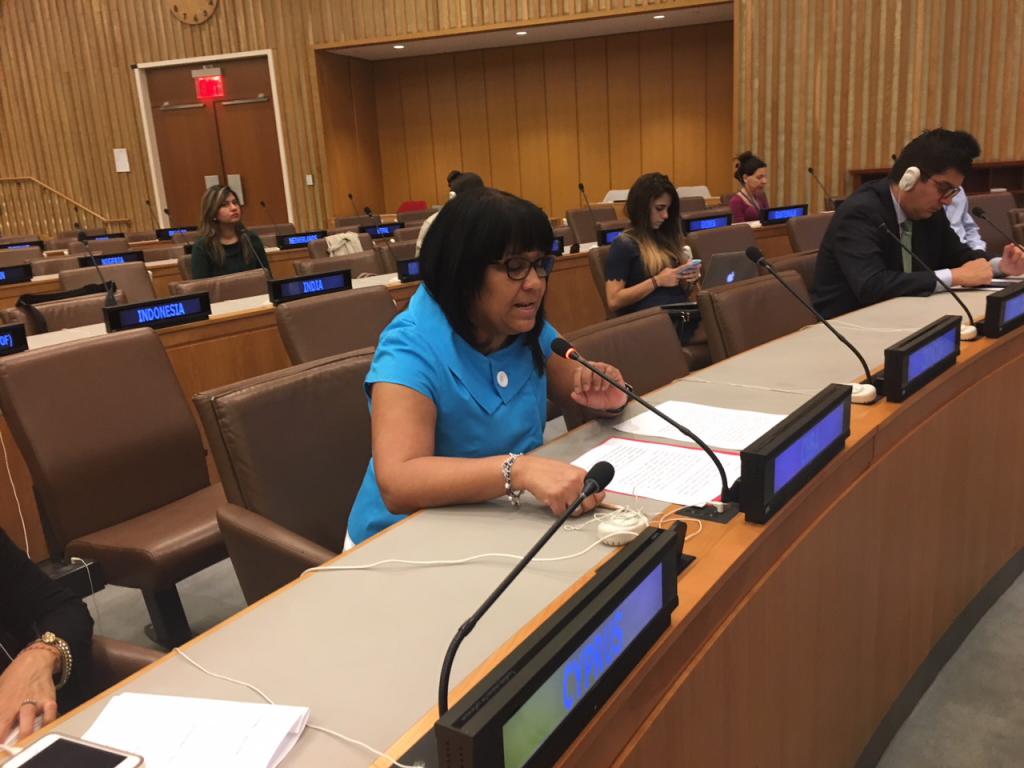
Mr. Chairman,
We reiterate our congratulations on your appointment to conduct the work of the Committee, which we extend to the other members of the Bureau. We wish them success in performing their responsibilities and assure them our cooperation.
Our delegation associates itself with the statements made by Egypt on behalf of the Group of 77 and China, El Salvador on behalf of the Community of Latin American and Caribbean States (CELAC) and Paraguay on behalf of the Group of Friends of Spanish.
We take this opportunity to express our recognition to Ms. Alison Smale, Under-Secretary-General, for her appointment as head of the Department of Global Communications and wish her a fruitful work. We appreciate her statement on the activities undertaken by the Department of Public Information and the implementation of resolutions 72/90 A and B, adopted by the General Assembly last year.
The work of the Committee on Information, the Department of Communications and Public Information and the Information Centers is essential for the dissemination of the work of the United Nations and for promoting the Organization’s transparency and accountability. We recognize that progress has been made in different areas under the conduct of the DPI, although there is still a long way to go.
Mr. Chairman,
The use and access to Internet and the new information and communications technologies is a particularly important issue at present. Some refer to digital literacy as the basic knowledge required by the twenty-first century citizens. According to some estimates, nearly half of the current world's population is Internet users and 2.7 billion use social networks.
However, it is a regrettable reality that millions of people on the planet remain excluded from the vast resources available on the Internet. Unequal access to these technologies increases the digital divide between developed countries in the North and underdeveloped countries in the South. The already considerable lack of equity and social justice increases in this way.
According to a report by the International Fund for Agricultural Development, 842 million people are hungry and 1.2 billion people are in extreme poverty worldwide. It is derisory to think that those millions of people can even think about accessing new technologies.
On the other hand, according to UNESCO, 774 million people are illiterate in the world. If the trend persists, this figure will increase to 780 million adults and 100 million young people by 2020. It is obvious that for these millions of human beings the opportunity of Internet access is denied.
The international community must address the scourges of hunger, poverty, inequality, inequity and lack of opportunity more effectively and decisively. Within its mandate, this Committee must implement actions to allow wider social appropriation of information technologies in order to reduce technological and social gaps.
The United Nations play an essential role in this regard, by promoting objective, factual and unbiased news. Digital literacy and the new information and communications technologies are useful and important. However, this cannot make us forget or dismiss the use of traditional media, especially radio, among the thousands of poor and illiterate people who lack other forms of information.
Mr. Chairman,
The defense of multilingualism and parity in the six official languages of the United Nations is a crucial task in designing and implementing the UN dissemination and information activities.
In this regard, we express concern that press releases are not yet issued in all the official languages of the Organization. The resolutions on "Information issues" adopted at the 69th session of the UNGA have repeatedly called on the DPI to devise, as a matter of priority, a strategy to translate these releases into the six official languages.
With regard to the live webcast of the General Assembly and Security Council sessions, the Department of Public Information should continue to make efforts to broadcast the said sessions through the United Nations webcast in the six official languages, in addition to the speaker's language.
Mr. Chairman,
More than 50 years after the adoption by the General Assembly of resolution 1514 (XV), which gave way to the Declaration on the Granting of Independence to Colonial Countries and Peoples, and 50 years after the occupation of Palestinian land, the promotion of the eradication of colonialism and other forms of foreign occupation, and support for the Palestinian cause, should remain priority tasks in the work of the DPI, as mandated by a large number of resolutions. That priority is reaffirmed and becomes even more relevant in the light of current circumstances.
Mr. Chairman,
The use of information and communications technologies must be consistent with the purposes and principles of the Charter of the United Nations and international law, in particular with respect for sovereignty and non-interference in the internal affairs of States. We reiterate our strong rejection of the use of such technologies in violation of international law.
We fully endorse the statement made on behalf of CELAC, expressing concern about violations of radio frequencies and reiterating the need to use those frequencies in the public interest in accordance with the principles of international law and the Charter of the United Nations.
I wish once again to put on record before this Committee our total rejection and condemnation of the continued radio and television aggression by the United States Government against Cuba, which is contrary to the purposes and principles of the Charter of the United Nations and various provisions of the International Telecommunication Union. By means of illegal radio and television broadcasts, the Cuban radio-electric space has been under permanent attack from outside, broadcasting programmes specially designed to incite the overthrow of the constitutional order established by the Cuban people. On average, 1631 hours per week were transmitted illegally in 2017 against Cuba on 19 frequencies from the territory of the United States.
Cuba hopes that those aggressions will end. Our country further wishes the lifting of the economic, commercial and financial blockade, which has caused serious damage to the Cuban people and harmful effects in the area of information and communications, among other spheres of Cuban society.
In January 2014, on the occasion of the Second CELAC Summit held in Havana, the Latin American and Caribbean region was proclaimed a Zone of Peace, among other objectives, to foster friendly and cooperative relations among themselves and with other nations, regardless of their differences in terms of political, economic and social systems or levels of development, to practice tolerance and to live together in peace with one another as good neighbors. Stopping these illegal aggressions would mean to stop undermining the will to make our region a Zone of Peace.
Mr. Chairman,
We look forward to the Secretary-General's concrete proposals for reforming the Department of Public Information, the future Department of Global Communications.
It would be advisable, once the internal assessment work has been completed and prior to implementing substantive changes, to consult with Member States on concrete proposals for the reform of the Department, with a view to expressing our views, taking into account their future impact on the Organization's work in this area.
In like manner, we believe that the Committee on Information, as the main subsidiary body mandated to make recommendations relating to the work of the Department, should play a role in the reform process. Such reform should consider the mandates established by Member States in the resolutions adopted each year by the General Assembly on the basis of the Committee's recommendations.
Finally, we reaffirm once again the role that the Committee on Information must play in promoting the establishment of a new, more just and equitable world information and communication order aimed at strengthening peace and international understanding, as enshrined in its founding documents. We are committed to those goals and ready to work with all States to turn them into a reality.
Thank you very much