
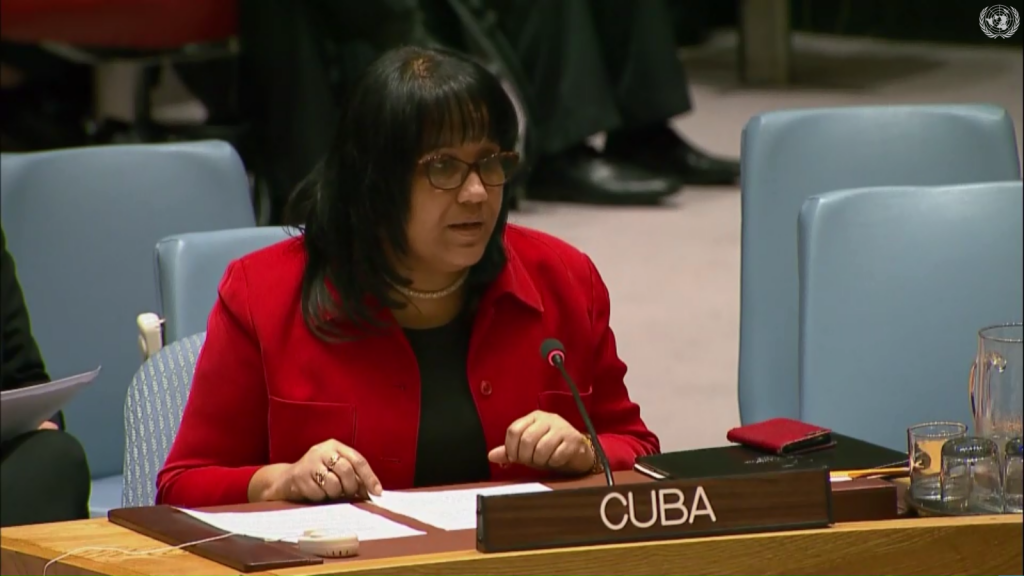
Mr. President,
Cuba fully supports the statement delivered by the representative of the Bolivarian Republic of Venezuela on behalf of the Non-Aligned Movement.
We took note of the address by the Secretary-General and the presentations of panelists, as well as the reform proposals to improve United Nations Peacekeeping Operations.
In order to improve security of peacekeeping personnel, the Secretariat should implement actions within the scope of its mandate, in consultation with Member States and due consideration of the relevant bodies.
We recall the primary role of the United Nations General Assembly in developing concepts, policies and strategies for peacekeeping operations and its Special Committee, the only UN forum mandated to address this issue. Peacekeeping ideas and approaches should only be implemented once agreed by Member States of the relevant body.
Mr. President,
In a context of increased risks to peacekeeping operations due to the current environments in which they are deployed, Cuba reaffirms that the basic principles of these operations remain extremely valid to guide the deployment of UN blue helmets.
The establishment and deployment of peacekeeping operations must be carried out in strict observance of the purposes and principles enshrined in the Charter of the United Nations, especially respect for the sovereignty, territorial integrity, political independence of States and non-intervention in their internal affairs.
It is more important than ever to respect these provisions as well as the basic principles established to carry out these operations, such as the consent of the parties, impartiality and the non-use of force, except in self-defense.
Cuba deplores the loss of life of blue helmets and expresses concern about the increased number of fatalities of peacekeeping personnel during the past year.
At the same time, we are not convinced that the adoption by the Security Council of operations that include the use of force, beyond the above-mentioned basic principles, can contribute to improving the effectiveness of peacekeeping operations and the security of their military, police or civilian personnel.
The use of force by a peacekeeping operation has political implications and may lead to unforeseen circumstances, including increased risk of threats and attacks against UN personnel.
We also wish to emphasize that peacekeeping operations, by their composition and character, are not intended or equipped for counter-terrorism operations.
We reiterate that efforts to protect civilians should be designed to support and not as a substitute for the efforts of national authorities. The protection of civilians cannot in any way become a pretext to disregard the principles of the Charter of the United Nations.
Mr. President,
Cuba believes that in order to eliminate the impact of threats on the security of peacekeeping personnel and improve their effectiveness, these operations must have realistic and viable mandates, clearly defined concrete objectives and the resources required for implementation thereof.
We call on all parties involved to give greater impetus, increase the number and even improve the functioning of triangular consultations among the Security Council, the Secretariat and troop- and/or police-contributing countries. This is an important tool, which would provide a better understanding of the situation on the ground and further assist in the design, development and renewal of mandates, as well as security for personnel.
While it is recognized that new technologies can improve the knowledge of the environment and the safety and security of personnel, legitimate concerns have been raised regarding the deployment and use of certain resources in peacekeeping operations, in particular associated with the control of the information retrieved. We therefore believe that the use of such information should be considered on a case-by-case basis with the consent of the host State.
In conclusion, we reiterate that peacekeeping operations are not a substitute for addressing and resolving the root causes of conflicts and that these should allow for the creation of a security framework to enable the implementation of a long-term strategy towards sustainable economic and social development.
Thank you very much.