
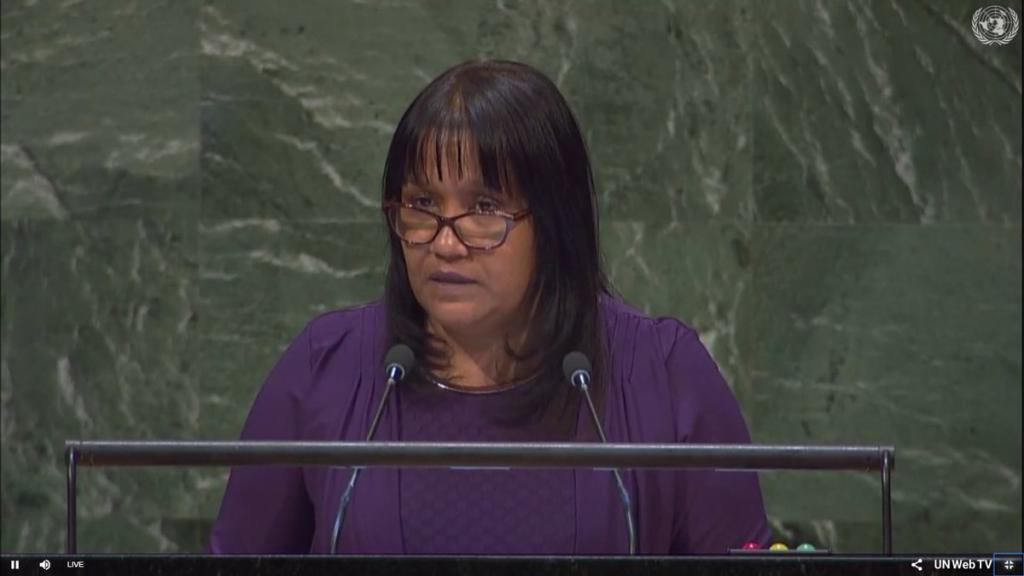
Madam President,
The Cuban delegation takes this opportunity to recognize the work done by the ambassadors of the United Arab Emirates and Georgia, who served as co-chairs of the intergovernmental negotiations process for the Security Council reform during the 72nd session.
In the first semester of the current year a total of five consultations relevant to this process were carried out, which concluded with the adoption, by consensus, of the oral decision of the President of the General Assembly that renews the mandate for the continuation of these negotiations in the 73rd session.
During the consultations, deep disagreements among the delegations were evident, not only in relation to the issues related to the five clusters, but also on the course of action regarding the negotiations.
In this context, Cuba reiterates that only through debate and negotiation, in the established time frames will it be possible to define a path towards a consensus in relation to this reform. To this end, it is essential that the five clusters on the Council reform be analyzed in a comprehensive manner and not separately, namely: category of membership, regional representation, expanding size of the Security Council and its working methods, question of veto and relationship between the Council and the General Assembly.
The update of the document on elements of commonality and issues for further consideration clearly shows that many consultations are still required to reduce the gaps among the different positions.
We reaffirm the fundamental role of the General Assembly in the Council reform. In this regard, all the proposals of the Member States should be listened to, analyzed and included in the core document of the process.
Madam President,
Current times show the importance of a true Security Council reform, which transforms it into an effective, transparent and representative organ.
An essential element of the Security Council reform is the modification of its working methods. Although documents have been approved aiming at improving such methods, including the note by the President S / 2010/507, greater efforts are needed in the search for effective formulas that guarantee the true participation of the Member States in the work and the decision-making of the Council.
Measures that do not take into account the opinions of all the members of the Council and, sometimes, not even those of all of its permanent members are frequently taken. The lack of transparency and exclusionary practices are a constant feature in the work dynamics of the organ.
The Council must adjust its functions to the mandate established in the Charter and respect the role, authority and functions of the General Assembly.
We share the concerns related to the growing tendency of the Security Council to consider issues and assume functions outside its competence, increasingly usurping the role assigned by the Charter to other organs of the United Nations, particularly the General Assembly. This trend must cease immediately.
The Council has been frequently and prematurely addressing issues that do not necessarily pose an immediate threat to international peace and security, invoking Chapter VII of the Charter.
Precisely, in accordance with the mandate given to it by the Charter of the United Nations, the Security Council must focus its attention on addressing the most urgent problems that threaten international peace and security. Chapter VII should be invoked, as intended, as a last resort.
The application of double standards and political manipulation in the analysis of certain issues under the consideration of this body is also a shared concern.
Madam President,
In accordance with Article 24 of the Charter of the United Nations, Member States recognize that the Security Council, in carrying out its functions, acts on their behalf. Therefore, the work of the Council is a collective responsibility of all Member States, to which the true participation in the work and decision-making of this body must be guaranteed.
We object that national agendas and interests are intended to be imposed as issues under the Council's attention, using as a false pretext the threat to international peace and security.
It is necessary to increase the number of public meetings of the Council. Closed meetings and informal consultations should be the exception and not the rule.
In order to increase transparency and the level of accountability, a final text should be adopted to regulate the work of the Council. It is unbelievable that the Security Council Rules remain provisional for 70 years.
The annual reports that the Council is obliged to submit to the General Assembly must be truly analytical and adequately evaluate their performance.
Madam President,
The question of veto is intrinsically linked to the working methods of the Council, in particular the decision-making mechanism. The veto is an anachronistic and undemocratic privilege that must be eliminated.
Regarding the membership of the body, Cuba reiterates that it favors the expansion of the Security Council both in the category of permanent and non-permanent members. The main objective of the expansion of the Security Council must be to rectify the under-representation of developing countries. Therefore, the main increase in this category should be for the developing countries of Africa, Asia, Latin America and the Caribbean.
If the category of permanent members is not extended and only the number of non-permanent seats is increased, the existing gap between permanent and non-permanent members would be further widened; the disproportion between the representation of developed and developing countries in the Council would increase and as a consequence, the Council would be even less representative, and therefore, less legitimate and effective.
Finally, I seize this opportunity to reiterate our aspiration for a representative, democratic, transparent and efficient Security Council, taking into account the points of view of all the Member States, in compliance with the mandate of the Charter and the different realities of the world. For this purpose, this Organization can count on the support of Cuba.
Thank you very much.