
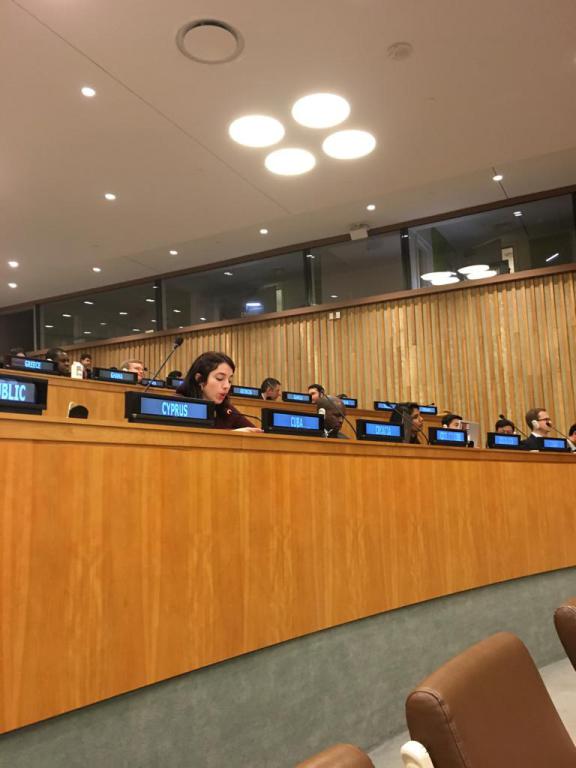
The Cuban delegation takes this opportunity to recognize the work done by the ambassadors of the United Arab Emirates and Luxembourg as co-chairs of the intergovernmental negotiations on Security Council reform during the 73rd session.
We appreciate the update of the document on elements of communality and issues for further consideration presented by the co-facilitators.
Deep disagreements among the delegations arose during the four consultations carried out in the period were evident, not only regarding the issues related to the five thematic clusters, but also on the course of action in relation to the process.
In this regard, Cuba reiterates that only through debate, in the established time and frameworks, will it be possible to define a path towards a consensus in relation to this reform. To this end, it is essential that the five clusters on the Security Council reform be analyzed in a comprehensive manner and not separately, namely: categories of membership, regional representation, size and working methods of an enlarged Security Council, question of the veto and relationship between the Security Council and the General Assembly.
Dear co-facilitators,
Cuba reiterates that it favors the expansion of the Security Council both in the category of permanent and non-permanent members. The main objective of the expansion of the Security Council must be to rectify the under-representation of developing countries.
At least two countries of Africa, two countries of Asia and two countries of Latin America and the Caribbean must be admitted as new permanent members.
The number of seats of non-permanent members with two years of mandate must be extended to a total of at least 15. Such members must have exactly the same prerogatives and rights as the current ones, without establishing selective or discriminatory criteria.
Cuba does not favor the creation of new categories or sub-categories of members. The new categories would increase the existing differences and would encourage the division among the members of the Security Council, instead of contributing to the better functioning of the Council.
Regarding the working methods, an urgent and in-depth reform of the Security Council is necessary to ensure that it functions as a transparent, democratic and representative body.
Although documents have been approved aiming at improving the working methods of the Security Council, including the note by the President S/ 2010/507, greater efforts are required in the search for effective formulas that ensure genuine participation of the Member States in the work and decision making of the Council.
Measures that do not take into account the opinions of all the members of the Council and, sometimes, not even all of its permanent members, are frequently taken. The lack of transparency and exclusionary practices are a constant feature in the work dynamics of the body.
In accordance with Article 24 of the Charter of the United Nations, Member States recognize that the Security Council, in carrying out its functions, acts on their behalf. Therefore, the work of the Council is a collective responsibility of all the Member States and they must be ensured true participation in the work and decision making of this body.
In order to increase transparency and the level of accountability, a final text should be adopted to regulate the work of the Council. It seems inconceivable that the Security Council Rules of Procedure remain provisional for more than 70 years.
The annual reports that the Council is duty-bound to present to the General Assembly must be truly analytical and adequately evaluate its performance.
The question of the veto is intrinsically linked to the working methods of the Council, in particular to the decision-making mechanism. The veto is an anachronistic and antidemocratic privilege that must be removed as soon as possible.
We share the concerns related to the growing tendency of the Security Council to consider issues and assume functions outside its competence, increasingly usurping the role conferred by the Charter to other United Nations bodies, particularly the General Assembly.
The Council has been frequently and prematurely addressing issues that do not necessarily pose an immediate threat to international peace and security, invoking Chapter VII of the Charter of the United Nations.
The application of double standards and manipulation in the analysis of certain issues under the consideration of this body is also a shared concern.
In regard to the relationship between the Council and the General Assembly, it is necessary to achieve a balanced and efficient relationship between the Security Council and the United Nations General Assembly, generated in strict compliance with the provisions of the Charter and in correspondence with the respective mandates of those bodies.
Likewise, all resolutions of the General Assembly that clarify the relationship among the Security Council, the General Assembly and the principal bodies must be fully respected. Article 24 of the Charter does not confer on the Security Council the competence to deal with issues that correspond to the functions and powers of the General Assembly and the Economic and Social Council.
It is necessary to duly ensure accountability of the Security Council to the General Assembly of the United Nations.
Thank you very much.