
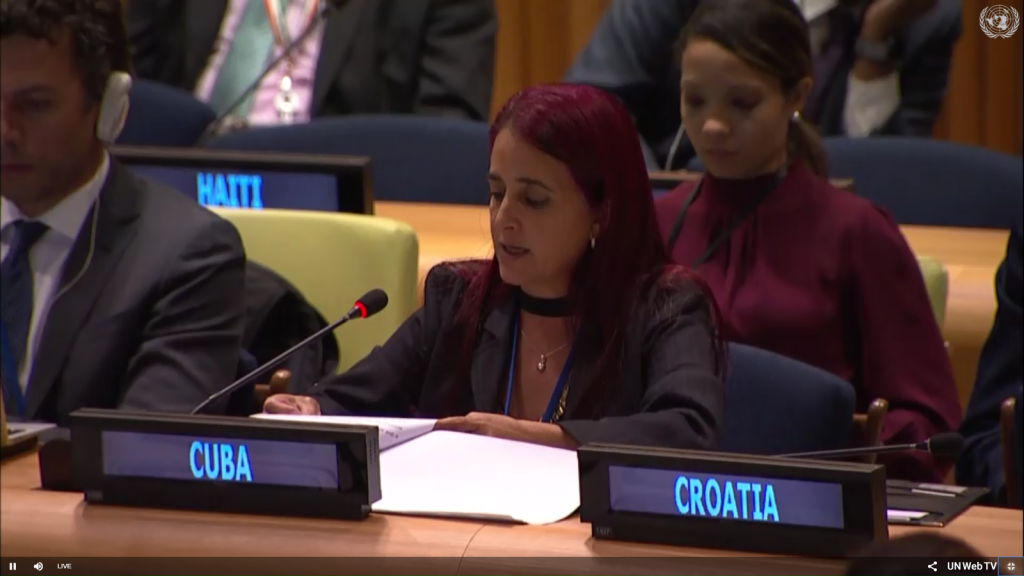
Mr. Chairman,
Cuba endorses the Statement delivered by the Islamic Republic of Iran on behalf of NAM.
The Government of Cuba reiterates its unavoidable commitment to promote and strengthen a genuine Rule of Law, which will undoubtedly allow us to change the unjust international order.
We are grateful for the Report submitted by the Secretary-General on this item, including document A/73/253, entitled “Strengthening and coordinating United Nations Rule of Law activities”. In this respect, a true Rule of Law begins with a reformed United Nations that is a banner of transparency, democracy and the participation of the entire international community in the solution of pressing global problems.
As part of this reform and a contribution to promoting and strengthening the Rule of Law, we must consolidate the central role of the General Assembly, the only body with universal membership and an exclusive task towards the progressive development and codification of international law.
The Declaration of the High-Level Meeting on the Rule of Law at the national and international levels clearly states in paragraph 36 that a true Rule of Law implies democratizing international economic, monetary and financial organizations, so that these serve to the development of the peoples rather than to the permanent enrichment of a few.
Cuba further reiterates its commitment to working towards a broad and profound reform of the Security Council, to make it an inclusive, transparent and democratic organ, in a way that reflects the genuine interests of the international community, in accordance with the principles and purposes of the Charter of the United Nations.
Mr. Chairman,
Cuba did not reveal its position regarding paragraph 28 of the aforementioned Declaration for we believe the Security Council has failed to make significant contributions to the Rule of Law, since this organ has no mandate to do so. Moreover, some of its Members openly violate international law and the decisions of the Council in order to impose their political and military-domination agenda on other nations, particularly developing countries.
Cuba reiterates that sovereign equality, good-faith compliance with the obligations undertaken by States, peaceful settlement of disputes, refraining from the use or threat to use force against the territorial integrity or the political independence of any State, non-interference in internal affairs of other States and non-selectivity, must be the basic principles governing at all times the actions of States and the promotion of the Rule of Law. This was clearly stated in paragraphs 1 and 3 of the High-Level Declaration and set out in paragraph 7 of the annex to document A/70/206. The international community should work for the real implementation of these principles.
In like manner, Cuba condemns any attempt to supersede or replace national authorities, including those actions to promote internal conflicts in sovereign States in order to impose foreign agendas. Paragraph 11 of the Declaration states straightforwardly the national ownership of every activity relating to the Rule of Law.
Mr. Chairman,
Promoting and strengthening the Rule of Law are based on due respect for the legal institutions of all States by the international community, as well as on the recognition of the sovereign right of peoples to create legal and democratic institutions in line with their social, political and cultural interests.
We should work to strengthen domestic legal systems on the basis of voluntariness, unrestricted respect for the self-determination of the peoples and without political conditions of any kind.
Mr. Chairman,
Cuba has noted with concern the attempts to impose a concept of Rule of Law and create a monitoring mechanism beyond the Sixth Committee of the United Nations General Assembly.
We reject any attempt to politicize the issue under the argument of its alleged cross-cutting nature. The delegations participating in the work of the Sixth Committee represent all States; thus, they are fully capable of discussing any topic we decide by consensus.
Mr. Chairman,
As a sign of its commitment to the search for peaceful solutions to long-standing conflicts, Cuba has made significant contributions to consolidating the Rule of Law in our region. Thus, we are proud to mention Cuba's contribution to the peace process in Colombia.
We also reaffirm the Proclamation of Latin America and the Caribbean as a zone of peace and recall that aggression and coup violence against any country in "Our America" only benefit the interests of those who insist on dividing us in order to dominate our peoples, without regard to generating conflicts with incalculable consequences in our region, such as those we are witnessing in different parts of the world.
Mr. Chairman,
A genuine Rule of Law requires the unequivocal waiver of any unilateral action or measure, including the enactment and implementation of extraterritorial laws and the politically-motivated exercise of the jurisdiction of national or international courts.
Cuba condemns and demands the immediate abolition of the whole set of extraterritorial rules that make up the economic, commercial and financial blockade imposed by the United States Government against Cuba for more than 50 years. Our country also urges compliance without further delay with the numerous resolutions adopted by this august Assembly on this issue and with the provisions set in paragraph 9 of the High-Level Declaration on the Rule of Law, which sets out that: “States are urged to refrain from promulgating and applying any unilateral economic, financial or trade measures not in accordance with international law and the Charter of the United Nations that impede the full achievement of economic and social development, particularly in developing countries.”
To conclude, we wish to emphasize that as part of the national efforts to strengthen the Rule of Law, our country is currently in a process of Constitutional Reform, in order to adapt the Magna Carta to the new circumstances of our society.
In this way, the political system will be strengthened with a view to consolidating and developing the fundamental rights attained by our citizens. Our power structures will be improved and modernized, making them more functional and allowing greater citizen control over their actions. The self-management mechanisms of the local government will be strengthened and greater citizen participation in decision-making will be encouraged, while the justice system is also improved.
We are pleased to add that the Preliminary Draft Constitution is being submitted to a process of popular consultation, which turns the people into a true constituent and will conclude in a popular referendum.
Thank you