
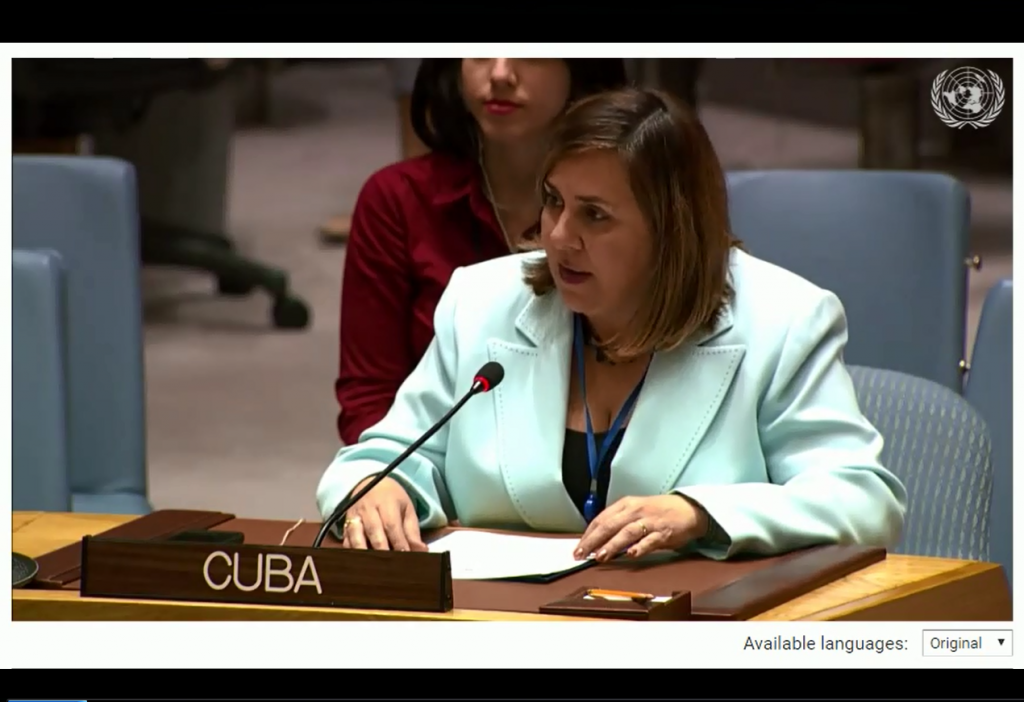
Mr. President,
We endorse the statement delivered by the Bolivarian Republic of Venezuela on behalf of the Non-Aligned Movement.
We share the concern reflected in the most recent report of the Secretary-General on the protection of civilians in armed conflict (S/2019/373), which states that civilians continue to account for the vast majority of victims in conflict situations, targets of indiscriminate attacks and other violations.
The United Nations Member States must act decisively to prevent conflicts. Preventing the development of conflicts is the safer and less expensive way to protect civilians. This requires strict compliance with the Charter of the United Nations, in particular its purposes and principles. It is also essential to root out the causes of conflicts, particularly by supporting the implementation of the 2030 Agenda for sustainable development.
The Security Council must fulfill its important responsibility to maintain international peace and security by encouraging respect for international law and the peaceful settlement of disputes. The Security Council should further refrain from supporting military adventures and from the threat or use of force in conflict resolution.
The responsibility for conflict prevention and the protection of civilians during conflict situations lies with States. The international community, the United Nations and regional and subregional bodies can provide constructive assistance, but cannot substitute the role of the government of the State concerned. They should support and complement impartially and unconditionally the efforts of national governments, at their request, with the utmost respect for their sovereignty, territorial integrity and political independence.
It is totally unacceptable that efforts to protect civilians are used to promote the geopolitical interests of certain states and serve as a pretext to ignore and violate the principles of the UN Charter and to interfere in their internal affairs.
We strongly condemn the murder of innocent people and the indiscriminate and disproportionate use of force against civilians. Their protection cannot be a pretext to legitimize military interventions aimed at imposing regime changes and overthrowing the political, economic and social order legitimately established.
We recognize that humanitarian assistance is a critical component of the protection of civilians in armed conflict, but it must be provided in accordance with the principles of the Charter, international law, international humanitarian law and United Nations General Assembly resolution 46/182. The guiding principles of humanitarian assistance, namely humanity, neutrality, impartiality and independence, should be respected. Furthermore, humanitarian assistance should be provided in accordance with international law and the national laws of the countries concerned, as well as the consent of receiving States.
We reject the political manipulation of humanitarian assistance and the application and reinforcement of unilateral coercive economic measures, resulting in severe deprivation and human damage to the same civilians sought to be protected.
Mr. President,
All parties involved in hostilities must comply with their obligations under international humanitarian law, as enshrined in the Geneva Conventions and their Additional Protocols.
This also applies to United Nations peacekeeping operations, in particular those with mandates on protection of civilians. These must have realistic and achievable mandates, clearly identified specific objectives and the resources necessary to avoid jeopardizing the safety and security of peacekeeping personnel.
Peace operations with robust mandates, including the proactive use of force for the protection of civilians, have not always ensured a more secure environment. The flexible application or reinterpretation of peacekeeping principles has increased the risk of threats and attacks against UN personnel, and has affected their integrity, credibility and neutrality.
Mr. President,
As the Secretary-General's report has reflected, concrete improvements are possible, in particular if the transfer of arms to unauthorized non-State actors is prohibited, military expenditures and the exponential development of sophisticated conventional weapons are reduced, lethal autonomous weapons systems and the use of military attack drones are prohibited, the war machinery is stopped and its resources are reallocated to economic and social development.
As we commemorate the 70th anniversary of the 1949 Geneva Conventions relating to the Protection of Victims of Armed Conflict, their postulates retain their full validity. The life and dignity of persons in conflict must be protected and respected, without discrimination of any kind.
Thank you very much.