
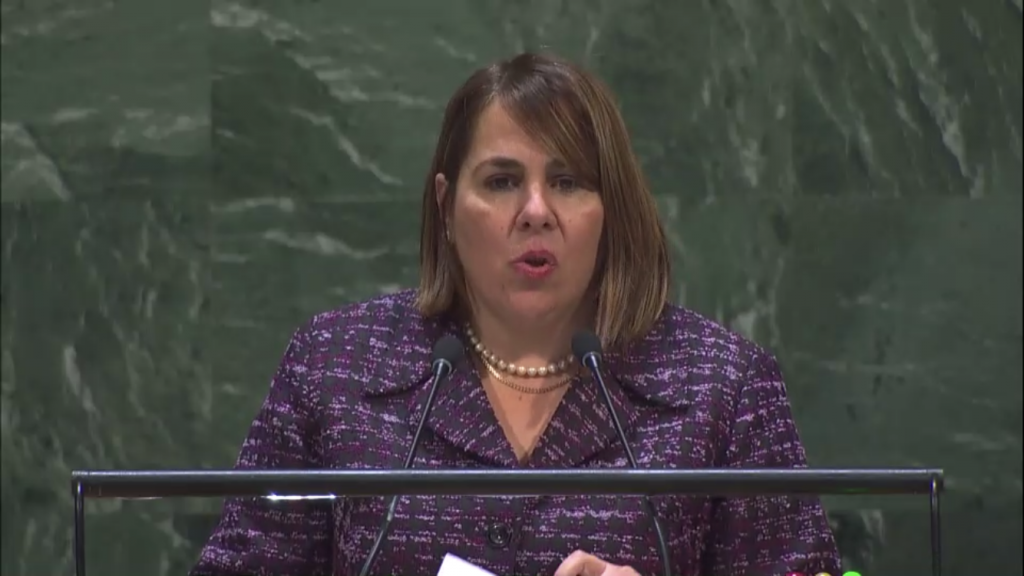
Remarks delivered by H.E. Mrs. Ana Silvia Rodríguez Abascal, Deputy Permanent Representative, Chargé d´Affaires a.i., at the High Level Plenary Meeting of the General Assembly on the occasion of the 30th Anniversary of the Convention on the Rights of the Child”. New York, 21 October 2019
Madam President:
My delegation thanks you for organizing this meeting and welcomes the presence in the room, since the morning session, of children in the seats.
José Martí, Cuba's national hero, wrote: "It is for children that we work, because children are the ones who know how to love, because children are the hope of the world" (end of quote).
And because a better future is guaranteed with a childhood and an adolescence protected and empowered with rights, on November 20, 1989, 30 years ago, this Assembly, through its resolution 44/25, adopted the Convention on the Rights of the Child.
The Convention recognizes that, for the full and harmonious development of the personality, the child must grow up within the family, in an atmosphere of happiness, love and understanding.
The rights set forth in the Convention apply to every child irrespective of race, color, sex, language, religion, political or other opinion, national, ethnic or social origin, property, disabilities, birth or other status of the child, his or her parents or legal guardians.
The Convention has become the most widely ratified human rights treaty in history and has contributed to transform the lives of children worldwide.
Regrettably, only one State has not yet ratified it: the United States of America, in what constitutes an action reflecting lack of commitment to childhood and which is, similarly, consistent with its daily actions, disregarding the best interests of the child.
Madam President,
Thirty years after the adoption of the Convention and despite the progress made, they continue to be insufficient. The current situation of childhood around the globe calls us urgently to address the root causes of the death of nearly 15,000 children every day, mostly from treatable diseases and other preventable causes; of more than 124 million children of primary and lower secondary school age who do not attend school; of 1.2 million children under nine years of age who are living with HIV/AIDS; and of approximately 420 million children, almost one fifth of the world's children, who live in armed conflict-stricken areas.
Implementing the Convention will not be enough if we continue to ignore the effects of climate change, if we do not change the unjust international economic order that makes the rich grow richer and the poor get poorer and that will force 167 million children to live in extreme poverty by 2030.
Madam President,
Cuba ratified the Convention on the Rights of the Child on 21 August 1991. We have designed national plans, policies and programmes by integrating the principles of the Convention. These plans encompass the areas of health, education, care of persons with disabilities, sports, culture, social prevention, promotion and protection of rights, among others. We work with a holistic and intersectoral approach.
Cuba ended 2018 with an infant mortality rate of 4.0 per 1,000 live births. All Cuban children are vaccinated at birth against 13 communicable diseases and priority is given to the early detection of congenital diseases. We are proud to have been the first country to receive validation from the World Health Organization for eliminating the mother-to-child transmission of HIV/AIDS and syphilis.
Cuba's significant progress made in respecting and promoting the rights of girls, boys and adolescents has been recognized in the presentations of its reports to the Committee on the Rights of the Child.
All these successes have been attained by the Cuban people despite the serious consequences of the intensified genocidal economic, financial and commercial blockade imposed by the United States against Cuba. This hostile policy is the main obstacle to Cuba's economic and social development, with very negative impacts on the availability of resources, food and goods to ensure better living conditions for our people. The blockade hampers the provision of health, education and social assistance services, particularly affecting children and adolescents. In spite of all this, the country is at the forefront of developing countries and shows levels comparable to those of developed countries in this area.
Madam President,
Thirty years after the adoption of the Convention, it continues to be the primary universal framework for upholding the rights of all children.
Cuba will continue to be committed to the full realization of all human rights for all people, without discrimination on any ground, in particular those of children and adolescents, with the political will to take to even higher standards the levels of social justice, inclusion and protection of human dignity. Cuba will continue to guide the improvement of its legislation, its policies and programmes by complying with the core principle that there is nothing in the world more important than a child.
Thank you very much.