
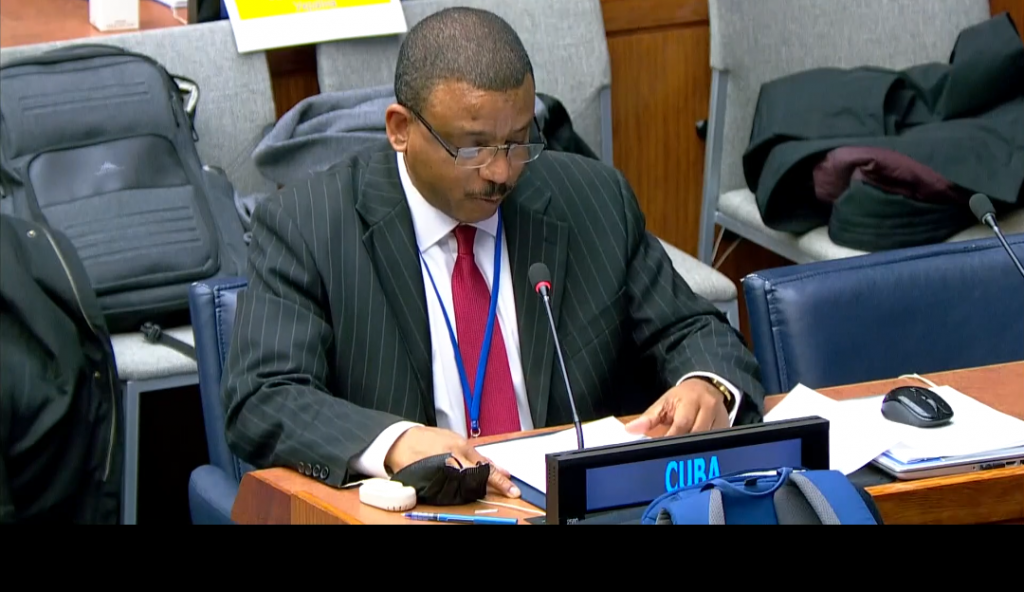
Madam Chair,
We appreciate the efforts made by the Bureau of the Ad Hoc Committee, under your leadership, and the Secretary of the United Nations Office on Drugs and Crime to hold the First Session of this body in New York.
The commencement of the work of the Ad Hoc Committee established by General Assembly resolution 74/247 has been delayed for far too long.
The use of information and communications technologies for criminal purposes is a growing phenomenon that is of concern to all countries, especially considering the vertiginous pace at which these technologies are being perfected and developed. Moreover, this is an area in which there is a significant legal vacuum at the level of the United Nations.
That is why Cuba has supported, from the outset, the idea of drafting a comprehensive international convention on countering the use of information and communications technologies for criminal purposes.
This is a very important process for developing countries, which face a growing digital divide and additional obstacles to accessing information and communications technologies and building the capacities to take advantage of their full potential.
It is vital that the instrument resulting from our deliberations should have a strong component of international cooperation and the transfer of technologies, resources and knowledge to the South.
We note with satisfaction that, in the proposed objectives, areas of application and structure of the future international instrument circulated several days ago, there is a component of international cooperation. This dimension should not be limited to investigative and procedural cooperation or to judicial assistance and enforcement of sentences between the competent authorities, once the criminal act has been committed.
Cooperation should also be approached from a perspective that allows developing countries to have the infrastructure, tools and trained personnel to prevent and identify the use of information and communications technologies for criminal purposes in their respective jurisdictions.
On the other hand, the future instrument should reaffirm the prohibition of the use of information and communications technologies to violate sovereignty, subvert the internal order of States, promote criminal activities, or to act in matters that are the exclusive competence of the latter, which contravenes the Charter of the United Nations and international law. In this regard, the future instrument should contribute to respecting and strengthening the sovereignty of States in the digital sphere.
Similarly, we advocate preserving the comprehensive nature of the future international instrument, as enshrined in the mandate conferred by General Assembly resolution 74/247. The future international instrument should have, first and foremost, a crime prevention and criminal justice approach, since its fundamental objective is to combat criminal phenomena.
In conclusion, allow me to assure you of Cuba's willingness to participate actively and constructively in the discussion and negotiation process that is beginning, in support of the unequivocal mandate of this Ad Hoc Committee, which is to elaborate a comprehensive international convention on countering the use of information and communications technologies for criminal purposes.
Thank you.