
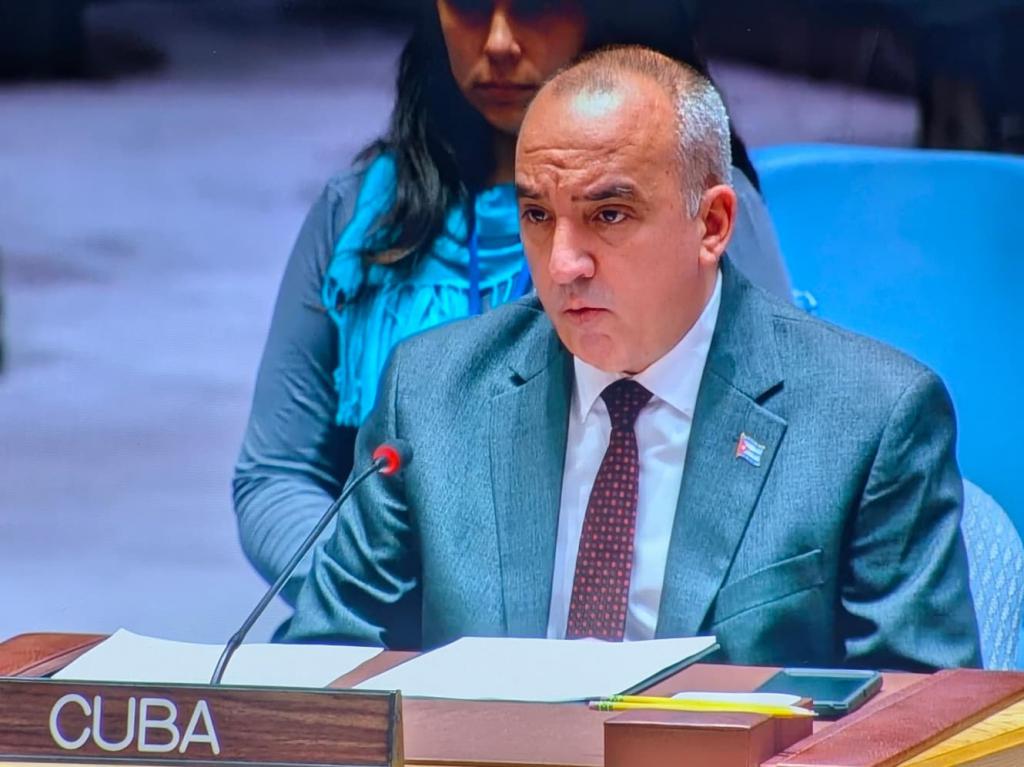
Mr. President:
Maritime safety is a key issue. Any threat in this area has global implications, especially for developing countries and particularly, small island developing states like Cuba.
Our country is aware of the negative impact of US actions that restrict shipping. President Donald Trump’s Executive Order of 29 January impedes fuel supplies to Cuba, with the aim of increasing collective punishment of Cubans to cause public unrest and overthrow the government. Those who sovereignly trade with Cuba are intimidated, coerced and extorted by the energy siege, while third countries and foreign companies are threatened with sanctions.
We reiterate our condemnation of acts of piracy and terrorism against oil tankers and their crew committed by US forces in the Caribbean Sea, which violate international law, maritime law and freedom of navigation and trade and threaten maritime security.
The recent actions of the US government, with a marked extraterritorial character, add to its extreme measures of economic war imposed against Cuba since 2019, designed to prevent any supply of fuel to our country, through sanctions and intimidation of producers and suppliers, transporters and insurance companies.
Cuba has the full right to trade fuel with any country, without threats, constraints, conditions or challenges to each state’s sovereign prerogative to export fuel and develop commercial relations with Cuba under the rules governing free trade, without interference from a foreign power.
The economic, commercial and financial blockade imposed by the US government against Cuba affects the freedom of trade and navigation not only of our country but also of other states, undermines their sovereignty and hinders economic progress and sustainable development aspirations, in flagrant violation of international law.
The Torricelli Act, which is part of the laws and regulations that underpin the blockade, comprises penalties on ships entering Cuban ports, prohibiting them from touching U.S. ports within the subsequent 180 days. These restrictions make it difficult to obtain offers for ship operations and generate higher fees for Cuban port operations.
Mr. President:
The serious escalation in the Middle East, triggered by US and Israeli military aggression against Iran, has also brought new maritime security risks. This war that has been imposed on the region is the result of well-known dominance interests, which have jeopardized regional and international peace, security, and stability more than once.
Efforts are urgently needed to stop the aggression and end its consequences, including the damage caused to all states in the Middle East. We reiterate our call for respect of the national sovereignty, territorial integrity and security of all nations in the region, and preserve good-neighborliness principle, moderation and, dialogue.
Mr. President:
The international community must act with determination and urgency to stop the proliferation of conflicts, coercion in international relations, the recurring threat and indiscriminate use of force and application of the aberrant doctrine that proclaims the supposed pursuit of peace through force.
We emphasize the important role of the International Maritime Organization in promoting the safety of navigation, of which Cuba is a member and to which it attaches special importance for its efforts to develop maritime transport
I conclude by reiterating Cuba’s call for international cooperation and collective efforts to address common challenges to international peace and security and to ensure a safe and sustainable maritime environment based on respect for international law, including the UN Convention on the Law of the Sea.
Thank you very much.