
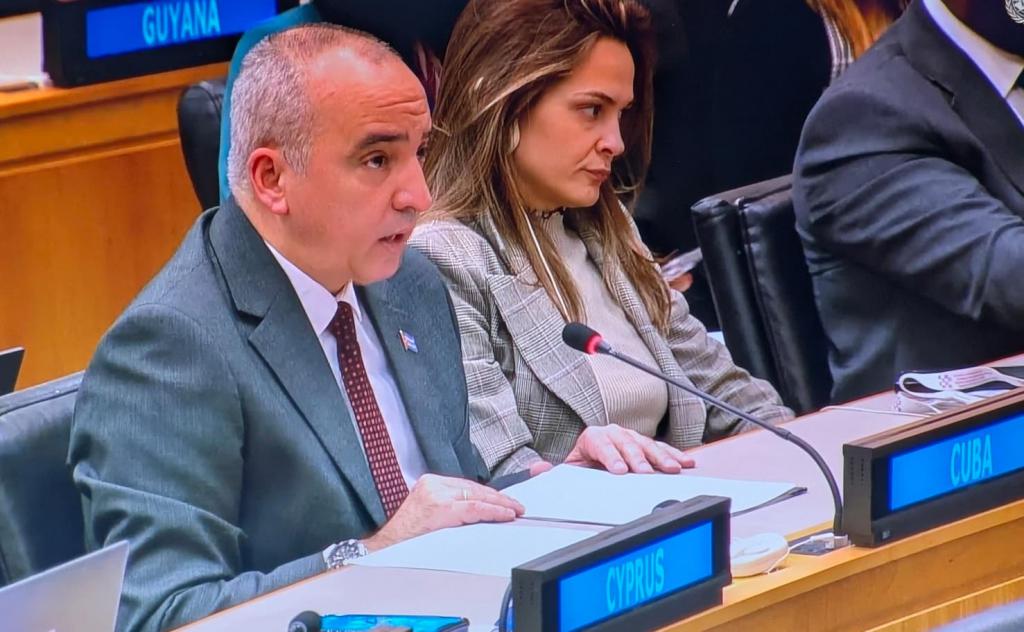
Mr. President,
I am starting by conveying the willingness of my delegation to actively participate in this session of the Committee on Information.
We welcome the presence of Undersecretary of Global Communication, Ms Melissa Fleming and thank her for the update presented on the activities of the Global Communication Department and the application of recommendations formulated in the resolutions 80/84 A and B.
My delegation associates itself with the statements made by Uruguay, on behalf of the Group of 77 and China, and by Spain, on behalf of the Group of Friends of the Spanish (to be confirmed).
In considering the reports submitted by the Secretary-General on the activities of the Department of Global Communication, we acknowledge the communications work carried out by the Organization during this period. In a context marked by the constraints stemming from the liquidity crisis, we urge the Department to continue identifying initiatives that will help ensure the accuracy, objectivity and integrity of information.
We also highlight the continuing momentum of the Department in generating and disseminating multilingual content. We value the promotion of multilingualism as an expression of peoples' cultural richness and diversity, and as a way to promote content accessible to diverse audiences.
Mr. President,
Cuba remains committed to the process of computerization of society. The transformation of information and communication technologies affects all areas of the country’s economic and social life, as it is an essential factor in advancing our sustainable development goals and promoting greater social inclusion.
In this effort, we have a high scientific-technical and professional potential of human resources and a strategy aimed at boosting digital government, strengthening technological sovereignty in the development of informatics and telecommunications, and support the infrastructure needed to ensure universal access to and productive use of information and communications technologies.
In accordance with our National Plan for Economic and Social Development until 2030, telecommunications offer strategic economic potential to drive the computerization of society and the structural transformation of the economy.
Nevertheless, our legitimate aspirations continue to be hampered by the US government’s aggressive policy against our country.
Communications and information technology are among the sectors most severely affected by the economic, commercial, and financial blockade imposed by the United States.
Cuba’s Telecommunications Company remains the most affected entity, accounting for 94.3% of sector damage and losses exceeding $500 million annually over the past three years.
The constant harassment and pressure on entities with commercial relations, as well as on others interested in negotiating with Cuban communications companies, have a negative impact on the possibility of having adequate infrastructure and greater Internet access. There are also restrictions on access to broadband links and sites that offer software updates used by millions of users worldwide.
Cuban representatives continue to face numerous difficulties in participating in virtual meetings and events, due to restrictions on Cuba’s access to various digital platforms, including Zoom.
Mr. President,
In addition to the long-standing and anachronistic blockade, the US government has imposed an energy blockade against our country that affects all sectors of the economy, including telecommunications. It maintains, in turn, the misuse of cyberspace and the permanent radio and television aggression against Cuba for destabilizing and politically subversive purposes, in contravention of the purposes and principles of the Charter of the United Nations and the provisions of the International Telecommunication Union.
We condemn these radio and television broadcasts that promote harmful content against Cuba and violate the national competence to regulate information flows and the use of mass media. During the month of March alone, 12 stations were broadcast against Cuba, using a total of 25 frequencies, 17 of them on shortwaves and 8 on medium-waves, with an average of 7383 hours per month.
Mr. President,
The dizzying advance of information and communications technologies must be properly managed in terms of human development, equitable access to knowledge, strengthening productive capacities and improving the quality of life for our peoples.
Such technologies should not be used as instruments of domination, coercion, or destabilization, nor to promote campaigns of manipulation and misinformation against sovereign nations.
Our actions in this area must be guided by a use of these technologies that is fully compatible with international law and the purposes and principles of the UN Charter, on the basis of full respect for the sovereignty of states. non-interference in their internal affairs and the promotion of peaceful coexistence.
In conclusion, reiterating Cuba’s commitment to contribute to international efforts aimed at building a more just, inclusive and equitable world information and communications order; an order in which cooperation and understanding between nations prevail over unilateral blockages and coercive measures, the sovereign equality of states, and not interventionist agendas.
Let us advocate for a digital and technological environment oriented towards sustainable development and the well-being of peoples.
Thank you very much.