
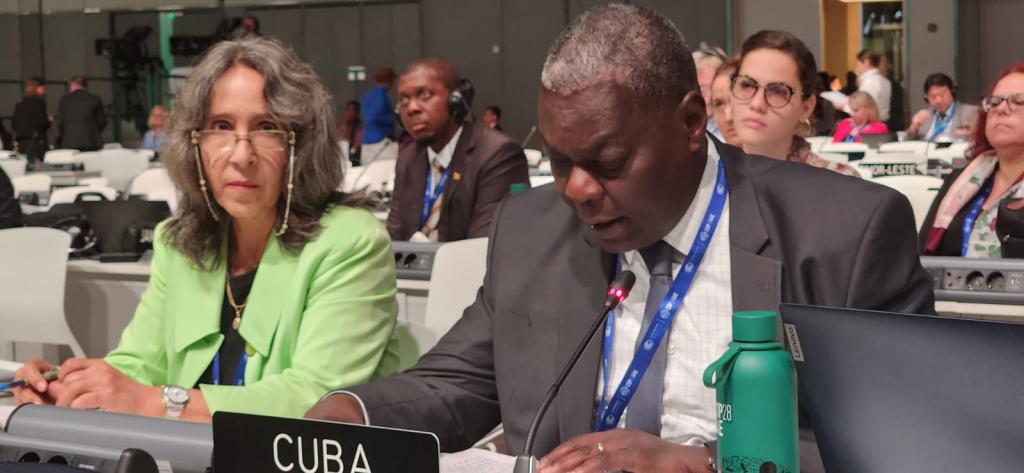
Mr. President:
I have the honor to deliver this statement on behalf of the 134 countries, which compose the Group of 77 and China.
On behalf of the Group I would like to express our deepest appreciation to the COP 28 Presidency for the very warm display of hospitality and all facilities and support provided to delegations to participate in all the process leading to this COP. At the same time, we also wish to convey the warmest message of thanks to the COP27 President, Egypt, for its leadership through this year.
We are very aware of the huge challenges and responsibilities that we all face. The latest IPCC report is clear when signaling that if current emission trends continue we will not be able to keep the temperature goal of 1.5ºC within reach with the ghastly implications that this would have to the life on the planet. Moreover, the most recent analysis and data exposing the growing gap in emissions cuts of major developed countries compared to their emission reduction commitments not only confirm the above, but even more importantly reveal that those who bear the greatest and historical responsibility for the modification of the global climate system are accelerating consuming the remaining of the carbon space.
We all know where this would lead. If we don´t act responsibly now this would only bring more negative and impactful consequences for developing countries who are already the ones suffering more, in particular small island developing States and least developed countries. If don´t reverse this trend, we will see the chances for the developing countries achieving the sustainable development significantly reduced, our livelihoods seriously at risk and the global inequality gap widening.
But colleagues, as if it was not enough, all this is taking place in a wider context. As the recent Summit on the sustainable development goals demonstrated, we are far behind of reaching the targets that we collectively set to achieve for 2030.
Even before the Covid-19 global pandemic, we were not in a pathway to reduce the poverty levels that we all committed to. The impact of the pandemic in food and energy security; the unfair and restrictive measures introduced by our developed partners in the area of trade, exorbitantly increasing the cost of developing countries exports to those markets; the serious decline in multilateral development assistance and the failure of developed countries to fulfill their commitments for the provision of the support needed by developing countries to undertake on multilateral agreements, to mention just a few, reflect a very dire scenario for the countries of the global south.
To highlight this, we deeply regret that the second replenishment of the GCF resulted in a lower amount of total pledges from developed countries, compared to the previous replenishment as well as unfulfilled pledges from the previous period– we are moving backwards in this critical juncture, rather than forwards.
We are simply running out of time. Hence, this is the most consequential COP of the last cycle after Paris and the G77 and China envision it as the main opportunity for regaining trust in our collective determination to urgently act to fulfill our respective commitments and accelerate action.
The recommendations of the Transitional Committee on the operationalization of the loss and damage fund are an important milestone to address the loss and damages of climate change in developing countries. A decision by this COP at an early stage adopting the recommendations of the TC will signal a positive point of departure for the COP. So, the G77 and China support the adoption of a decision in this opening session. We look forward to a quick start-up of the fund and to its capitalization, by developed countries, especially through grant-based contributions, commensurate with the scale of the loss and damage sustained by developing countries.
Mr. President,
To have strong and substantive decision on the GST is a priority for the G77 and China.
We accord high priority to the Global Stocktake as a key element in the Paris Agreement, in accordance with the principles of equity and common but differentiated responsibilities and respective capabilities, in the light of different national circumstances, for achieving our common objective of enhancing the collective ambition of action and support and international cooperation under the Paris Agreement. For the Group of 77 and China, equity and the best available science are key to understanding the context and identifying future actions for enhancing ambition, addressing support, implementation barriers, gaps and opportunities, and strengthening international cooperation under the Convention and the Paris Agreement.
The principle of equity and recognition of the best available science are foundations for the robustness of the GST’s outputs in all the thematic areas and related efforts considered under the GST.
The GST’s backward looking and forward looking elements are both important and integrally and holistically linked, and the GST’s outcomes should reflect this linkage.
The outcomes from the GST should be comprehensive and balanced, faithfully reflect the goals, principles and provisions of the Convention and its Paris Agreement, particularly equity and common but differentiated responsibilities, and highest possible ambition, considering the best available science in a crosscutting and party-driven manner. We also need a concrete signal from developed countries that they are committed to course correct and to take the lead in filling the ambition and implementation gaps. The GST outcome should be informed by an assessment of the gaps and failure of implementation, including ensuring the means of implementation in the period prior to 2020.
The development context and national circumstances of Parties determine the manner and conditions in which enhanced climate action and international cooperation are undertaken, highlighting the need for policy space, recognition of developing countries’ sustainable development and poverty eradication imperatives, and provision of the enabling means of implementation and support for their climate actions consistently with the Convention and its Paris Agreement
All thematic areas as contained in decision 19 CMA.1 must be addressed in a balance and integral manner.
The outcome should identify opportunities and challenges for enhancing action, support and international cooperation and key political messages to inform enhancing, in a nationally determined manner, action and support. For the G77 and China, it is critical for this to be in the context of promoting sustainable development, poverty eradication and economic diversification, taking into account the needs of developing countries in terms of sustainable development and just transitions. The outcomes should inform new NDCs in an effective way.
As we conclude the first global stocktake, it’s important that we recognize that response measures is critical to the implementation of the UNFCCC and the Paris agreement, and it should be at the core of work and not sidelined or treated as an afterthought. In fact, as we pursue more ambitious mitigation action, we cannot ignore the impacts of implementing our climate policies and must ensure response measures are assessed thoroughly at each step. A key message for the GST is that response measures within the process should study, assess and address the implications of all discussed policies of countries’ societies and economies.
In a context when we are all doing efforts to increase our climate action, it´s an issue of serious concern the growing impact of unilateral economic coercive measures on the capacity and ability of developing countries to meet their obligations under the convention and the Paris Agreement.
Adaptation is a global challenge face by all, but is a matter of survival for developing countries.
At COP 28 we need to adopt a robust and integral GGA framework that takes into account equity and CBDR-RC, sustainable development, as well as different national circumstances, needs and priorities of developing countries. For the G77 and China, adaptation to climate change is a priority and a key component of the implementation of the Paris Agreement.
COP 28 needs to conclude the two-year Glasgow Sharm El Sheikh work programme on the Global Goal on Adaptation with a substantive framework, including ambitious targets that delivers on the need for increasing adaptation action and support.
The Global Goal on Adaptation and its framework outcome should include the establishment of the GGA stand-alone agenda item, development of indicators to track progress, and assessment reports
This framework must as well be inclusive, equitable, recognize developing countries challenges, ensure flexibility and mobilize the support needed from developed countries for developing countries. It should recognize our challenges, needs and priorities, and not represent additional burden for developing countries.
The 2023 Adaptation Gap Report places the financing gap for adaptation between USD 194 and 366 billion per year. Even if we double the current finance allocated to adaptation by 2025, this gap would only be reduced by 5-10%. A drastic increase of adaptation finance is needed from developed countries for developing countries now. We look forward to doubling the adaptation finance from developed countries, as one step in the journey of achieving the balance between, which should be balance in relation to mitigation and mitigation finance in line with Article 9, paragraph 4, of the Paris Agreement.
Mr President,
The overarching context in which climate action needs to take place is delivering on sustainable development and poverty eradication. COP27 in Sharm el-Sheikh last year clearly articulated this and further agreed on the establishment of a new work programme on Just Transition Pathways. The Group looks forward to this work programme supporting a whole-of-society and all-of-economy transition, to achieve more equitable and sustainable societies, within a more just world. We believe that this Programme must include workshops, capacity-building sessions, high-level ministerial meetings, and in inputs from expert bodies. It must also, have a holistic approach that transcends mere mitigation or sector-specific focuses, embracing all three dimensions of sustainable development.
This vision of addressing not only the environmental, but also the economic and social realities of climate change and ensuring climate justice, is premised on each Party having the sovereign right to choose its own developmental pathway towards shared objectives.
The Work Programme must not confine to the energy sector or specific regions; it is a universal commitment to a just transition that includes everyone: workers, impacted communities, and businesses, especially Small Medium Enterprises that face unique challenges during this transition. In this sense, the group underscores that the just transitions must be equitable, inclusive, and sustainable for all.
We look forward to the expedited launch for this Programme and the Group is ready to engage and support the programme’s objectives, ensuring a timely and impactful progression towards a fair and inclusive future for all.
Mr. President:
The provision of new, additional, adequate and predictable means of implementation, such as climate finance, from developed to developing countries is the main pillar of the climate change regime, enshrined in the principles of the UNFCCC and its Paris Agreement. More than a matter of solidarity, the fulfillment of the financial commitments of developed countries is a condition sine qua non to our collective success.
The continued failure of developed countries to meet their commitment to jointly mobilize US$ 100 billion per year by 2020 and through 2025 is a serious concern for our Group and is one of the main reasons of the lack of trust in the process. Guaranteeing tangible progress and transparency in the finance agenda is, therefore, key to the success of COP 28. We would also like to see us move forward on the procedural and substantive discussions on the NCQG.
We have high expectations on the operationalization of the new fund to address loss and damage, on a targeted outcome for the NCQG, both in substance and in procedure, as well as ambition in the component of means of implementation of the GST. Our Group is also gravely concerned about the attempts to deviate the discussion on the fulfillment of existing obligations of developed countries through twisted interpretations of article 2.1.c that are adversely impacting developing countries as we stand here today, and any interpretation of the article should be complementary to Article 9.
Mr. President:
Regarding technology transfer and cooperation, the G77 and China underscore the need for trillions of dollars in funding per year to meet the needs of developing countries. Neither adaptation nor capacity building are contemplated in this figure. The Technology Mechanism is the UNFCCC instrument for facilitating technology development and transfer towards climate resilience and low GHG emission development, but is constrained by the lack of funding. We urge developed countries to increase funding for this mechanism, particularly for the Climate Technology Centre and Network (CTCN) and emphasize the need for enhanced support for NDEs and to build upon local institutions and networks.
The G77 and China calls for the GST to address the challenges identified in the periodic assessment of the technology mechanism as requested at COP27, and looks forward to the financial negotiations to consider sustained funding for CTCN activities and enhance operational linkages as requested by the yet to be implemented decisions 2/CP.17 para 139 and 12/CP.24 paragraph 4.
G77 and China is also concerned for the lack of progress on the negotiations on agriculture and food security which is a key area for climate action in our countries and requests our partners and colleagues to quickly agree on a way forward to start deploying concrete action in this area.
The G77 and China also wants to remind that the cooperative mechanisms included in Article 6 of the PA are still requiring critical decisions to finalize shaping the full architecture to ensure the quick implementation of these mechanisms while ensuring transparency and environmental integrity, so as our countries can also increase ambition for climate action in the context of NDCs implementation. Capacity building is key to enable developing country Parties to implement adaptation and mitigation actions to achieve the climate goals of the Convention and its Paris Agreement. Capacity building has proven to be a major enabler for facilitating technology development, dissemination and deployment of climate action, access to climate finance, education, training, and public awareness.
There has been progress in scaling up capacity-building support at individual, institutional, and systemic levels since the adoption of the Paris Agreement. Such progress is evident looking at the efforts made through the Paris Committee on Capacity-building, the NDC Partnership, the different Capacity Building Initiatives for Transparency, examples of South–South cooperation, and endogenous processes of creating capacity and resources from developed countries within the developing countries Parties.
However, there are challenges limiting the enhancement of skills and knowledge. Also limiting the retention over time of the created capacity and there´s still insufficient, fragmented project-based efforts, that are mostly knowledge-sharing-focused, and inefficient and insufficient financial resources provided for capacity-building.
For this COP28, we want to highlight that capacity building is a must for developing countries to enable a more effective and ambitious implementation of their Nationally Determined Contributions (NDCs) to ensure mitigation actions and climate-resilient development.
The G77 and China acknowledges the continuing need for gender mainstreaming through all relevant targets and goals in activities under the Convention as an important contribution to increasing their effectiveness, fairness and sustainability.
In this spirit, we welcome this COP28 acknowledging there is still a lot to do to ensure effective, iterative and participatory country-led capacity-building, guided by lessons learned, existing knowledge and shared experiences.
The G77 and China is willing and prepared to engage constructively with our partners for a successful outcome at the COP28 in all its major streams.
I can assure you, Mr. President, the full support of the G77 and China.
I thank you.