
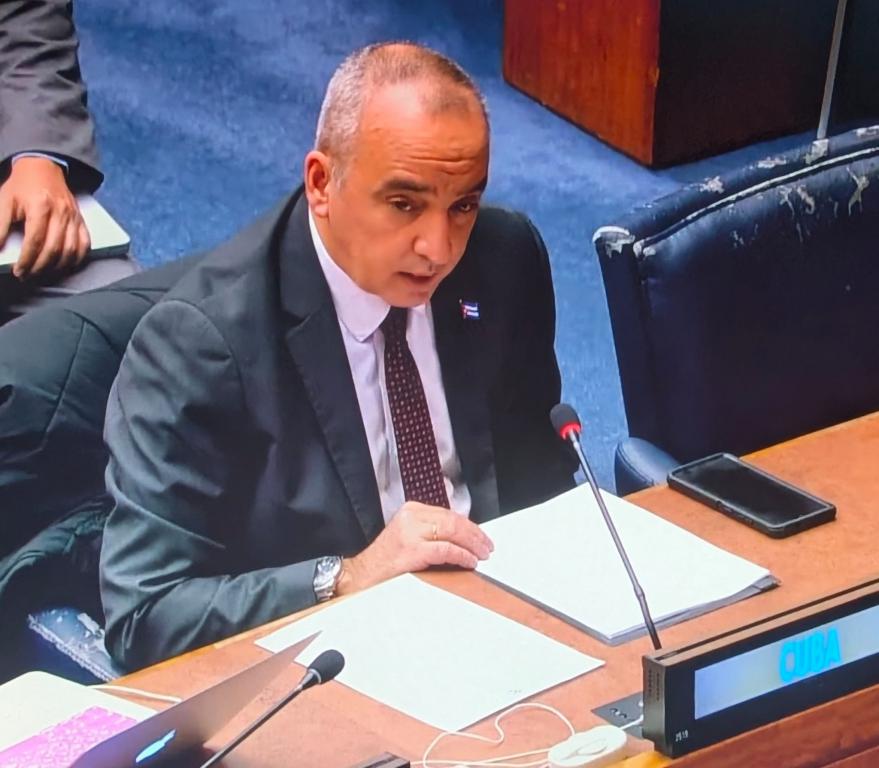
Ms President:
Cuba endorses the statements made by Uruguay, on behalf of the G77 and China, and by Venezuela, on behalf of the Group of Friends in Defense of the United Nations Charter, whose members we thank for their unwavering solidarity.
The social development commitments made in Copenhagen and renewed in Doha remain an outstanding debt to our peoples. At the same time, the goals of the 2030 Agenda are increasingly distant from the daily realities of hundreds of millions of people, especially in developing countries.
Today, humanity faces unprecedented challenges, exacerbated by an unjust and unequal international order that perpetuates poverty and exclusion for the majority. How can we talk about social development in a world where more than 750 million people suffer from hunger, 2.3 billion suffer from food insecurity, and 3.8 billion lack social security?
How much further could we advance if at least part of the trillions of dollars squandered each year on the arms race were devoted to development? The answer is obvious, but it requires genuine political will and a paradigm shift in favor of the well-being of our peoples.
It is imperative that acts of aggression, threats, the use of force, blackmail, and coercion against sovereign states cease.
Ms. President:
In this complex scenario, the persistent and unacceptable imposition of unilateral coercive measures against countries of the South, in open violation of international law and the Charter of the United Nations, exacerbates inequalities.
It is the peoples who suffer directly from the devastating impact of these practices. Cuba has been the victim of the most comprehensive, complex, and prolonged system of coercive measures ever imposed on any country.
The blockade severely limits the acquisition of medicines, reagents, medical equipment, and health technologies; it hinders and increases the cost of imports of food, fertilizers, and agricultural machinery; it restricts access to digital platforms, specialized software, and technological equipment necessary for inclusive and quality education. These and many other limitations have a direct impact on the well-being of families and the quality of life of older persons, children, adolescents, women, and persons in vulnerable situations.
The siege against Cuba has intensified to extreme levels, from the infamous inclusion of our country on the list of countries that allegedly sponsor terrorism, to the attack on Cuban medical cooperation, and more recently, the attempt to impose a total blockade on fuel supplies to our country.
This extreme measure, which we categorically reject, exposes our people to extreme living conditions and unpredictable humanitarian consequences.
Cuba does not pose a threat to any country. We are a peaceful, supportive, and cooperative nation, internationally recognized for our modest but constant contribution to health, education, and humanitarian assistance to nations in need, particularly in the South.
Ms. President:
Despite these challenges, Cuba continues to promote inclusive, equitable, and people-centered policies, in line with its commitments to social development.
With enormous effort, we will continue to guarantee universal access to education, health, social protection, equal opportunities, and full participation in economic, social, and cultural life. At the same time, we are committed to international cooperation, including South-South and triangular cooperation, as an essential means of advancing toward development.
In this context, we emphasize the value of multilateralism and the urgency of a new international order that is more just, equitable, and peaceful, as a prerequisite for addressing global challenges and promoting the social and economic development of all peoples.
Thank you very much.