
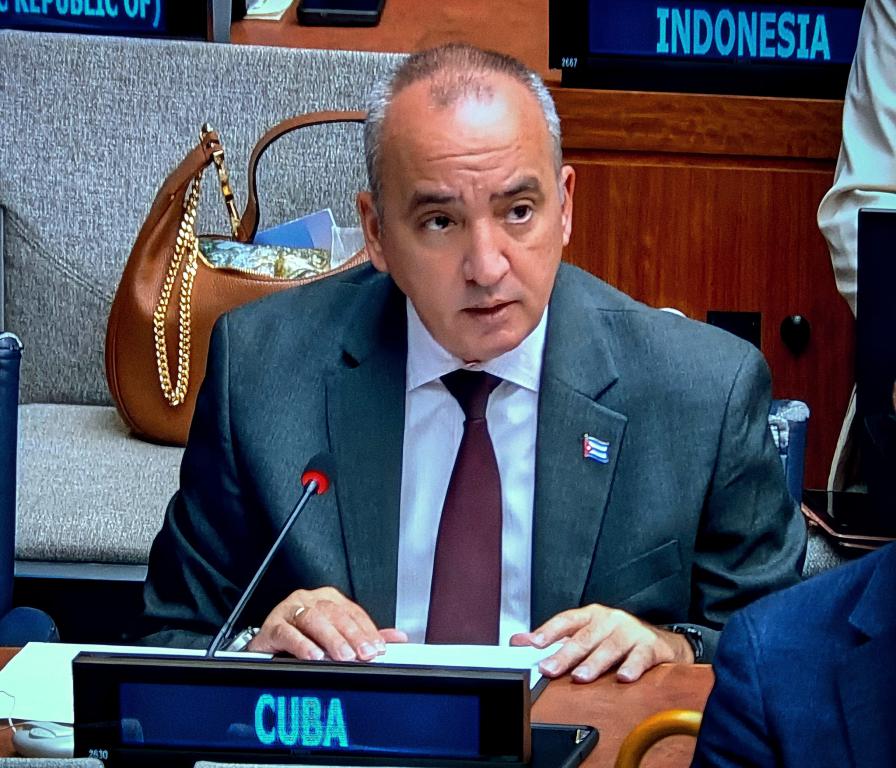
Mr. President,
My delegation joins in extending congratulations on your election as Chair of the Fourth Committee, and we extend these congratulations to the other members of the Bureau as well. We wish you every success in your work during this session.
Mr. President,
The debate on this issue remains as relevant today as it was in 1960, when the Declaration on the Granting of Independence to Colonial Countries and Peoples was adopted—a landmark document that recognizes that “the peoples of the world desire the end of colonialism in all its manifestations.” More than six decades later, colonialism continues to be an affront to the principles and values upheld by the United Nations.
Colonialism stands as an obstacle to the legitimate aspirations for social and economic development of the peoples who suffer under it and undermines their very cultural identity. Colonial practices have no place in today’s world.
The principle of equal rights and the aspiration for social progress enshrined in the UN Charter will remain unfulfilled as long as a single people remains under colonial domination.
Currently, 17 Non-Self-Governing Territories—and others, such as Puerto Rico, which are not officially classified as such—continue to suffer under this anachronistic form of domination.
The proclamation of December 14 as the International Day for the Elimination of Colonialism in All Its Forms and Manifestations constitutes a renewed commitment to the cause of decolonization. We are confident that it will help raise awareness about the historical legacies of colonialism and give greater visibility to the important work carried out by the UN on this issue, particularly by the Committee on Decolonization and the Decolonization Unit of the Department of Political and Peace Consolidation Affairs (DPPA).
The process of decolonization that led to self-determination and independence for numerous peoples and territories under colonial rule is considered one of the most significant transformations of the 20th century. Throughout those years, many people fought—and even gave their lives—to put an end, once and for all, to this shameful form of domination.
Mr. President,
Unfortunately, colonialism is not a relic of the past. Every day, modern forms of colonialism emerge with greater force, manifested through the appropriation and exploitation of peoples’ natural resources, the imposition of cultural norms to the detriment of indigenous traditions and heritage, the illegal application of extraterritorial laws that seek to govern the economic and commercial relations of sovereign nations; and also through unilateral coercive measures whose despicable purpose is to provoke regime change and impose political and economic models that are alien to the will of the people.
This is evident in Cuba, an independent and sovereign nation with a long tradition of struggle against colonialism and neocolonialism, which is currently confronting—with heroic resistance—a multidimensional aggression by the United States government aimed at reestablishing its neocolonial domination over Cuba.
Its hegemonic ambitions and interests in dominating our country are deliberately laid bare through the energy blockade, the unprecedented economic war, collective punishment, and the constant threat of military aggression against our people.
Mr. President,
We stand in solidarity with the peoples of Palestine, Puerto Rico, and Western Sahara, who have long been denied their right to self-determination.
The colonial status imposed on Puerto Rico continues to prevent this sister nation from making sovereign decisions regarding its needs and the complex economic and social problems affecting it.
The United States, the colonial power, is attempting by every means to consolidate its economic, political, and social dominance over this Latin American and Caribbean island, ignoring the numerous resolutions and decisions adopted by the Decolonization Committee, which have reaffirmed the inalienable right of the people of Puerto Rico to self-determination and independence, in accordance with General Assembly Resolution 1514 (XV) of the General Assembly.
Putting an end to colonialism in all its forms and manifestations also requires an end to the Israeli-Palestinian conflict. Israel’s continued violations of the ceasefire reached in Gaza, its sustained military incursions—including in the northern West Bank—and its illegal plans for annexation and settlements in the occupied Palestinian territories are unacceptable and form part of a systematic strategy of occupation, colonization, and collective punishment aimed at preventing, by force, a two-State solution and the recognition of the State of Palestine.
Similarly, we deeply regret that Western Sahara remains the last territory under colonial occupation in Africa, a continent with a strong history of struggle for self-determination and independence among its peoples.
We will continue to advocate for a just, lasting, and mutually acceptable political solution that leads to the self-determination of the people of Western Sahara, in accordance with United Nations General Assembly Resolution 1514 (XV) on the granting of independence to colonial countries and peoples.
Mr. President,
Any action we take now and in the future to eliminate colonialism will help to permanently eradicate its historical legacies associated with a past of slavery, plunder, exploitation, extermination, and structural dependence.
Our collective efforts must be stepped up in this essential and highly relevant area of the Organization’s work. In this way, we will preserve multilateralism and help build a shared future of well-being and progress for all peoples.
Thank you very much.