
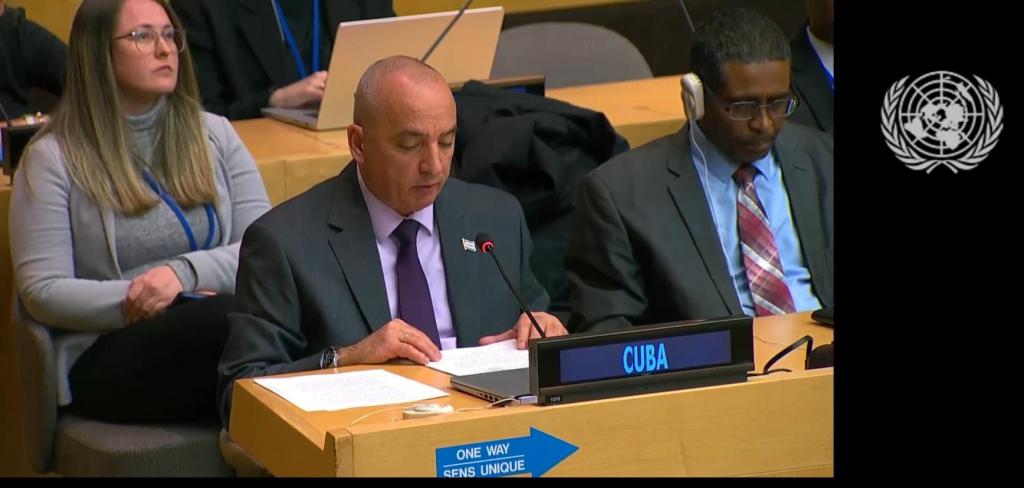
Mr. President:
We support Venezuela´s statement on behalf of the Group of Friends in Defense of the Charter of the United Nations.
We appreciate the convening of this meeting and the presentations by the briefers, including the United Nations Special Rapporteur on the negative impact of unilateral coercive measures on the enjoyment of human rights.
We agree with her that these measures violate international law and the Charter of the United Nations. They restrict the enjoyment of human rights by the peoples and individuals of the targeted countries and hamper socio-humanitarian activities and economic and social development, particularly in developing countries. The so-called “humanitarian exemptions” are an excuse used by those who apply them to evade their responsibilities.
This issue is of particular importance for Cuba. For more than six decades, we have been the victim of a brutal economic blockade imposed by the United States government. This blockade is tantamount to a prolonged war of attrition against the country's productive, commercial and technological potential, aimed at depressing personal income, essential services, consumption levels, social development and the well-being of the entire population.
It is not only the effort to prohibit all commercial and economic interaction between Cuba and the United States, a measure that in itself is sufficiently harmful to any developing economy, but an overwhelming and prolonged effort to sabotage and impede Cuba’s commercial and economic relations with any country in the world.
This ruthless aggression is based on laws specifically designed against Cuba to cause harm, to extraterritorially impose the will of the U.S. government on other countries, and to apply coercion against Cuba within their respective jurisdictions, beyond the sovereign prerogatives of any state.
I draw attention to the absurd inclusion of Cuba in an arbitrary and unilateral State Department list of countries that allegedly sponsor terrorism.
The extraterritorial coercive measures that are automatically triggered by this groundless classification have very serious repercussions throughout the world. They confirm that the objective is to use a pretext to attack Cuba and that these U.S. government’s illegitimate lists have become an opportunistic instrument to apply political and economic coercion against countries with which the United States disagrees.
The US economic blockade against Cuba has been clearly, absolutely and repeatedly rejected by the international community. It fulfils, and has fulfilled for several decades, the objective of punishing the entire Cuban population as a whole, violating their human rights in a flagrant, massive and systematic manner, and virtually prohibiting all contact and interaction between citizens of the United States and Cuba.
It does not and will not achieve the goal of subjugating Cuba to the will of the US government. It is not capable of convincing the Cubans to give up their sovereign prerogatives and their determination to build their own future without foreign interference.
It is absurd to assume that this will happen. Those who dream of such an aspiration, which is contrary to international law and the UN Charter, may continue to cause harm, but they will not achieve their desired goal.
A change in the aggressive course of the United States is possible, through the actions of the current president and also of the newly elected one. This is not a difficult step for such a powerful country, but it is very important for the subject of this debate and for the position shared by the international community.
Cuba has directly and publicly reaffirmed its willingness to develop a relationship of respect with the United States, as the one we have with almost all countries of the world, regardless of political differences, which is constructive and beneficial to both nations and which favors dialogue on all issues, not confrontation.
Thank you.