
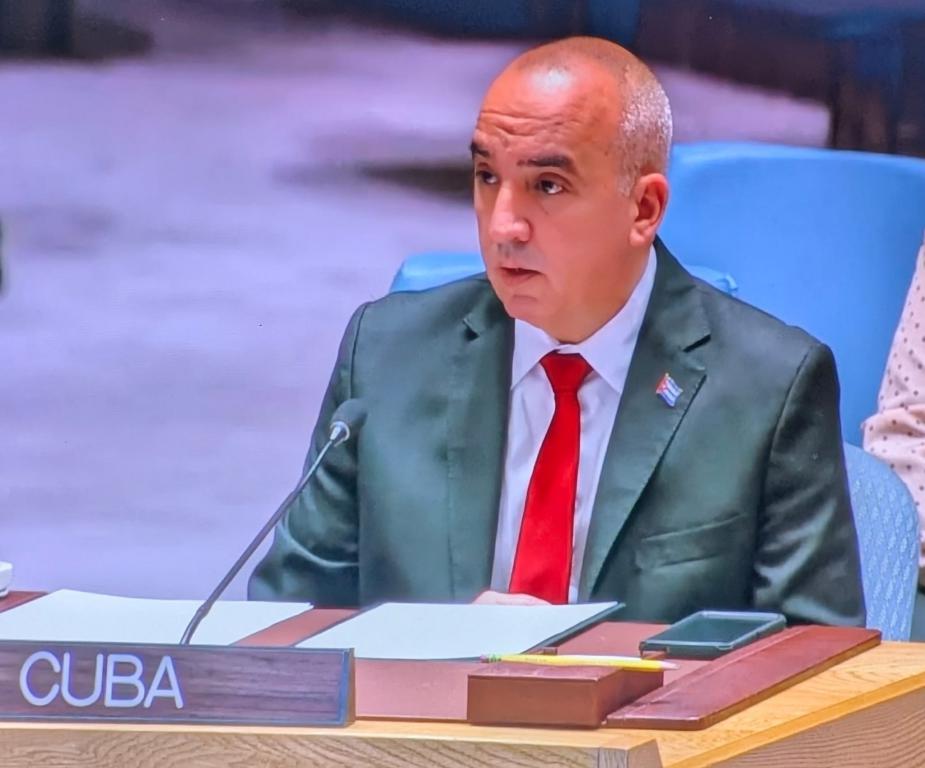
Mr. President
We welcome His Excellence Mr. Julius Maada Bio, President of the Republic of Sierra Leone, to the opening of this meeting.
We appreciate the presentation by Deputy Secretary-General of the United Nations Amina Mohammed.
We stand in solidarity with our sister nations in Africa, where long-standing conflicts persist as legacies of centuries of colonial domination and exploitation, which have hindered the development of their peoples, and many of their children today suffer the consequences, including food insecurity.
Mr. President:
This year’s report on the state of food security and nutrition in the world, prepared by several united nations agencies and programs, estimates that between 638 and 720 million people, corresponding to 7.8 and 8.8 percent of the global population, faced hunger.[1] The Outlook for 2030 is not encouraging.
With only five years left until the 2030 Agenda deadline, the goal of eradicating hunger remains distant and represents one of humanity’s greatest failures.
The General Assembly is called upon to spearhead global efforts alongside other specialized United Nations agencies to achieve this goal.
Meanwhile, global reports confirm that conflicts continue to be the main catalyst for acute food insecurity, affecting approximately 140 million people in 20 countries and territories[2].
Last August, the Food and Agriculture Organization of the United Nations (FAO), the United Nations Children’s Fund (UNICEF), the World Food Program (WFP), and the World Health Organization (WHO) reported that more than half a million people in Gaza are trapped in famine[3].
Despite the negotiated ceasefire, Palestinians still face obstacles to accessing humanitarian aid, including food. This November, the WFP reported that the amount of food in Gaza remains severely limited and insufficient.
This is in addition to the fact that 98.5% of cropland in the Gaza Strip is either damaged, inaccessible, or both, which poses further challenges to the already severe food situation[4].
The data illustrates that hunger is being used as a powerful weapon of war against the Palestinian population.
As we deliberate here, millions of people in Gaza are being condemned to starvation as a result of Israel’s genocidal actions, extermination and ethnic cleansing, carried out with impunity, guaranteed by military and financial support from the United States government. The Security Council must put an end to these actions, in accordance with its mandate to preserve international peace and security.
Mr. President:
There are abundant resources on the planet, but they are squandered in the interests of the great powers, including on sophisticated killing devices. Wealth must be redistributed fairly.
There is an urgent need to respond to the longstanding call by developing countries for a new, fair, democratic, and equitable international economic order, enabling us to eradicate the root causes of hunger and inequality, and promote sustainable development for all people. In doing so, we could eliminate potential triggers of conflicts that affect international peace and security.
Thank you
[1] Joint 2025 report by the Food and Agriculture Organization of the United Nations, the International Fund for Agricultural Development, UNICEF, the World Food Programme, and the World Health Organization. https://openknowledge.fao.org/server/api/core/bitstreams/e612e779-ec47-44c2-a3e0-499569c3422d/content
[2] Global Report on Food Crisis, published in May 2025. https://www.unocha.org/publications/report/world/informe-mundial-sobre-las-crisis-alimentarias-grfc-2025
[3] Joint Press Release by FAO, UNICEF, WHO and WFP, of 22 August 2025. https://www.un.org/unispal/document/joint-press-release-by-fao-unicef-who-and-wfp-22aug25/
[4] Evaluación realizada por la FAO y el Centro de Satélites de las Naciones Unidas (UNOSAT), 9 de agosto de 2025. https://www.fao.org/newsroom/detail/gaza-strip--98.5-percent-of-cropland-unavailable-for-cultivation-as-famine-looms/en