
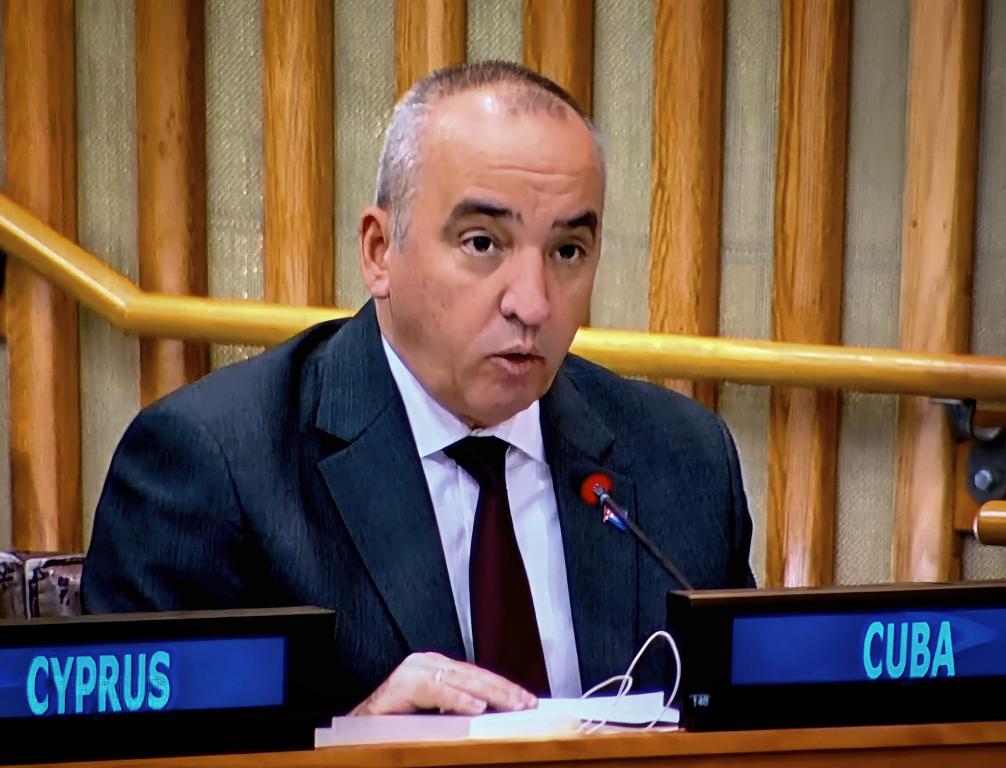
Mr. President:
- I have the honor of speaking on behalf of Belarus, Burundi, China, the Democratic People’s Republic of Korea, Equatorial Guinea, Eritrea, Iran, the Lao People’s Democratic Republic, Mali, Nicaragua, Niger, Palestine, Russia, Uganda, Zimbabwe, and my own country, Cuba. Due to time constraints, I will deliver an abridged version. The official English version will be available in the UN Journal.
- Please allow us to extend our best wishes to you and the other members of the Bureau. We look forward to working together actively and constructively during this session.
Mr. President:
3. We attach the highest importance to the promotion and protection of all human rights, both individual and collective, regardless of level or category. We believe that their promotion and protection must be strengthened on the basis of dialogue and cooperation, in accordance with the principles of impartiality, objectivity, transparency, non-selectivity, non-politicization, and non-confrontation, while respecting the sovereignty of States and refraining from interference in internal affairs, as established in the Charter of the United Nations, and within a framework of equality and mutual respect.
4. All actors within the United Nations human rights system—including the treaty bodies, the Human Rights Council, its special procedures, and the Universal Periodic Review, as well as the Office of the United Nations High Commissioner for Human Rights and other relevant departments of the UN Secretariat—must continue to work on the basis of multilateralism, cooperation, respect, and dialogue. Achieving this objective while preserving the credibility and integrity of the United Nations human rights system is only possible through constructive dialogue and cooperation with States. The UN human rights machinery must be protected from politicization at all times.
Mr. President:
5. We are living in an extremely challenging and dangerous international context. Threats to international peace and security are on the rise; attempts are being made to legitimize flagrant violations of the Charter of the United Nations; and policies of domination are being promoted that threaten social development, the right to self-determination, and the promotion and protection of human rights throughout the world. The intensification of trends that promote unilateralism and divisiveness weakens the United Nations and undermines a truly democratic, just, inclusive, and equitable international order.
6. In this complex context, we reiterate our deepest concern and condemnation of the ongoing acts of violence committed by Israel against the Palestinian people, particularly in Gaza, including its systematic use of forced displacement and starvation, as well as the deliberate destruction of civilian and critical infrastructure. Israel’s continued violations of the ceasefire reached in Gaza are unacceptable. We renew our call to end the occupation, the violence, the bloodshed, and the cycle of impunity prevailing against the Palestinians. A serious multilateral effort, within the framework of the United Nations, is essential to ensure, among other things, safe and unimpeded humanitarian access to those in dire need, as well as the mandate and work of UNRWA in the Occupied Palestinian Territory. We continue to advocate for a comprehensive, just, and lasting solution to the Question of Palestine, in accordance with relevant United Nations resolutions and the two-State solution.
7. We condemn in the strongest possible terms the atrocious attacks carried out by the United States and Israel against the Islamic Republic of Iran on February 28, 2026, which resulted in the deaths of innocent civilians, including women and children. We emphasize that these reprehensible attacks constitute flagrant violations of the Charter of the United Nations and international law—including international human rights law and international humanitarian law—while also seriously violating the fundamental principles of sovereignty, territorial integrity, and the prohibition against the threat or use of force against the territorial integrity and political independence of States. Dialogue, good neighborliness, and relations based on peace, friendship, and cooperation must prevail in the region.
Mr. President:
8. The political, economic, social, and cultural diversity present in today’s world constitutes a value that must be preserved and respected, on the basis of multilateralism and the continued promotion of a culture of peace, intercultural and interreligious dialogue, nonviolence, and the fight against the spread of hate speech and disinformation—as indispensable tools for strengthening the values enshrined in both the Charter and the Universal Declaration of Human Rights.
9. In this context, we firmly oppose any form of collective punishment against certain nations as a result of the freely expressed will of their peoples, including the so-called “cancel culture,” which negatively affects the realization of their rights in the spheres of education, culture, sports, science, religion, and other relevant areas, and leads to social exclusion.
10. We reiterate our categorical rejection of double standards in human rights matters. We express our serious concern over the continued proliferation of mechanisms and procedures that purport to conduct “impartial” assessments of human rights situations in certain countries without the due consent and participation of the States concerned. We condemn the establishment of any such mechanism based on bilateral agreements with States other than the States concerned and under the pretext of providing technical assistance to third parties. We reiterate the need to use credible and verified sources; to take into account Member States’ efforts in the field of human rights; and to consider the impact of external challenges.
11. We reaffirm our firm condemnation of the imposition of unilateral coercive measures—particularly against several of our countries—which drastically undermine the full enjoyment of human rights by more than one-third of humanity, preventing and hindering access to, among other things, food, medicines and medical treatments, medical equipment, financial services, education, technological advances, and energy sources, as well as other essential goods and services.
12. Let us be clear: it is not only contradictory but also immoral for some governments to present themselves as defenders and supposed protectors of human rights, while their deliberate and systemic policies—particularly the imposition of unilateral coercive measures—result in massive violations of the human rights of billions of people around the world. This is simply unacceptable.
13. We reiterate our firm condemnation of the illegal economic, commercial, and financial blockade imposed by the United States against Cuba—which has been intensified by an energy siege—and which continues to have devastating consequences for the Cuban people. Once again, we urge States to refrain from enacting and applying, and to lift, any unilateral coercive economic, financial, or commercial measures that hinder the full achievement of economic and social development, given their negative impact on the full enjoyment and realization of all human rights and the achievement of the Sustainable Development Goals.
Mr. President:
14. We also express our grave concern regarding the persistent global drug problem, which must be addressed with full respect for the purposes and principles of the Charter of the United Nations and the sovereignty of States. We reaffirm our firm commitment to the international drug control regime.
15. We emphasize that migration is not a crime and that the rights and dignity of migrants must be respected, in accordance with relevant national and international obligations. We recognize that external factors, such as the systematic application of unilateral coercive measures, are among the main drivers of migration. We reaffirm that migration, including voluntary return, must be safe, orderly, and carried out with full respect for the dignity of migrants, in order to prevent crimes related to human trafficking. We emphasize that migration policies must be based on solidarity, international cooperation, and full respect for the sovereignty of States and international law, while firmly rejecting the persecution and stigmatization of migrants, particularly in Western countries.
Mr. President:
16. We condemn and reject systemic racism and racial discrimination, xenophobia, and any related forms of intolerance, and we reaffirm that human rights belong to everyone, without distinction of any kind, as established in Article 2 of the Universal Declaration of Human Rights. We categorically reject the resurgence of trends that promote the idea of superiority among human beings, including fascism, Nazism, neo-Nazism, and any form of racial exceptionalism.
17. We reaffirm that the right to development is an inalienable human right, which belongs to every human being and all peoples, and must be fully realized without discrimination of any kind. We call for the timely conclusion of an “International Covenant on the Right to Development” as a legally binding instrument, based on the proposal submitted by the Human Rights Council. The adoption of the Covenant would represent a historic step toward rectifying global asymmetry, reaffirming the right of developing countries to pursue their own paths of development free from coercion and ensuring that international cooperation is based on equity, solidarity, and shared responsibility.
18. In conclusion, we insist that there must be no alternative to dialogue, cooperation, compromise, and national ownership in every process that is truly aimed at strengthening human rights, both at the national and international levels, while reaffirming our firm determination to continue working actively and constructively to improve the effectiveness and credibility of the United Nations human rights system, as well as to preserve, promote, and defend the primacy and validity of the United Nations Charter, both in letter and in spirit.
Thank you very much.