
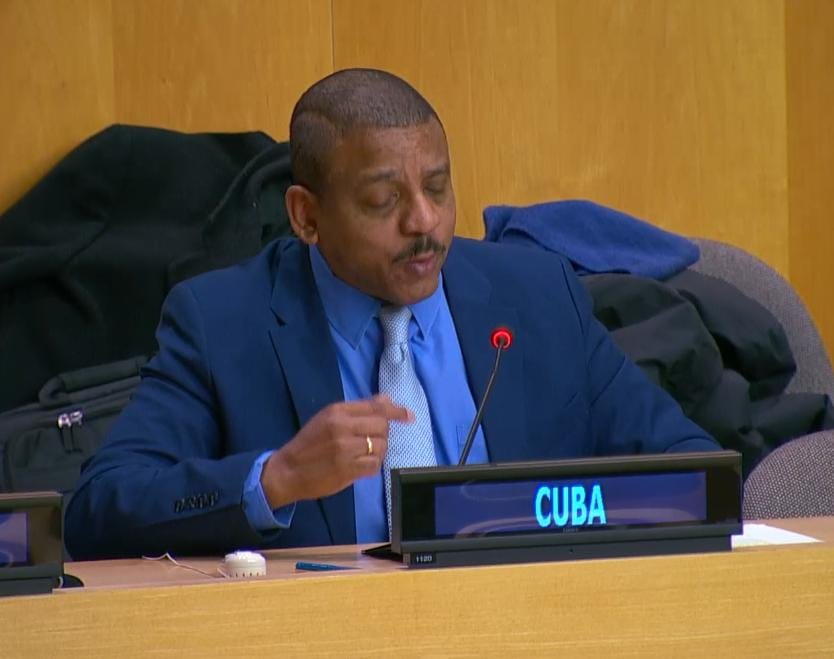
Distinguished Co-Chairs,
My delegation aligns itself with the statement delivered by the Non-Aligned Movement (NAM), and would like to add the following remarks in national capacity.
The revitalization of the General Assembly is meant to strengthen the role of the UNGA as the main deliberative, normative and representative organ of the United Nations, while fully respecting its intergovernmental character.
Improving the functioning of the General Assembly and its Main Committees cannot, under any circumstances, restrict the rights conferred to States by the Charter of the United Nations and the Rules of Procedure of the UNGA.
Revitalization is a process that has to be comprehensive of the three pillars of the Organization. We oppose any selective approach that seeks to target the development pillar.
We are aware that there are duplications and overlaps that need to be addressed in order to make the Organization as efficient as possible. However, this cannot come at the expense of limiting the right of States that wish to submit resolutions, of restricting the format or content of such resolutions, or of establishing criteria for excluding proposals.
The relevance and periodicity of agenda items and resolutions must be determined on a case-by-case basis, grounded in sound reasoning and with the consent of the proponents of the draft resolutions.
In the same vein, we recall that resolutions adopted by the General Assembly remain in effect until their operational scope and mandate have been fully implemented by Member States and other organs or entities of the United Nations.
We also express concern about the idea of standardizing or harmonizing speaking time limits across all meetings. Efficiency measures must not come at the expense of inclusiveness, transparency, or the effective participation of all Member States, nor introduced as administrative or procedural "fait accompli".
We also remind that the automatic microphone cut-off has no basis in the Rules of Procedure, and represents a departure from established diplomatic practice, which is based on respect for Member States.
Any proposal to reduce, merge, or eliminate mandated reports must be pursued only with the explicit consent of the proponents of the respective initiatives. Such an exercise should not be treated as a process of standardization, but should rather be examined on a case-by-case basis, with full respect for intergovernmental prerogatives.
Reports should also be disseminated in a timely manner to enable delegations to make appropriate use of their contents.
In conclusion, we reiterate our willingness to engage constructively to advance the process of strengthening and revitalizing the General Assembly, on the understanding that the effectiveness of our work can never come at the expense of the historical claims of developing nations.
Thank you so much.