
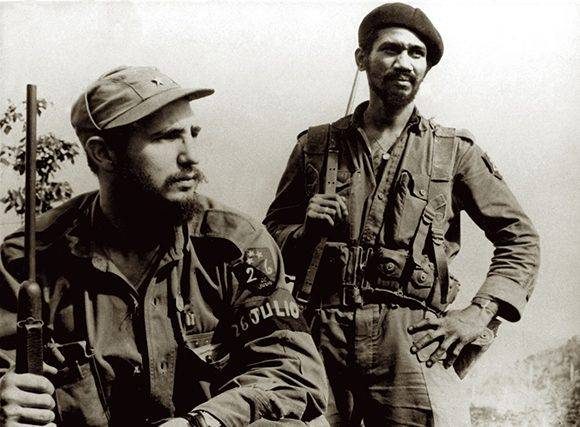
On September 11, 2009, Commander of the Revolution Juan Almeida Bosque, one of the most important figures in Cuban history, passed away . From an early age, Almeida demonstrated exceptional courage by joining the Cuban revolutionary movement led by Fidel Castro.
His commitment to the revolutionary cause was undeniable, and he assumed the responsibilities assigned to him with determination and dedication. Almeida stood out not only for his bravery on the battlefield, but also for his exemplary leadership and his deep love for his country .
Fifteen years after his physical departure, Cubadebate and the Fidel Soldado de las Ideas website remember him through fragments of his testimonies collected in his book ¡Asistencia! ¡Recuento! in the section Presidio , in which he recounts how his imprisonment was during the Presido Modelo, on the Isle of Pines, where he was sentenced along with Fidel and the young people of the Centennial Generation, for the actions of July 26, 1953, which recall his close ties with the leader of the Cuban Revolution and with the revolutionary process:
The Boniato prison is behind us
–Attention! Count!
The iron doors of the galley, the doors of each cell, are opened and creaked; we go out into the corridor, line up in front of an officer accompanied by a soldier and a prisoner. This has been the case every day at six in the morning and in the evening, and also at other times for a search on suspicion or as a precaution. On this occasion we are informed that after the count we will be transferred and we are ordered to collect our belongings.
A prisoner has a pencil in one hand, a clipboard in the other, and on top of it a sheet of paper fastened with a pressure clip where he writes down, as we are told: “one, two, three, four...”
He counts up to twenty-six, because the rest of those who were with us in the galley have already been released. There were some from different political parties: communists, orthodox, authentic; a former police chief in Santiago de Cuba, students, a businessman with his wife and driver. Now, it's just us.
Fidel Castro (right) at the Santiago de Cuba Bivouac, from left to right, combatants Armando Mestre, Juan Almeida Bosque, José Suárez and Commander Rafael Morales, August 1, 1953. Source: National Archive of Cuba/ Fidel Soldier of Ideas Site.
Everything is calmer and the cells of those already mentioned are empty, since they were released when we declared ourselves guilty.
An hour later, with the strong guard of soldiers with long weapons, in a row, almost marching without keeping time, handcuffed in pairs by the wrists, one on the right and the other on the left, the condemned in Case No. 37 for the attack on the Moncada barracks in Santiago de Cuba and Céspedes in Bayamo, we go to take the buses that are waiting to take us to the airport .
It is October 13, 1953. We go out into the morning air, which blows softly on our faces as if to liven up our countenances, the memory of everything we have experienced in those two and a half long, endless months of Moncada and the trial still fresh.
I still feel as if I can hear the judge's bang on the table as he passed sentence: thump, thump, thump, thirteen years, ten years, three years in prison at the La Cabaña military fortress in Havana, and seven months for the two girls in the Guanajay National Women's Prison in Pinar del Río; then Fidel's sentence: fifteen years.
We drive along a narrow road. Behind us lies the Boniato prison.
Now, in this Model Prison of the Isle of Pines
We have read and heard so many horrors about the Isle of Pines, things ranging from when Martí was here in the last century to what Pablo de la Torriente Brau tells in his book Presidio Modelo .
It is said that no one escapes from here, because on land, in the swamp, you can be eaten by alligators and at sea, by sharks, if they do not kill you first with the law of escape.
Like Martí, when he was sent to this island in 1870, we arrived on the same date, October 13. Also in 1896, other deportees left from these shores on an expedition to join Maceo's mambi forces in Pinar del Río, where the invasion ended.
The influence of the North American presence in our country since 1898 is very noticeable on this island, where they have created towns in their own style and likeness, identifying them with names from their country.
With these thoughts about this new place where they bring us, the plane touches down, raising a great cloud of dust, and the sound of small stones jumping and hitting the fuselage can be heard.
(...) The building extends to both sides. At each end, but separated from it, some buildings with corners like a small castle seem to flank the larger building. Next, on each side, a row of six houses. It is a whole complex in order and distance, forming a half moon.
We get off the bus and climb a flight of grey marble steps. We are in the prison administration, where they give us blue denim clothes, a shirt and trousers, a number that will be our first and last name while we are here, that is what they tell us, and a notebook to record the delivery of money and other objects for deposit. One after another we change clothes in a small room. Here all the space is well used. We put the clothes we bring in a brown paper bag. This operation is slow and takes a long time.
The day has also been long for us, it seems as if it lasted longer than the others; perhaps it is because we have done new, unusual things, since we had little activity in the Boniato prison.
We cleaned the galley, the bathrooms, each one of us his cell. We took turns in pairs, one pair mopping, the other cleaning and washing the bathrooms.
(...) Four days later, Fidel arrived with another comrade. From then on, discussions began with the prison management, as well as the organization of our small and reduced army to impose on us, here in prison, a stricter discipline than that announced, ending the regulations that had been imposed on us in the courtyard ceremony. In prison, empty life, without content, deteriorates. We must fill every minute, every hour, every day and every night, with exercises, sports, reading, cultural events. We must seek a correlation between thought and action.
Fidel immediately began to write and receive directly from each comrade their impressions of the events of Moncada and Bayamo , from the position each had there. In this way he reconstructed other parts of those events.
(...) Now, in this Model Prison on the Isle of Pines, we find ourselves once again facing our relatives, friends and acquaintances and those of our fellow prisoners. They tell us everything that happened in our absence, and we tell us what happened on July 26 and 27.
Thus began, first verbally and then in writing, the messages that would be distributed in matchboxes and under the cover of cigars, so that nothing would be hidden and everything would be known. From us to them and from them to the rest, the truth emerged from the very depths of the earth, from the tomb of each dead or murdered comrade, from that mass of concrete and iron, Fidel's document: History will absolve me.
It's the tyrant who visits the prison!
I climb onto the marble slab to look out of the window, almost cramming myself into the gap. I can make out a group of people walking down the street towards our pavilion. Among them, in the centre, I think I can make out the tyrant. I say to myself: “No, no, it can’t be.”
I try to look again, even though the bars make it difficult. But now I am quite sure, convinced that it is him, in a white suit, made of fleece because of how stretched he looks, a white shirt and a blue tie. It is the tyrant who visits the prison!
I go downstairs and walk over to Fidel, who is reading, walking back and forth. I approach him and say:
–Fidel, there is the tyrant.
He answers me with some surprise:
–Don’t tell me!
He immediately calls the others. Once everyone is gathered around him, he tells us:
–We have to do something.
But what to do with so little time?
–You keep watching –he points to me–, while the others will look through the other windows.
The question remains: what can we do behind bars? After deliberation, we agreed to sing the 26th of July March when he approaches and shout “Murderer! ”
That's what we'll do. It will be our salute, the march and shouting "Murderer!". That's what we've agreed.
Outside, the group begins to move again after a brief stop.
From my observation post, I notice:
–There they come! There they come!
Fidel says:
–Get ready, everyone! Let me know when they get close to the window – he points to me.
When they get within striking distance, I shout:
–There, there, there it is!
We begin to sing the march. At first, the tyrant may think it is a praise to him, because the March of July 26 begins: “We march towards an ideal.” His face, up to that point, is still normal. But when we sing the part that says: “the blood that was shed in the East, we must not forget…”, his face begins to disfigure into a grimace. When we get to “insatiable tyrants who have plunged Cuba into evil,” and we accompany him with shouts of “Murderer, murderer!”, he can’t take it anymore, he turns yellow with rage. He cannot conceive that through these bars he can receive such a barrage of truths, it is as if voices were coming out of a grave, because they have thrown us here so that no one will know more about us, at least for ten or fifteen years.
Now listen to the voices that reaffirm our existence, that proclaim our permanent militancy, firm and unwavering in our principles, combative, without caring about the measures that may be taken against us. It is a gesture of defiance, that we do not fear the regime of disgrace, torture, murder that he represents and directs. From here, although materially defenseless, we challenge him. We do not care about dying in his dungeons, nor the mistreatment or the law of escape. We challenge him, risking everything that we have: visits, letters, games, outings to the patio and even the sun that we receive. Even so, we challenge him with our strongest weapon: our morale and our battle hymn.
The tyrant came for wool and came out shorn, as has happened before in other places, thanks to the awareness of our people. It was impossible for this satrap to be elected President of the Republic in 1952, the year in which the elections were to be held. That is why he carried out the coup d'état, the only way to return to power and enrich himself again. Here he arrived with a smile on his lips, vain, possessed, and he leaves with a grimace. He had never been shouted tyrant and murderer to his face, in front of his acolytes. His ears, accustomed to flattery, refused to hear those adjectives, just like that, to his face.
But they were said and there would be consequences. We are on guard, we take all measures to resist any reprisal from the prison management, which we expect will be unleashed, although we see a calm attitude, which the tyrant forces those who walk beside him to adopt, when they move between surprised and uncomfortable. The tyrant, with his arms and hands extended, tells them to be calm, calm, while his front men, with obvious fury, look towards the windows of our pavilion. We fill the vessels with water, we place the beds against the entrance door of our galley and we stand guard all night.
Nothing happens, everything remains calm. The second day, the same. On the third, everything is normal. Life takes its course again.
On the fourth day, the officer wearing dark glasses arrives with a list, announces the names of the comrades who are due to visit their families and tells them to get ready, that he will come by in half an hour to pick them up . The comrades shower, shave, change their clothes, quickly go out into the yard and march with the officer.
How unaware they are that now the punishment for having sung the march and having shouted “Murderer!” at the tyrant is going to materialize!
The five named on the list are punished, Fidel and those they consider most responsible. Of course, Cartaya, the composer of the march, whom they knew from his letters, is not missing, and they attack him with beatings. At dawn they take him to a solitary cell and beat him brutally until he is unconscious. Not even in the worst years of the Machado regime was such an injustice and abuse committed. Fidel is locked up and separated from us.
The others, Ramirito, Tizol, Tápanes and Alcalde, are locked in individual cells and morally and physically abused.
The above anecdotes demonstrate that his legacy lives on as an inspiration for the new generations who continue to defend revolutionary principles in today's Cuba. In his reflection Almeida lives, Fidel wrote:
“I had the privilege of knowing him: a young black man, a worker, a combatant, who successively was the head of a revolutionary cell, a combatant of Moncada, a fellow prisoner, a platoon captain disembarking from the Granma, an officer in the Rebel Army – paralyzed in his advance by a shot to the chest during the violent Battle of Uvero –, a Column Commander, marching to create the Third Eastern Front, a comrade who shares the direction of our forces in the last victorious battles that overthrew the tyranny.”
By: Editorial Team Site Fidel Soldier of Ideas