
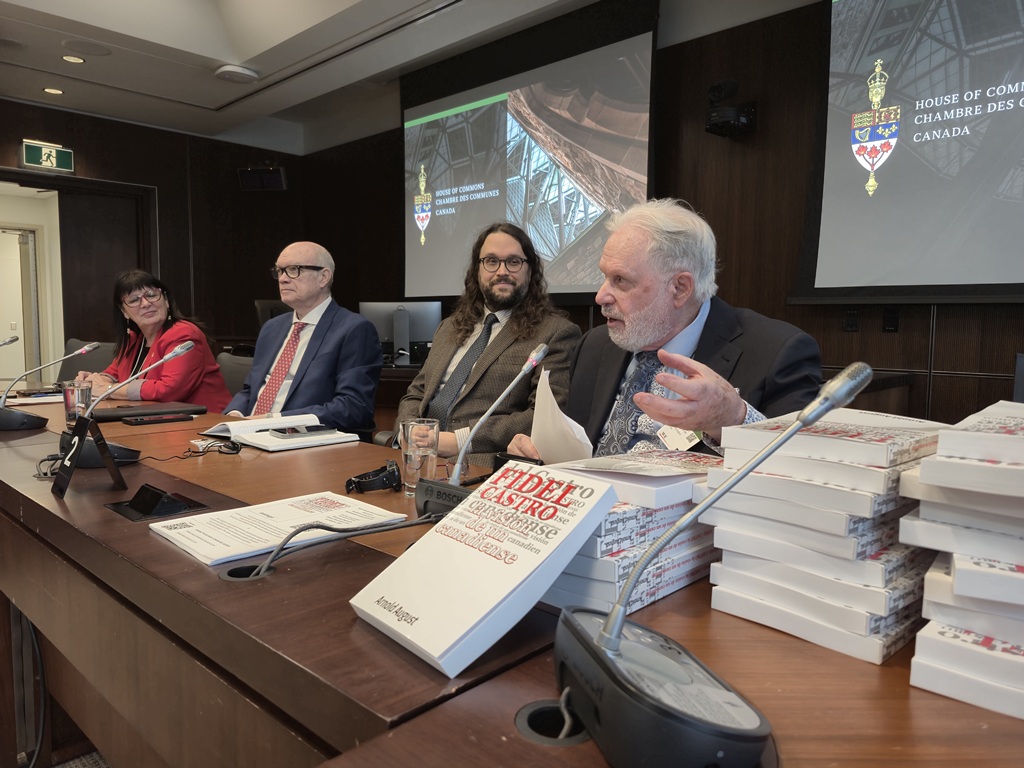
On the occasion of the 80th anniversary of uninterrupted diplomatic relations between Canada and Cuba, address by Arnold August, along with the presentation of his book Fidel Castro: la visión de un canadiense, delivered at the Parliament of Canada in Ottawa on December 3, 2025, at a meeting hosted by the Canada–Cuba Parliamentary Friendship Group.
A sincere thank you to the co-chairs of the Canada–Cuba Parliamentary Friendship Group: Bloc Québécois MP Gabriel Ste-Marie from the riding of Joliette, and the Honourable Senator Judy A. White from Newfoundland and Labrador, for inviting me. It is always an honour to sit beside His Excellency, the Cuban Ambassador to Canada, Rodrígo Malmierca Díaz. Today, we gather to celebrate 2025 as the 80th Anniversary of diplomatic relations between Canada and Cuba – an uninterrupted milestone in our hemisphere, matched only by Mexico.
On this occasion, allow me to highlight one central theme from my fourth book on Cuba and Latin America. This volume examines two prominent figures, Fidel Castro and Pierre Trudeau, and explores the dynamics of the Canada–Cuba–United States triangle from 1959 to 1976. It also outlines how both the conservative and the liberal parties, which have governed Canada since 1959, played key roles in shaping this unique relationship. Other political formations have also contributed – and continue to contribute – to this history, as I will address later.
Conservative Party leader and then-Prime Minister John Diefenbaker, at the time of the January 1959 Cuban Revolution, defended the continuation of diplomatic relations between Canada and Cuba. He did so despite pressure from the United States under President John F. Kennedy. When Kennedy tried to force Diefenbaker to join the US-led effort to impose the anti-Cuba blockade and other coercive measures, Diefenbaker, the Prairie farmer, responded sharply to the wealthy urban intellectual from Massachusetts. He reminded Kennedy that “Canada is not a Boston in the state of Massachusetts.” This political tendency also plays a vital role in Canada–Cuba relations.
Who invited Fidel Castro to Montreal only months after January 1959? To understand the complexity of the moment, one must remember that, although Fidel was widely admired internationally, a massive US-led media campaign was spreading disinformation – including in mainstream Canadian media. This campaign targeted the Revolution’s legal proceedings, including the trials and the executions of Batista’s known torturers and murderers – measures that had been demanded by the victims’ families. Yet the person who invited Fidel – and hosted him during his 24-hour visit to Montreal – was not a “leftist” or even a liberal. His name was Claude Dupras, a conservative at both the federal and municipal levels.
Why was he drawn to Fidel Castro? At the time of the Cuban Revolution in the late 1950s and 1959, Quebec was evolving in the budding atmosphere of its own multipartisan “Quiet Revolution,” which was initiated in 1960, challenging US-Anglo control over its vast electricity resources. Its goal was to become “maîtres chez nous” – masters of our own house. Dupras could relate to Fidel as a leader standing up to the United States on behalf of a small nation. It was therefore natural to invite him to Montreal. The spontaneous street scenes in April 1959, and the photos of TV interviews that I include in the book, show the broad support for Fidel in Quebec despite the disinformation campaign. People were clearly shrugging off the slanders.
At Fidel’s April 1959 press conference in Montreal, who do we see leaning in to interview him? None other than René Lévesque, the best-known journalist in Quebec at the time, an emerging sovereigntist, and a political precursor of today’s Bloc Québécois and MPs such as Gabriel Ste-Marie. The book shows that, in addition to conservatives and liberals, this political tendency also plays a vital role in Canada–Cuba relations.
But there is more. Pierre Trudeau is widely associated with his 1976 state visit to Cuba. However, few know that he had been to Cuba earlier, including in 1964 as part of a Canada–Cuba friendship delegation. Which political formation organized that trip? It was largely the social democratic NDP, of which Pierre Trudeau was a member at that time.
In 1995, during a joint meeting in Ottawa between Cuban and Canadian foreign affairs officials, which Pierre Trudeau attended, the Cuban Ambassador thanked him for laying the foundation of Canada–Cuba relations. Pierre Trudeau corrected him, saying the credit belonged to John Diefenbaker, who developed Canada’s Cuba policy in the early 1960s. Was this just a polite remark? It seems not. In Pierre Trudeau’s own Memoirs – and reproduced in my book – we see a photo of him wiping away a tear at Diefenbaker’s funeral. This is yet another sign of how multi-partisan the Canada–Cuba relationship has been.
Of course, Pierre Trudeau also left his own mark. After he was re-elected in 1972, the decision was made that he would visit Cuba in 1976 to meet Fidel Castro. This decision was upheld by Pierre Trudeau despite unanimous opposition, expressed as a protest against Cuba’s actions in Angola – actions taken because Cuba had deployed troops at the request of the Angolan government to help resist the apartheid regime in South Africa. When I say “unanimous opposition,” I mean precisely that: Pierre Trudeau’s own Liberal Party, the Conservatives, and virtually all mainstream media in both Canada and the United States urged him to cancel the trip. Yet Pierre Trudeau went anyway.
In 1976, speaking in fluent Spanish next to Fidel Castro, he ended his remarks by shouting: “Viva el Presidente Ministro Comandante Fidel Castro!” Even today, when controversy arises over Canada–Cuba relations and calls emerge to follow US policy, the media often refers back to this now-famous “Viva” – a reminder of the long, independent tradition of Canada’s Cuba policy.
But we are now in a different era, and there is a new standard. I am referring to Bloc Québécois MP Gabriel Ste-Marie’s 2024 petition tabled here in Parliament. It calls on the Government of Canada to urge the United States to lift the blockade against Cuba and to remove Cuba from the list of state sponsors of terrorism. This demand remains valid and deserves the full support of all political parties in Parliament, in keeping with the multi-partisan tradition of Canada’s Cuba policy.
What better way to celebrate the 80th anniversary of our uninterrupted diplomatic relations than to take further steps in that direction in the coming months?
Thank you.