
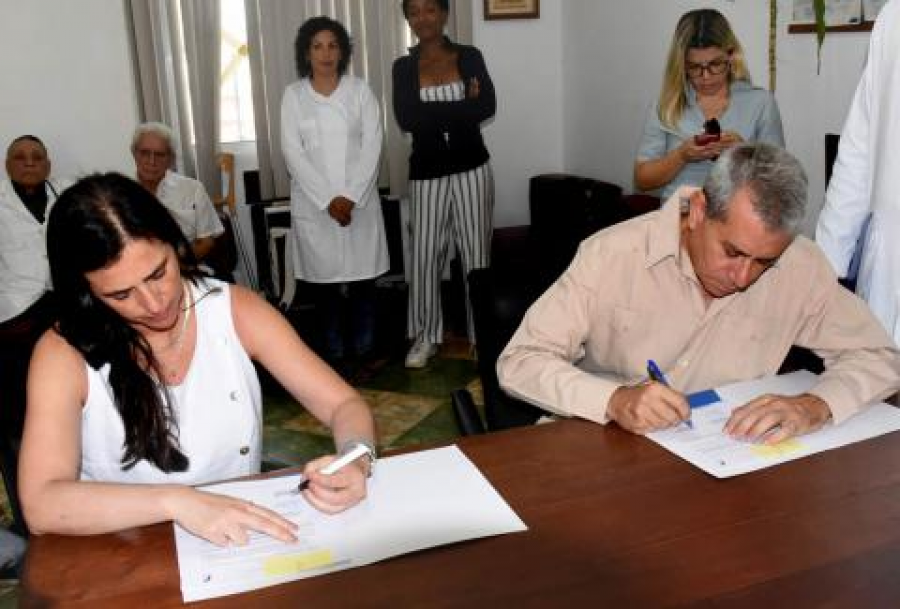
Havana, February 17, 2025 - Cuba and Bolivia signed here Monday a collaboration agreement that will allow nuclear energy institutions of both countries to join knowledge and productive capacities to develop radiopharmaceuticals against cancer and other diseases.
The Isotope Center (Centis), which belongs to the Agency of Nuclear Energy and Advanced Technologies (Aenta) of the Caribbean nation, and the Bolivian Agency of Nuclear Energy (ABEN) consolidated this agreement that will allow the elaboration of biotechnological components that are not made in Latin America.
René Leyva, director of Centis, told Prensa Latina that, with more than 30 years of experience in radiopharmaceuticals at the institution, this alliance will make it possible to “combine Cuban experience with innovative Bolivian production capacities in order to develop promising products in the fight against cancer”.
For her part, the general director of ABEN, Hortensia Jiménez, said that the agreement with Centis is based on a concept of scientific and technological complementarity, which also aims to bring Bolivian professionals closer to the knowledge generated by Cuba in terms of radiopharmacy, radioisotopes and the application of nuclear energy in health.
“Cuba is an example of struggle, of scientific sovereignty for all Latin Americans and for us it is very exciting to see how they advance, despite the obstacles, for the welfare of the people; we found with Centis synergies to cooperate in radiopharmaceutical research, production and clinical, preclinical areas for theranostics”.
In nuclear medicine, theranostics refers to the use of specific molecules (peptides, agonists, antagonists, amino acids, analogues, etc.) which, when labeled with a specific radionuclide, allow diagnosis and treatment of a disease.
Jiménez also emphasized that Centis has a great development in biotechnology and Bolivia already has the capacity to produce high-energy radioisotopes and “there we are working together to develop components that are not made in Latin America”.
“We have been working on large projects in the nuclear sector: one in the network of nuclear energy and radiotherapy centers for cancer and other pathologies; the nuclear research center where we put into operation the cyclotron for preclinical radiopharmacy, in addition to a gamma irradiation center for agriculture and we are still in the construction of the nuclear research reactor”, detailed the Bolivian expert.
The Cyclotron Complex, installed in the city of El Alto, located more than 4,000 meters above sea level, will start producing radiopharmaceuticals in 2023 for the highly specialized diagnosis of cancer and neurological and cardiological pathologies.
With all this capacity, said Jiménez, the three centers have the diagnostic part for cancer, linear accelerators, brachytherapy that allow patients to have free access to this technology, from the single health system implemented in Bolivia and we have also stopped importing radiopharmaceuticals to produce them in the country.
He emphasized that Bolivia has incorporated nuclear technology as a development tool for the nation. The day before, the Cuban ambassador in Bolivia, Elba Rosa Pérez, told Prensa Latina exclusively that the health of both countries will benefit from the signing of an Interinstitutional Cooperation Agreement between these institutions.
(Cubaminrex-PL)