
By Luc Allaire
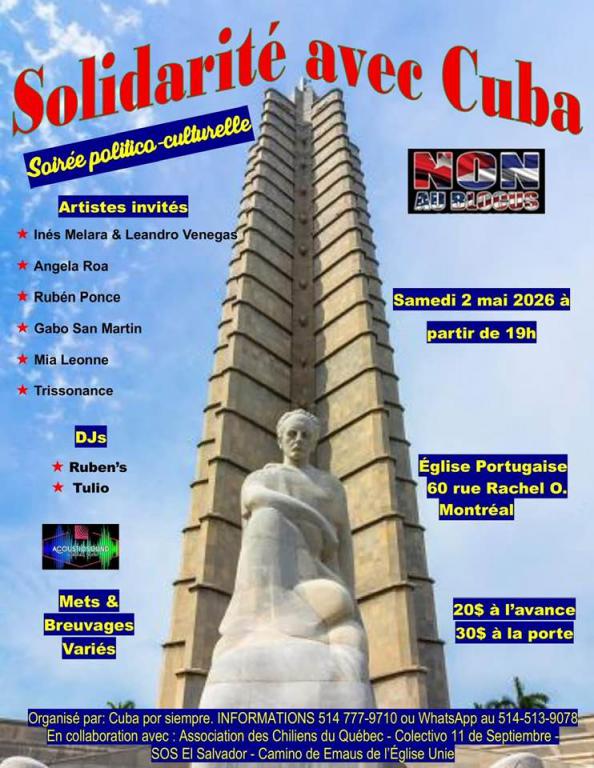
On May 2, in Montreal, a fundraising evening organized by the Cuba Por Siempre collective brought together around one hundred people who came to express their solidarity with the Cuban people. Music, food, speeches, and fundraising were all part of this initiative, born in a context of humanitarian emergency marked by shortages and power outages affecting the Island for several months.
During the evening, Mauricio Guerrero, one of the organizers, set the tone by recalling the collective’s underlying motivations. “We are a group of people of Latin American origin who believe in social justice throughout the world,” he told the audience. “We admire the strength of the Cuban people and their capacity to resist despite the difficulties.”
The funds raised during the event will be donated to the Table de concertation de solidarité Québec-Cuba, which works with its Cuban counterpart, the Cuban Institute of Friendship with the Peoples (ICAP), to support various humanitarian projects on the Island.
An emergency committee born of urgency
Behind this mobilization is an informal group of Latin American activists and supporters, mainly Chileans, united by their attachment to Cuba and their opposition to the blockade imposed by the United States for decades.
“This is not an organization as such,” Mauricio Guerrero explained in an interview. “It is more of an emergency committee. We came together because we saw the situation in Cuba deteriorating and wanted to do something concrete.”
The idea arose when an activist named Hortensia posted a call on Facebook to bring together people concerned about U.S. threats against Cuba and Venezuela. An initial meeting took place at the University of Quebec in Montreal, where participants began to imagine ways to help the Cuban people.
The idea of a benefit concert quickly took shape. “It was a lot of work: finding a venue, preparing the food, organizing the ticket sales,” Mauricio Guerrero recalled. Fortunately, all of the artists agreed to participate on a volunteer basis.
“What unites us, beyond ideologies, is the admiration we feel for the Cuban people,” he said.
A claimed international solidarity
In his speech, Mauricio Guerrero also placed the Cuban situation in a broader international context, referring to current wars and crises.
“The world is going through difficult times,” he said. “Protracted conflicts and genocidal attacks in Gaza and elsewhere, perpetrated by the same global military power and its allies that seek to suffocate the Cuban people through a total blockade.”
Comparing the blockade of Cuba to the siege of Leningrad during the Second World War, he denounced what he sees as a strategy of economic strangulation aimed at causing the country’s collapse.
“We cannot remain indifferent to these atrocities because history repeats itself and could affect us here as well,” he stated. “Hate-filled rhetoric has resulted in the deaths of millions of people.”
The Chilean activist believes that many Western criticisms of Cuba ignore the historical and geopolitical context in which the Island has evolved for more than sixty years.
“Those who demand change in Cuba have forgotten that this change took place on January 1, 1959,” he said, later quoting Fidel Castro’s famous words: “We will never return to the past.”
Another vision of democracy
Mauricio Guerrero’s interview extends beyond the fundraising event to address Cuban politics and Western perceptions of democracy.
While acknowledging the current difficulties in Cuba, he believes that many criticisms overlook the effects of the U.S. blockade and the distinctive features of the Cuban political system.
According to him, Cuban democracy functions differently from traditional Western models. He highlights the participation of citizens from diverse social backgrounds in political institutions and notes that Cuban deputies receive no additional salary for their duties.
“In Cuba, those elected are often doctors, teachers, workers, and even university students who have taken part in international missions or social projects. They are not professional politicians enriched by politics,” he said.
Mauricio Guerrero also draws a parallel with the current political situation in Chile. In his view, the Chilean left underestimated the impact of disinformation campaigns carried out by right-wing media during the 2022 constitutional referendum.
“The right constantly repeated that people would lose their homes or that certain rural traditions would be banned. Through repetition, many ended up believing it,” he said.
He believes that one of the central elements of Cuban resilience lies in the population’s political awareness. “Cubans know their history. They know what existed before 1959 and what changed after the Revolution,” he stated.
Cuba’s internationalist legacy
During the evening, Mauricio Guerrero also highlighted several international initiatives undertaken by Cuba over recent decades.
He referred to the humanitarian program for children affected by the Chernobyl disaster. Between 1990 and 2011, more than 26,000 patients, mainly children, were treated free of charge in Cuba for various radiation-related illnesses.
He also underscored the role of the Latin American School of Medicine (ELAM), founded in 1999 by Fidel Castro. Since its creation, the institution has trained tens of thousands of doctors from more than one hundred countries.
“Cuba is not a terrorist state,” Mauricio Guerrero declared to applause. “It is a threat to capitalism because it possesses the most powerful weapon: unity, international solidarity, and friendship among peoples.”
He concluded his remarks by quoting Ernesto Che Guevara: “Hasta la victoria siempre” — “Ever onward to victory.”