
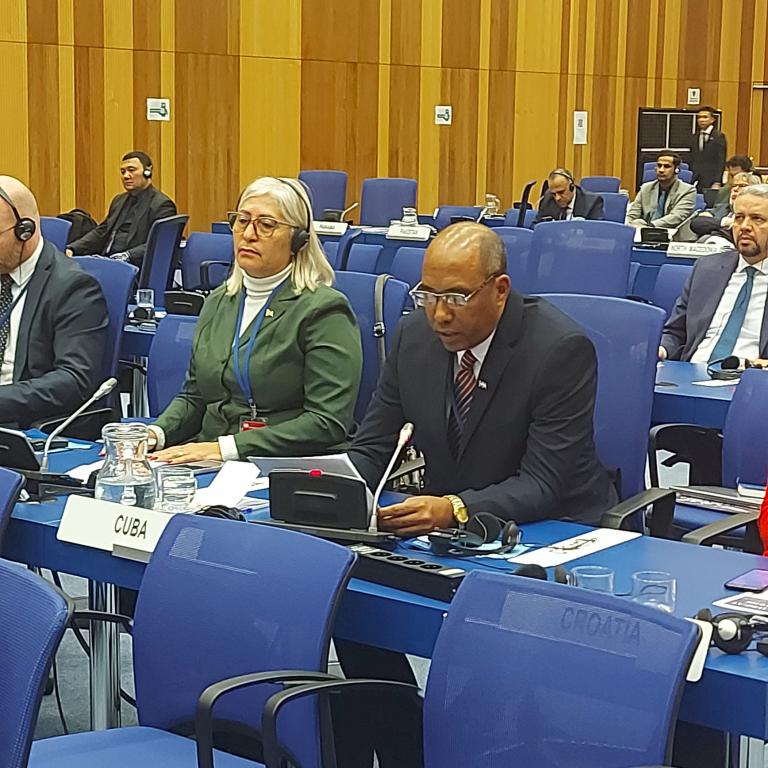
Intervention by Colonel Hector Gonzalez, Second Chief of the Anti-Drug Directorate of the Technical Department of Investigations of the Ministry of the Interior during the 68th Commission on Narcotic Drugs.
Agenda Item 7: Interagency cooperation and coordination of efforts to address and counteract the world drug problem
Thank you Mr. Chairman,
It is an honor to address you on behalf of the Republic of Cuba
At this time, the question that several colleagues repeatedly ask us is how, despite the ironclad financial, economic and commercial blockade imposed, can Cuba achieve a harmonious balance between prevention and confrontation?
Throughout the last six decades, Cuba has persisted in its firm political will and commitment to the fight against drugs in the multilateral and bilateral order, under the principle of “zero tolerance”, respect for human rights and differentiated treatment for consumers, based on free and inclusive public health. Educational programs and community strategies conceive high popular participation, promote healthy lifestyles and educate the population, particularly the youth, in the rejection of this scourge.
Mr. President, Cuba is not a producing country.
President,
Cuba is not a drug producing, storage or transit country, but it suffers the external consequences of this phenomenon, given the persistence of traffickers in organizing operations to introduce drugs into the country, through traditional and new ways of operating.
We have a Ministerial System for Confronting the threats posed by new psychoactive substances, particularly synthetic cannabinoids and methamphetamines, which, together with measures adopted in the legal system, reduce impunity and prevent the emergence of internal criminal organizations or the basification of others based abroad that could use the country for such purposes.
This systemic work allowed during 2024, effective actions against 28 operations of attempts to introduce drugs through the air border with the use of passengers, cargo and postal shipments; to hinder five operations with the use of speedboats with the objective of introducing drugs and trafficking people, to confront 133 drug shipments -not destined to the country- with 844.13 kilograms seized, to dismantle 105 local marijuana crops and to neutralize 157 internal trafficking operations.
With this confrontation, a total of 1051.93 kg of drugs were seized, mostly marijuana, cocaine, synthetic cannabinoids and methamphetamines.
With the updating in 2022 of the “Ley del Proceso Penal” and the “Código Penal”, the legal system was harmonized with the provisions of international instruments, such as the application of the Special Investigative Techniques.
The 43 anti-drug agreements signed at the governmental level, as well as others adopted between the Ministry of the Interior and Customs of Cuba with counterparts from various countries and INTERPOL, promote the exchange of intelligence in “real time”, the development of joint investigations; among other actions that have been characterized by their transparency and professionalism.
Mr. President, dear colleagues
We have the firm conviction that we can win against drugs and we are guided by the thoughts of our historic leader and Commander in Chief Fidel Castro and I quote,
"If we all do not do what we have to do and more, drugs will gain more and more space. That is why we are obliged to do our part, to work with intelligence, systematicity and resolution to prevent drugs from gaining the streets, the schools and to prevent them from taking over the best of a society: its youth..."
Thank you very much.