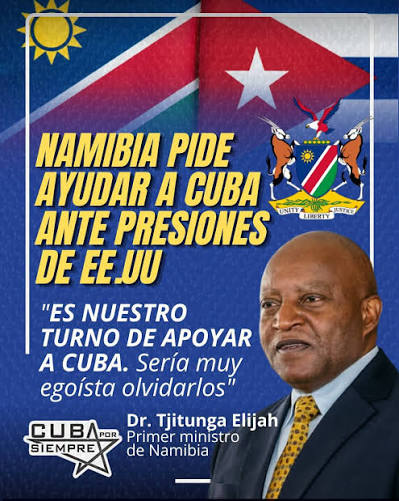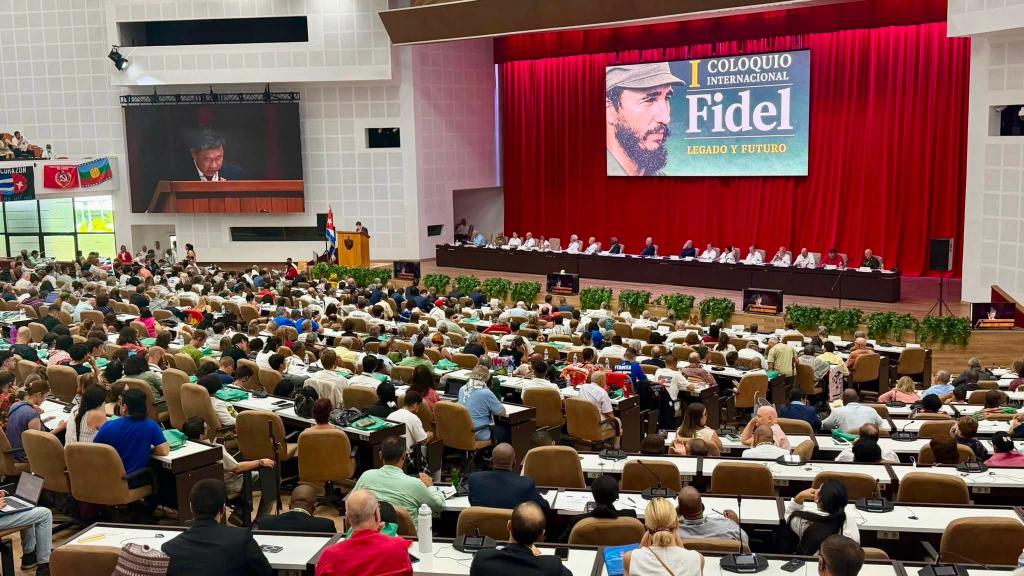
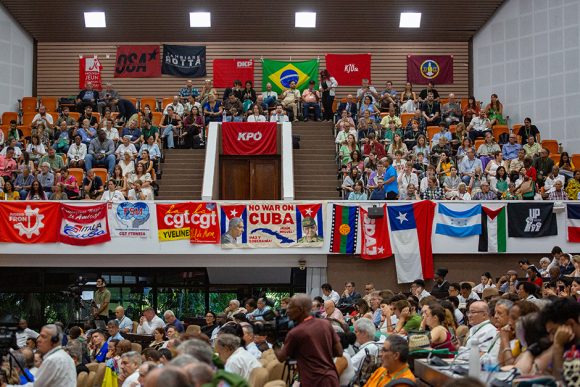
During the First International Colloquium “Fidel: Legacy and Future”, held in Havana as part of the commemorations for the centenary of the birth of the Commander-in-Chief, the Prime Minister of the Republic of Namibia, Right Hon. Dr. Tjitunga Elijah Ngurare, delivered a moving speech in which he paid tribute to Fidel Castro and Cuba’s decisive role in the liberation of Southern Africa.
The Namibian representative began by thanking the audience for the opportunity to speak and extended warm and supportive greetings from the President of Namibia, Dr. Netumbo Nandi-Ndaitwah, the first woman to preside over the SWAPO Party and the Republic of Namibia. “I also send greetings from your friends, your families, and especially from the peace-loving Namibian people”, he said, and recalled that President Nandi-Ndaitwah had already expressed her solidarity with Cuba at the United Nations.
The Prime Minister highlighted that Namibia's Parliament unanimously passed a resolution supporting Cuba, and that Namibia proudly joined the 136 countries that recently called for an end to the blockade against the island. "Namibia and Cuba have been inseparable", he affirmed, evoking the bond between Namibia's founding president, Sam Nujoma, and Commander Fidel Castro.
"As we know, Fidel Castro passed away in 2016, just a decade shy of his 100th birthday. He was a monumental figure who, in many ways, shaped the world we know today", the prime minister noted.
"He withstood enormous trials; his leadership transformed Cuba's social and economic reality in unimaginable ways. He made the impossible possible", he added.
"Fidel is Fidel", the Namibian representative reiterated, emphasizing the Cuban leader's status as "a symbol of international solidarity, an emblem of patriotism" who "embodied unparalleled courage and determination". “For us in Namibia, Commander Fidel Castro is a revered hero. Today, no one can speak of freedom in Southern Africa without mentioning Cuba”.
The speech then turned to the most moving chapter: Cuban participation in the struggle for Namibian independence and the end of apartheid in South Africa. “Stories are recounted, filled with the living memory of Cuban internationalist fighters who fought shoulder to shoulder with Namibians and Angolans under the leadership of SWAPO”, he related. “The objective was to secure Angola’s independence and ensure that SWAPO had a strong position to guarantee the armed struggle”.
The orator recalled the beginning of this heroic journey with Operation Carlota in 1975, named in honor of an exceptional African woman who, as a slave, fought against colonial oppression in Cuba. “Operation Carlota lasted 16 years”, he noted, emphasizing that those heroic battles resulted in Namibia’s independence in 1990. But the impact was even greater: “Those battles, as Sam Nujoma confirmed, also made possible the end of apartheid in 1994, which brought Nelson Mandela and the African National Congress to power—the first Black government in South Africa—and Cuba made that possible”.
The Namibian envoy dedicated special attention to the Battle of Cuito Cuanavale, described as “the final phase of Operation Carlota”, which “shattered the military myth of apartheid South Africa”. “Today, Operation Carlota occupies an honorable, clean, and brilliant page in the history of solidarity between peoples and in the history of internationalism”, he affirmed. He concluded with a phrase that resonated powerfully with those present: “Cuito Cuanavale is the eternal flame that will never die”.
The representative closed his remarks by highlighting the bond of solidarity between the two peoples: “It may be more than 11,000 km apart, but for us in Namibia, that bond of solidarity between our nations is inseparable”.