
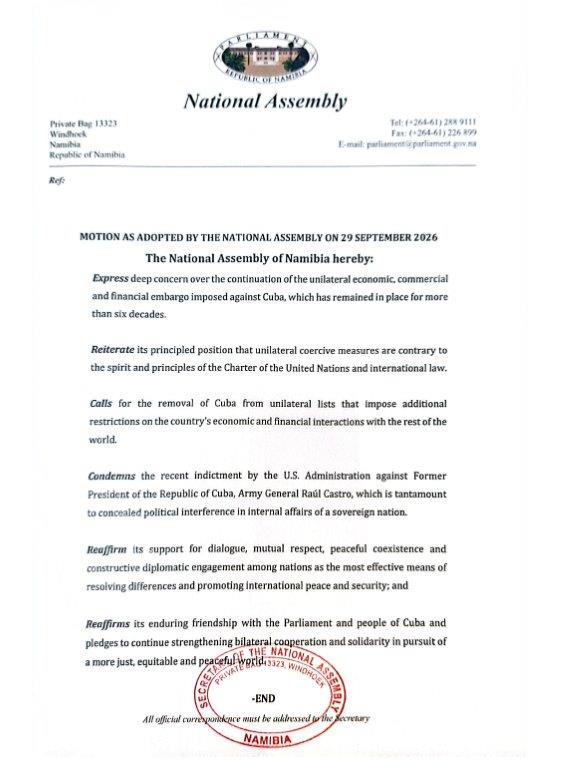
The historic friendship between Namibia and Cuba once again took center stage in the African nation's National Assembly with the unanimous approval of a motion of solidarity and support for the Cuban people. This move comes amidst the difficulties the Caribbean nation faces as a result of economic and financial measures imposed by the United States.
The initiative was introduced during a session of Parliament of the Republic of Namibia by Prime Minister R.H. Tjitunga Elijah Ngurare. It sparked a broad exchange among representatives from various political parties, all of whom highlighted the deep historical ties uniting both peoples and the need to stand with Cuba in the face of the energy blockade imposed by the U.S. government-a measure with severe humanitarian consequences.
The motion expresses deep concern over the persistence of the economic, commercial, and financial blockade imposed on Cuba, which has remained in effect for over six decades. It reiterates a principled stance denouncing unilateral coercive measures that run counter to the spirit and principles of the UN Charter and international law, as well as the principle of the sovereign equality of states.
In this context, the National Assembly demands Cuba's removal from unilateral lists that impose additional restrictions on the country's economic and financial interactions with the rest of the world-a situation exacerbated by the oil blockade, which constitutes a form of collective punishment with humanitarian consequences.
The motion reaffirms the enduring friendship with the Parliament and people of Cuba and pledges to continue strengthening bilateral cooperation and solidarity in the pursuit of a more just, equitable, and peaceful world.
The National Assembly's statement comes amidst a renewed outpouring of solidarity with Cuba. Days after the parliamentary debate began, the country held a Solidarity Gala with the island, attended by H.E. Netumbo Nandi-Ndaitwah, President of Namibia. She reaffirmed Namibia's historic responsibility to stand with Cuba, recalling the bonds forged during the liberation struggle and the decades of cooperation following independence.
The position expressed in the National Assembly also aligns with the stance Namibia has championed in various international forums.
During the General Debate of the 81st session of the United Nations General Assembly in New York, President Netumbo Nandi-Ndaitwah strongly denounced the sanctions that undermine the economic, financial, and commercial stability of the largest of the Antilles.
These measures-involving a blockade and an energy siege-are presented under the absurd and ridiculous justification of labeling Cuba an "unusual and extraordinary threat" to U.S. national security and foreign policy. Their true purpose is to justify the U.S. government's genocidal actions against the Cuban people and to pave the way for potential military aggression.
The solidarity with the island expressed in the Namibian Parliament reflects a shared history. Namibia and Cuba-two peoples geographically far apart-remain united by a common memory: one of solidarity, the struggle for sovereignty, and the defense of every nation's right to forge its own path.