
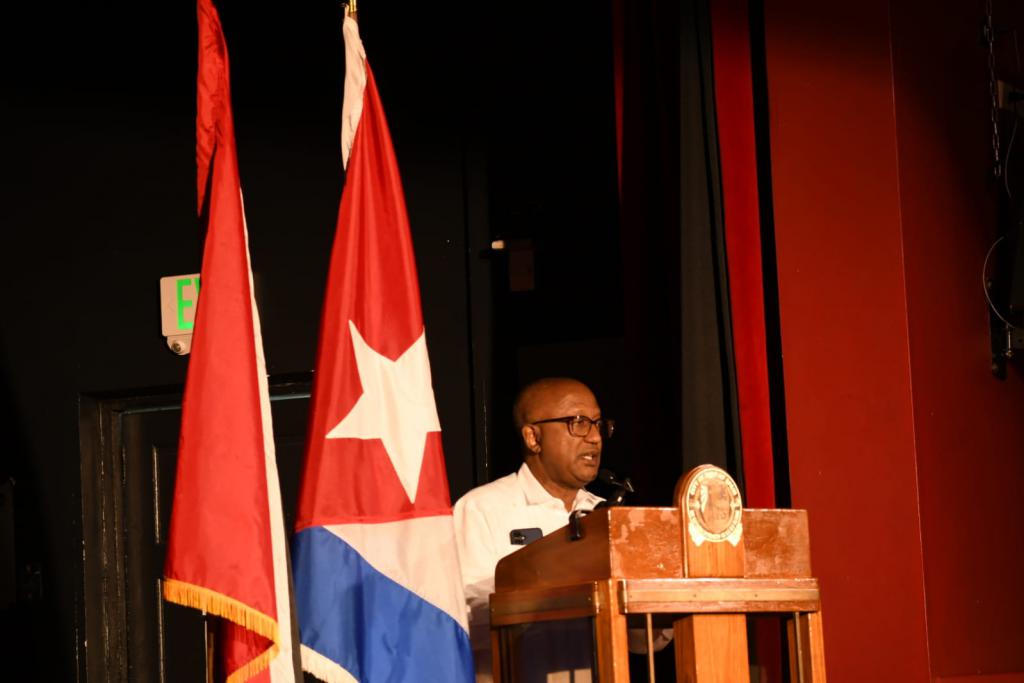
Excellencies, distinguished guests;
His Worship Chinua Alleyne, Alderman and Mayor of Port of Spain;
Chief Secretary of Tobago House of Assembly, Farley Chavez Augustine;
Ms. Mickela Panday, Leader of the Patriotic Front;
Mr. David Abdulah, Political Leader of the Social Justice Movement;
Professor Rose-Marie Belle Antoine, Chancellor of the University of the West Indies;
His Excellency Álvaro Sánchez Cordero, Ambassador of the Bolivarian Republic of Venezuela and Dean of the Diplomatic Corps, along with other distinguished representatives;
Mrs. Noemí Espinoza Madrid, Secretary General of the Association of Caribbean States (ACS);
Representatives of political and social organizations;
Members of the Cuban Medical Brigade serving in Trinidad and Tobago;
Members of the “Abraza a Cuba” Association of Cubans Residing in Trinidad and Tobago;
Members of the press;
Friends, brothers and sisters of the Caribbean.
We gather today to commemorate the centenary of the birth of a person whose life and ideas transcended the borders of Cuba and for millions of people in Cuba and around the world, represents resistance, sovereignty, dignity and solidarity.
That is Fidel Castro Ruz. Today, as we remember his birth, we cannot speak only about the past.
Because Cuba is once again facing one of the most difficult moments in its recent history and we have a duty to speak about it. We have a duty to say it clearly. Cuba is suffering.
Our people are facing a policy of economic, commercial and financial asphyxiation that, for more than six decades, has intention to weaken the will of a nation.
And today, that policy has reached a new dimension. The energy blockade is having direct consequences on the daily lives of millions of cubans.
When fuel is scarce, when is not an electricity, hospitals are affected. Operating rooms are affected. Medicine refrigeration systems are affected. Transportation is affected. Food distribution is affected. Ultimately, people’s lives are affected.
According to figures presented by the Cuban authorities, 98,500 patients are currently on surgical waiting lists, including approximately 12,000 children.
It has also been reported that around 67,000 children under one year of age have not been able to complete their immunization schedules on time.
Some 117,000 adults and 1200 children are facing difficulties in receiving the appropriate cancer treatments.
And approximately 34,000 pregnant women have been unable to receive all the prenatal ultrasounds they require.
Infant mortality, which for years remained between four and five deaths per 1,000 live births, has now risen above 9.8 per 1,000.
Behind every statistic there is a life.
Behind every statistic there is a mother, a father, a child, a family.
And that is precisely why we cannot remain indifferent.
What is happening in Cuba compels us to look toward Gaza. Not because the two situations are identical. They are not.
In Gaza, we see the devastation of war. In Cuba, we face a different form of suffering: a policy of economic and energy asphyxiation that threatens to deprive an entire population of essential resources for survival.
Cuba is being subjected to a silent genocide.
Cuba risks becoming a silent Gaza behind a hospital without electricity. Behind a medicine that does not arrive. Behind an operation that has to be postponed. Behind a child who does not receive the care he or she needs in time.
This expression is not merely rhetorical. It has recently been used by united nations human rights experts to warn of the risk that the situation in Cuba could become a much larger humanitarian crisis.
And it has also been used by members of the United States congress following visits to Cuba.
Our denunciation, therefore, is not directed against the American people.
Our denunciation is directed against a policy. A policy that Cuba has faced for decades.
And this is where Fidel’s historical significance becomes extraordinary.
Because Fidel did not merely confront the blockade. Fidel made the struggle against the blockade a permanent battle for Cuba’s sovereignty.
For decades, he denounced its consequences before the United Nations, before the peoples of the world, and before governments across Latin America, the Caribbean, Africa, Europe and Asia.
And there is one historical fact that captures the extraordinary length of that confrontation.
Fidel Castro lived through eleven United States presidencies. Eleven.

From Dwight D. Eisenhower to Barack Obama. eleven American presidents during Fidel’s political life. And Fidel outlasted them all politically.
He survived the Bay of Pigs Invasion.
He survived the October Missile Crisis. He survived the collapse of the Soviet Union. He survived the Special Period.
And he survived hundreds of assassination attempts.
But above all, he survived a policy designed to bring about the collapse of the Cuban Revolution.
Fidel turned resistance into a doctrine. But not an empty resistance.
A resistance accompanied by education. By healthcare. By science. By culture. By international cooperation.
Among the achievements associated with his government were the expansion of literacy and education, the establishment of a universal healthcare system, agrarian reform and the development of science and biotechnology, as well as an extensive policy of international medical cooperation.
And there is another dimension of his legacy that deserves to be remembered here, particularly in the Caribbean.
Fidel understood that Cuba could not live isolated from its brothers and sisters.
That is why Cuba stood alongside the peoples of Africa. Alongside the peoples of Latin America. Alongside the peoples of the Caribbean.
Cuban doctors went where there was illness. Cuban teachers went where there was illiteracy.
Cuban technicians and professionals went where there was need.
This internationalist vocation is an essential part of the image of Cuba that Fidel sought to project to the world.
And that is why we say today:
Fidel does not belong only to Cuba.
Fidel also belongs to the Caribbean.
Fidel is part of the history of Africa.
He is part of the history of Latin America.
He is part of the history of peoples that struggled against colonialism, racism, apartheid and different forms of domination.
No one can deny that he was one of the most influential political figures of the twentieth century.
And no one can deny that his name is permanently inscribed in contemporary history.
Today, one hundred years after his birth, Cuba is once again facing a test.
And Cuba once again says what Fidel said so many times:
Surrender is not an option. We will not surrender. We will not renounce our sovereignty.
We will not renounce our right to exist as an independent nation. And we will not renounce solidarity.
That is why I wish to take this opportunity to express, on behalf of Cuba, our profound gratitude to the people and organizations of Trinidad and Tobago and the Caribbean who, for so many years, have stood alongside our people.
To those who have raised their voices. To those who have sent assistance. To those who have defended Cuba’s right to live in peace. To those who have understood that solidarity knows no borders. To all of you, thank you.
On this centenary of Fidel, Cuba is not asking for privileges. Cuba is asking for solidarity. Cuba is asking for respect. Cuba is asking for the right to live in peace.
And Cuba is asking for an end to policies that punish an entire people.
Today we remember Fidel. But we also look toward the future because his legacy must not be merely a memory. It must be a commitment. a commitment to sovereignty, to dignity, to social justice, to solidarity among peoples, to the defense of peace, and to the conviction that even small nations have the right to determine their own destiny.
Friends:
One hundred years ago, Fidel Castro was born and until his final days, he held firmly to one conviction: Cuba must be master of its own destiny. Today, from this beloved Caribbean, we reaffirm that conviction.
And we also reaffirm our friendship with the peoples who have stood alongside Cuba. particularly with the brotherly people of Trinidad and Tobago.
May the friendship between our peoples continue. May solidarity continue. May the struggle for peace continue. And may, in the face of adversity, the spirit of resistance embodied by Fidel remain alive:
Let us raise our glasses to Cuba. To the Caribbean. To the friendship between our peoples and, on this centenary, to another hundred years and beyond in the company of Fidel Castro’s legacy.
Long live Cuba!
Long live Caribbean solidarity!
Long live the friendship between Cuba and Trinidad and Tobago!
Long live Fidel!
(Embassy of Cuba in Trinidad and Tobago)