
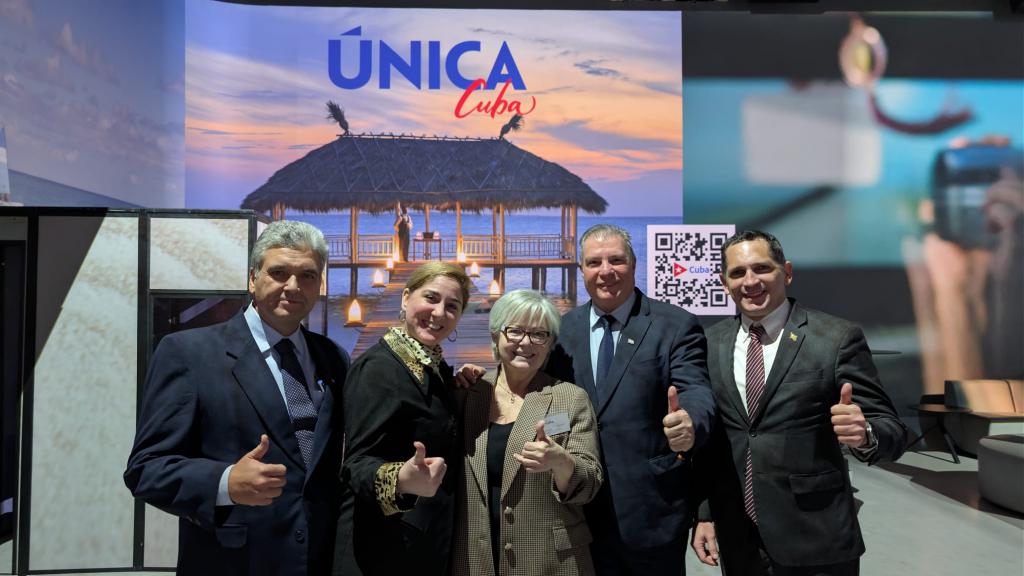
By Marsha Mowers
Cuba’s Minister of Tourism, the Honourable Juan Carlos García Granda, arrived in Toronto Wednesday (November 12) with a clear message for Canadian travel partners: the island is open, ready, and deeply grateful for Canada’s unwavering support.
Speaking to the Canadian travel trade ahead of an industry event for 150 travel advisors and suppliers in Toronto, the Minister provided an update on the country’s swift recovery from Hurricane Melissa, one of the strongest storms to impact Cuba in recent years.
Thanks to Cuba’s well-established emergency response protocols, no lives were lost — neither local residents nor foreign visitors. The Minister said that more than 600,000 people were safely evacuated, including over 1,000 Canadian visitors in the Holguín region.
“What is most important for us is the protection of human life,” he said. “We train every year for these situations. That preparation made all the difference.”
“Our geography helps; Cuba’s long island shape allows us to relocate guests efficiently,” he said. “In this case, many visitors were moved to Cayo Coco and Ciego de Ávila, where they remained safe and comfortable.”
Within just five days of the hurricane’s passage, Cuba announced it was ready to welcome tourists back to its key destinations, including Guardalavaca on Cuba’s northern shore and one of the country’s top resort areas.
“Twenty-four hours after the storm, the Holguín airport was already operational,” Granda said. “That is proof of our organization and our workers’ dedication. The tourism teams immediately focused on recovery, restoring facilities and preparing to receive visitors once again.”
“Everywhere in the eastern region of Cuba is totally operational for visitors,” Gihana Galindo, newly named Director for the Cuba Tourism Board told Travel Market Report Canada. “Electricity, airports, and tourist facilities are all functioning normally. Canadian travellers can come with confidence, we are ready to welcome them.”
The Minister was quick to reaffirm the deep bond between Cuba and Canada, its largest international tourism market.
“Canadians are our most important visitors,” Garda said with a smile. “The relationship between Canadian travellers and the Cuban people is built on trust, warmth, and friendship. No sensationalist news can break that connection.”
He also praised Canada’s major tour operator partners including Sunwing, WestJet Vacations and Air Canada Vacations, for their crucial role in connecting the two nations.
“Without them, we could not share our island with so many Canadians,” Galindo said. “They make it possible for our visitors to discover Cuba and for our people to get to know Canadians. We are proud and grateful for that partnership.”
With Canadians representing Cuba’s largest international market – about 860,000 of us visited last year – Sunwing continues to see strong demand for the destination. The brand operates from multiple gateways across Canada, offering a wide range of vacation packages to Cuba’s most popular regions, from Varadero and Holguín to Cayo Coco and Havana.
With additional airlift already in place from gateways across Canada — including Toronto, Montreal, Vancouver, and Halifax, Galindo says the goal of one million visitors is within reach. Starting December 18 through April 23, 2026, WestJet will operate two flights per week on Thursday and Sundays to Havana.
“This event is for travel agents; they are the key to our success,” Galindo said. “They help us share the beauty of Cuba and drive bookings.”
“Cuba has been the backbone of Sunwing for many, many years,” Eric Rodriguez, Executive Vice President, Sunwing Vacations Group told us. “Our very first flight was to Santiago de Cuba. It’s a partnership that’s weathered good times and bad and one we continue to value deeply.”
With the multiple daily departures from major Canadian cities and competitive all-inclusive pricing, Cuba remains one of the most accessible sun destinations for Canadians.
“The unity between our tour operators and hotel partners is essential, said Garda. “Together, we can continue to grow and strengthen the love Canadians have for Cuba.”
“You can stay for weeks, have great food, friendly service, and strong medical support, all for far less than what you’d pay elsewhere,” said Rodriguez. “The value is undeniable. For many Canadians, Cuba still feels like a second home.”
As the winter season approaches, Cuba is focused on enhancing its offerings for the Canadian market, including promoting long-stay programs that cater to snowbirds seeking extended getaways in the sun. Both Garda and Rodriguez say they are also aiming to capture that market.
“We’re seeing retirees and remote workers booking hotel stays for up to three months,” Rodriguez said. “When you factor in the all-inclusive convenience; daily housekeeping, meals, and no property upkeep, it’s often more affordable than a condo in Florida.”
“We are adapting our products, our logistics, and our services to meet the expectations of Canadian travellers,” Garda said. “Canadians escape the cold, and we want them to feel completely at home in Cuba.”
Despite challenges, the Minister’s message was one of resilience, readiness, and gratitude.
“Our friendship with Canada has always been special,” he concluded. “We are proud of our recovery, proud of our hospitality, and proud of our Canadian friends who continue to visit us year after year.”
Galindo summed it up – “For next year, we are confident we can achieve 1 million Canadian visitors. The conditions are right, the people are ready, and the partnership between Cuba and Canada has never been stronger.”
Taken from Travel Market Report