
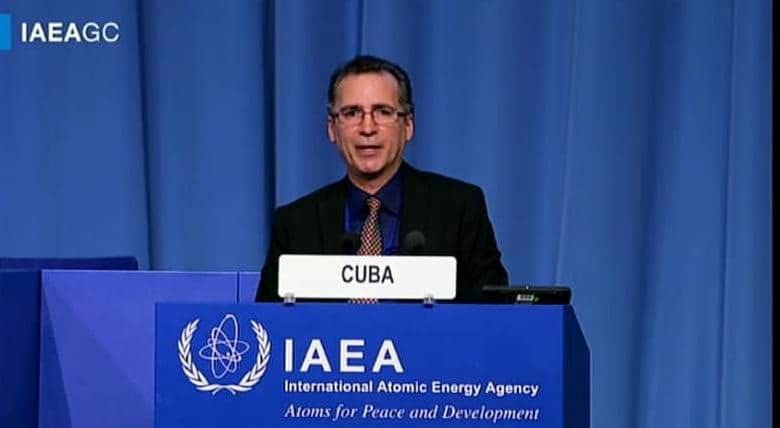
Statement by the Cuban delegation to the 67th Regular Session of the General Conference of the International Atomic Energy Agency.
Mr. President,
The Cuban delegation congratulates you on your election to preside over this session of the 67th IAEA General Conference, as well as the rest of the members of the Bureau, ratifying our permanent willingness to contribute to the success of this meeting.
As every September 26, yesterday we celebrated the "International Day for the Total Elimination of Nuclear Weapons", an initiative promoted by Cuba and supported by the Non-Aligned Movement.
The existence of more than 12,000 nuclear weapons, the continuous modernization and deployment of new nuclear weapons systems, and the successive increase in global military spending, show that there is still much to be done for the current civilization to understand that reducing nuclear risk is not enough and that those resources must be allocated to sustainable development and the promotion of peace.
Cuba remains firmly committed to multilateralism and to the defense of the priority of achieving nuclear disarmament in a transparent, verifiable and irreversible manner, for which we consider that the universalization of the Treaty on the Prohibition of Nuclear Weapons will be crucial. We will also continue to support the work of this important Agency in promoting the peaceful uses of nuclear energy.
Mr. Chairman,
At the recent Summit of Heads of State and Government of the Group of 77 and China, held in Cuba in its capacity as President pro tempore, the importance of strengthening the promotion of science and cooperation as fundamental pillars to make social and economic progress possible, particularly in developing countries, was recognized.
In this regard, in the current complex international scenario, marked by multidimensional crises, it is only fair to acknowledge the efforts and actions carried out by the IAEA in the pursuit of its statutory mandate, and in the promotion of numerous initiatives to address global problems related, among other issues, to health and the environment. Among these are: Rays of Hope, for cancer care for all; the NUTEC Plastics initiative, to address the global problem of plastic pollution; and the ZODIAC initiative, to help our countries implement integrated measures against zoonotic diseases. Cuba has actively joined these initiatives.
We recognize the important contribution of the Agency's Technical Cooperation Program to the achievement of the 2030 Agenda for Sustainable Development, and in this regard, we highlight the management of the Division for Latin America and the Caribbean. Cuba has been among the countries that have benefited from cooperation opportunities, and has demonstrated a high commitment to compliance and participation in national and regional projects, mainly within the framework of the Regional Cooperation Agreement for the Promotion of Nuclear Science and Technology in Latin America and the Caribbean (ARCAL). We take this opportunity to acknowledge the work in the context of this regional agreement, which is about to celebrate 40 years of successful cooperation.
We reiterate our appreciation to the IAEA for its support in addressing the damage caused by a fire at the supertanker base in the Cuban province of Matanzas, which resulted in the acquisition of environmental and air quality monitoring equipment to assist in efforts to measure the effects of the fire and make mitigation decisions after collecting such data. We are also grateful for additional support to Cuba in the aftermath of Hurricane Ian, which included the purchase of mobile X-ray equipment for four hospitals and equipment to determine the presence of environmental contaminants and water quality.
It is worth mentioning the training activities carried out by the Agency, combining classroom and virtual components as a part of the training program.
We welcome the fact that the percentage of women within the Agency's staff and at senior levels exceeds 41%, the highest figure to date; as well as the continuity of the Marie Skłodowska-Curie Fellowship Program and the announcement of the IAEA's Lise Meitner Program, which boost the advancement of women in the nuclear field.
Mr. President,
Cuba attaches great importance to Nuclear and Radiological Safety, Nuclear Physical Safety and Nuclear Safeguards and encourages the integration of all during the use of nuclear applications. Proof of this is the process of updating the current legal framework that reinforces its principles and the actions of the Regulatory Authority.
Hosting the Regional Meeting on the authorization process in the Safety Assessment of medical and industrial facilities allowed us to transfer and share experiences with other Latin American countries.
Cuba presented its second national report to the 8th and 9th Review Meeting of the Contracting Parties to the Convention on Nuclear Safety and we were again recognized for our good performance in promoting Safety Culture.
We maintain the proposal for the IAEA to consider the design and implementation of a School on Safety Culture, based on the successful experience and innovative teaching methods of the Safety Leadership Schools, as a way to train personnel with greater vision and better capabilities to minimize the risk of accidents.
Cuba submitted its second National Report to the 8th and 9th Review Meetings of the Contracting Parties to the Convention on Nuclear Safety and we were again recognized for our good performance in promoting Safety Culture.
We maintain the proposal for the IAEA to value the design and implementation of a School on Safety Culture, based on the successful experience and innovative teaching methods of the Safety Leadership Schools, as a way to train personnel with greater vision and better capabilities to minimize risks and prevent accidents derived from radiation sources.
In addition, we also highlight the contributions of the Ibero-American Forum of Radiological and Nuclear Regulatory Agencies. This space for integration and cooperation, together with the IAEA, contributes with innovative results to improve nuclear, radiological and physical safety in the Ibero-American region, from which we benefit and contribute with our experiences.
Mr. Chairman,
Our link with the work of the IAEA does not escape the effects of the intensification of the blockade policy maintained by the US government against Cuba for more than 60 years. These unilateral coercive measures force us to acquire technologies and training in distant countries, exclude us from opportunities to participate in projects in our region, do not allow US companies or others with US capital or technology to trade with Cuba specialized equipment for the application of nuclear techniques, under the threat of strong sanctions, with implications in increased costs and delays in the execution of projects.
Likewise, the costs and difficulties faced by the IAEA Secretariat in acquiring the scientific equipment approved in the projects with Cuba are maintained and increased. This is a reality that some try to ignore, but we are duty-bound to denounce this unjust extraterritorial measure imposed on our country, which hinders the full exercise of our inalienable right to the peaceful use of nuclear energy. We express our rejection of and solidarity with countries subjected to unilateral coercive measures that affect their development and sovereign rights. Cuba, faithful to its tradition of solidarity, places at the disposal of all countries, especially developing countries, its human resources and the capabilities acquired in these years of successful cooperation with the IAEA, for a global development of the use of nuclear technologies, in terms of peace and sustainable development.
Mr. Chairman,
The Cuban delegation welcomes the re-election of the Director General of the IAEA for the next period, and wishes to reaffirm that it can count on Cuba's firm support in the success of its management, and the willingness to contribute modestly to fulfill the slogan of this Agency: "Atoms for peace and development".
Thank you very much.
(EmbaCubaAustria)