
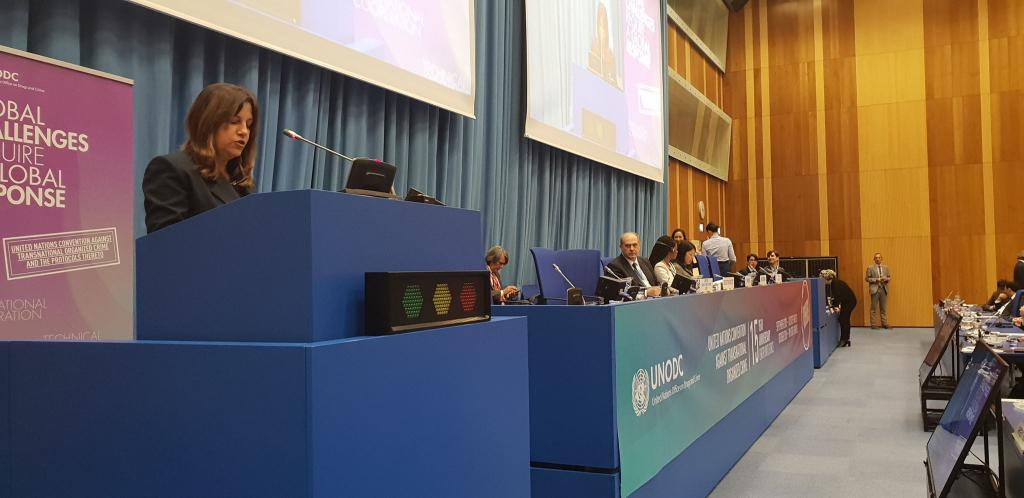
Mr. President,
I would like to congratulate you for your election to preside over the work of the Conference; we offer you our full readiness to cooperate in the exercise of your functions.
Our delegation supports the statements made by the distinguished representatives on behalf of G 77 + China and the Group of Latin American and Caribbean States, respectively.
Mr. President,
We are aware of the applicability and usefulness of Palermo Convention and its three Protocols as the major instruments for combating the diverse forms of transnational organized crime and actively cooperate with all countries for its appropriate implementation. Likewise, we renew our commitment to continue contributing with the effective application of the international legal regime created by these instruments.
We stand up for the leading role of the Commission on Crime Prevention and Criminal Justice and we support the work of the United Nations Office on Drugs and Crime.
Mr. President,
The transnational organized crime is a global issue that makes difficult the economic and social development, encourages corruption, violates the full enjoyment of human rights, encourages violence and affects countries´ governance.
These crimes should be collectively addressed under the principle of common and shared responsibility with full respect for the sovereignty, non-intervention in the internal affairs of the States, territorial integrity, and law of each state.
Inspired by these principles, we should carry on reinforcing international cooperation and the existing legal frameworks. We condemn the application of unilateral coercive measures and the establishment of country categorizations which limit the international cooperation in terms of fight against transnational organized crime, corruption, human trafficking and terrorism. This type of practice is contrary to international law and the Charter of the United Nations.
Cuba has ratified the United Nations Convention against Transnational Organized Crime and its three Protocols. In this regard, the fact that the whole group of Member States of the Latin American and Caribbean have ratified the United Nations Convention against Transnational Organized Crime and the United Nations Protocol to Prevent, Suppress and Punish Trafficking in Persons, especially Women and Children is recognized as a significant outcome.
The international cooperation is crucial in combating transnational organized crime. Cuba has in force 25 agreements on legal assistance, 22 agreements on the transfer of prisoners and 11 agreements on extradition.
Mr. President,
New forms of transnational organized crime like cybercrime, illicit traffic of cultural property, environmental crimes and their related crimes, illegal mining, trafficking in organs, blood, and tissues, identity theft and fraudulent use of documents for smuggling of migrants are constantly emerging and developing.
The increase of criminal behaviors associated to the use of the new Information and Communication Technologies is a perfect way to commit a wide range of illicit behaviors that may affect the diversity of the personal, patrimonial or social legal goods.
Human trafficking and sexual abuse in any of their forms constitute a prioritized issue for the Cuban State and the civil society. The “Zero Tolerance Policy” to these crimes is demonstrated in the actions and measures aiming at increasing prevention, strengthening the confrontation, harshly punishing the perpetrators and offering protection for victims.
Regarding the behavior of the criminal activity at the international level, there are new and greater complexities in the domestic and foreign crime which affect the nation. This challenges prevention, confrontation, and protection work for victims whose low perception of risk of this phenomenon and its modalities, particularly of the transnational trafficking nature has been demonstrated.
In February 2017, the National Plan of Action for the prevention and confrontation to trafficking in persons and the protection of victims (2017-2020) was adopted. This is a vital tool for the coordinated actions among the State and the organizations of the Cuban civil society when addressing this serious crime.
Mr. President,
Cuba refuses all acts of terrorism in any place, circumstance and whatever the causes are invoked. We condemn any activity whose purpose is encouraging, supporting, financing or cloaking terrorist acts.
Our country recognizes the need of the international cooperation to comprehensively face the challenges of the irregular migration and to combat the smuggling of migrants aiming at reaching an orderly and secure migration for the migrants to receive a dignified treatment and full respect for human rights.
We do recognize the structural causes of this phenomenon which are underdevelopment, poverty, and social exclusion. Those have been the outcomes of centuries of exploitation and plundering our peoples have suffered. Likewise, the unjust and unequal international economic order imposed must change.
The illicit trafficking in arms, their parts, components and ammunition is a globally sensitive issue and a matter of great international concern. The consequences of these illicit activities have serious political, economic and social implications. It is becoming increasingly evident that the prevention, confrontation and eradication of the global phenomenon of the illicit trafficking of firearms cannot be the task of a single State, but the sum of the joint efforts of the international community, under the auspices of the United Nations. .
Mr. President,
We share the idea of establishing a Review Mechanism for the Convention and its Protocols, with an intergovernmental, transparent, non-intrusive, inclusive, impartial nature and it should be financed mostly, through the regular budget, in accordance with Resolution 8/2 of the UNTOC in 2016. This Mechanism must be cooperative, with a balanced geographic criterion and that does not give rise to categorizations or rankings between countries, so that it creates opportunities to share good practices, provided that the principle of equality and sovereignty of States is respected and political or selective criteria in their operation will not be applied.
We hope that in this session of the Conference a decision on the establishment of the Mechanism can be finally adopted. It should include a comprehensive review of all the articles based on a peer review. Similarly, we hope that the positive experiences of the UN Convention against Corruption (UNCAC) Review Mechanism can be duly taken into account in its design.
It is crucial to follow up on the growing incidence of new crimes such as cybercrime, trafficking in cultural property and crimes of environmental impact.
Mr. President,
To conclude, I would like to reiterate Cuba´s commitment, as part of Community of Latin American and Caribbean States (CELAC, by its Spanish initials) to guarantee the peace in the region through the implementation of the International Law and to strengthen the fight against international organized crime.
Thank you very much

(Embacuba Austria)